
We are excited to announce the release of Pedestrian Dynamics® 4.6, the latest evolution of our advanced crowd simulation and Digital Twin software.
Continue readingWe are excited to announce the release of Pedestrian Dynamics® 4.6, the latest evolution of our advanced crowd simulation and Digital Twin software.
Continue reading
Enterprise Resource Planning (ERP) systems are essential for modern warehouse and supply chain operations. Boehringer Ingelheim, a global pharmaceutical company, faced challenges in optimizing its logistics and warehouse operations. To address these issues, the company decided to use “virtual commissioning” as part of its SAP ERP implementation. This article explains how virtual commissioning works and what the benefits of this approach for Boehringer Ingelheim were.
A digital twin is a copy of reality that mirrors real-world operations, allowing businesses to plan, test, and control scenarios and select the optimal configuration.
Using Enterprise Dynamics® from InControl, a Digital Twin of the warehouse was created. This allowed the company to test various “what-if” scenarios, analyze bottlenecks, and optimize processes before implementing changes in the real-world environment.
Virtual commissioning is a cutting-edge approach that integrates digital simulation and emulation tools with industrial control systems. It is an integration of physical and digital worlds and it allows businesses to test, optimize, and validate material flow and logistics operations before actually deploying physical systems.
By creating a digital twin, virtual commissioning enables seamless interaction between enterprise resource planning (ERP) systems, material flow controllers (MFCs), and programmable logic controllers (PLCs), ensuring a smooth transition from design to operational execution. This removes the need to implement and test all the logic and communication between the ERP system on one side and the physical machines in the factory or warehouse.
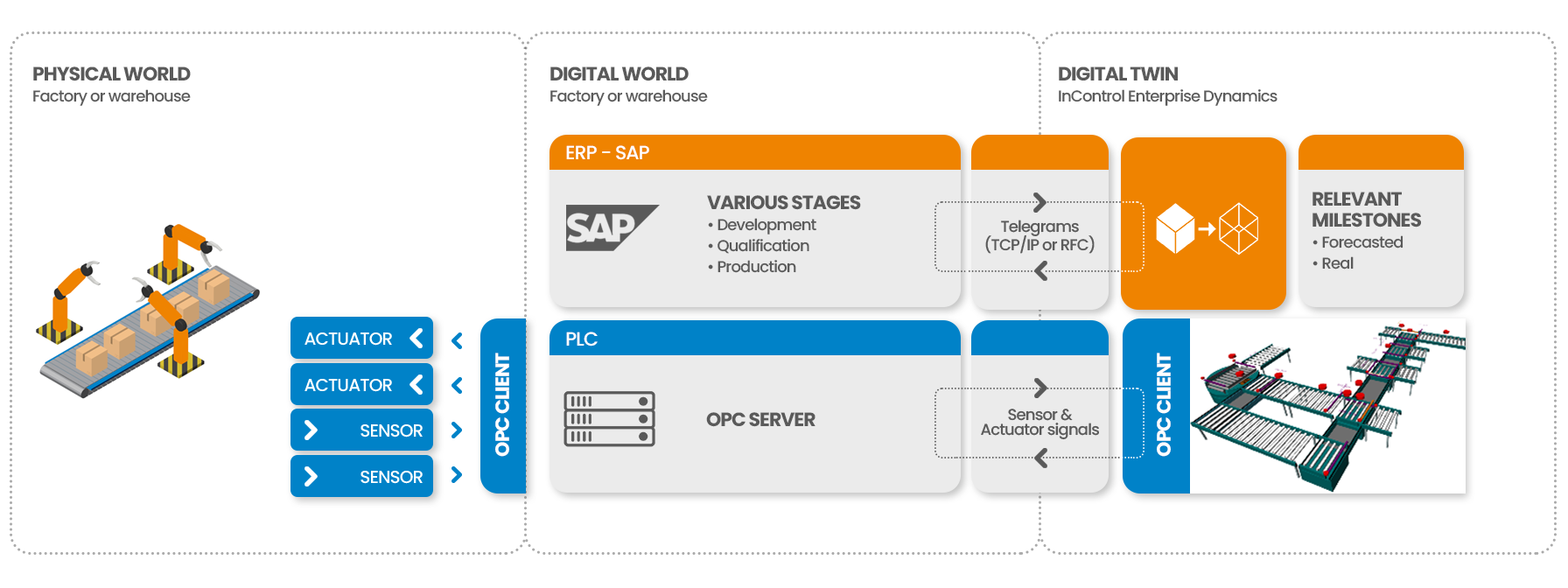
Virtual Commissioning is the process of testing and validating control systems, automation logic, and mechanical designs in a virtual environment before deploying them in the real world. Finding and solving bugs will happen much more efficiently in a digital environment instead of in – a more expensive – real production environment.
Testing Through Virtual Commissioning enabled Boehringer to:
The SAP EWM-MFC (Extended Warehouse Management – Material Flow Control) system was integrated with the simulation model based on Enterprise Dynamics. The integration works as follows:

Implementing virtual commissioning delivers significant advantages:

InControl’s Enterprise Dynamics® platform facilitates virtual commissioning by integrating:
This holistic approach enables businesses to simulate warehouse layouts, optimize logistics chains, and test automation solutions before physical implementation, leading to improved efficiency and reduced operational costs.
“
Implementing SAP in a live production environment comes with high demands and inherent risks. With InControl’s Digital Twin, we were able to thoroughly and risk-free test this complex process. This resulted in significant time and cost savings and a flawless commissioning.
Boehringer Pharma GmbH & Co. KG
The SAP EWM implementation at Boehringer, based on virtual commissioning and digital twin technology, sets a benchmark for modern warehouse and logistics optimization. Virtual commissioning reduces costs and time in SAP EWM implementations by bridging the gap between physical and digital operations. Companies leveraging this technology can achieve faster commissioning, lower resource consumption, and minimized downtime.
With Enterprise Dynamics® from InControl, businesses gain a competitive edge by enhancing reliability, scalability, and operational efficiency through data-driven decision-making. As industrial digitalization advances, virtual commissioning is set to become the standard solution for ERP implementations.
Explore our Expert Insights Series — a concise collection of articles on the latest in industrial automation, digital twins, AI, and simulation. Discover how these technologies are transforming manufacturing, logistics, and supply chains with real-world impact.
InControl will be exhibiting at LogiMAT 2026 — the leading international trade show for intralogistics solutions and process management!
Booth #4A65 / March 24–26, 2026

The logistics industry is undergoing a transformation, driven by cutting-edge technologies like digital twins and artificial intelligence. Recent McKinsey research highlights how companies are leveraging these innovations.
Continue reading
Artificial intelligence (AI) is gaining ever more traction with the latest trends of large language
models, generative AI, and autonomous agents bringing capabilities to the attention of millions
outside of its classic computer science domain.

As AI continues to revolutionize industries, its integration with simulation tools is opening new doors for efficiency, risk management, and decision-making in supply chains. We spoke with Kees van der Klauw, former Chairman of the Netherlands AI Coalition and former Research Executive at Philips, about the synergy between AI and simulation, and what the future holds for smart supply chains.
My career started at Philips, where I was involved in digital transformations across various domains—semiconductors, LCD displays, TV innovations, and LED lighting systems. Over a decade ago, in Philips Research, we already explored AI applications such as automated design of electronic circuits and customer preference analysis. Later, I played a key role in establishing AIOTI (now a leading IoT and Edge Computing initiative) and led the strategy and development of the Netherlands AI Coalition. This coalition now consists of over 500 parties and nearly 2,000 experts working on AI applications across multiple industries.
Simulation is used to predict outcomes in scenarios that are too complex, costly, or risky to test in real life. With advancements in computing power, we can now create highly detailed simulations, but they still require strong domain knowledge. AI, on the other hand, is built on statistical models trained on massive datasets. While simulation models are generally based on known physical principles, AI finds correlations within data, sometimes revealing hidden insights. The great opportunity we now have is not to replace the one with the other but to augment simulation models (which usually have a very limited number of parameters) with AI algorithms that add statistical intelligence on effects that until now were too complex or simply unnoticed to include in simulation tools.
Many AI models are trained on large datasets to detect patterns and correlations, but this does not necessarily mean they understand causal relationships. Training AI solely on raw data requires extensive resources, while digital twins integrate domain knowledge, providing faster, more accurate, and explainable insights. By combining AI with simulation models, we leverage expert knowledge for efficient and precise system behavior predictions. This hybrid approach enables accurate manufacturing simulations while accounting for unpredictable factors like human behavior or equipment failures, ultimately leading to smarter decision-making.
Simulation has already revolutionized the supply chain industry, particularly in material handling and manufacturing, where internal goods flow management relies heavily on simulation models. Today, these models extend across multiple production sites, enabling integrated and efficient operations. Smart Industry initiatives further enhance this by facilitating programmable manufacturing lines where production stages communicate seamlessly. In complex assembly lines with multiple suppliers, ship-to-line logistics has become a standard practice.
Optimizing logistics—covering warehouse space utilization, cycle times, time-critical deliveries, loading, transport costs, and more—is achievable through simulation. However, a key challenge remains: various stages, sites, machines, and transport systems are often managed by different entities and suppliers. Since these elements are not always part of a unified simulation model, fine-tuning is essential to ensure accuracy. To achieve this, models must be parametrically adjustable, tuned by domain experts, and supported by strong data-sharing collaboration across the value chain. This need for seamless data exchange becomes even more critical with AI integration.
With advancements in AI, we will soon be able to create highly accurate digital twins of complex logistics flows—both within individual companies and across entire supply chains. These digital twins will not only drive efficiency and support risk analysis but also act as real-time decision-making companions during supply chain disruptions. Beyond optimizing logistics, AI-powered simulation will contribute to sustainability by tracking CO₂ footprints, improving reliability and flexibility, and ensuring compliance with regulations.
Simulation provides outcomes based on set parameters, but human decision-makers must still interpret the results, considering aspects like regulations, financial risks, and operational constraints. AI can enhance this process by augmenting simulation engines with AI models (not replacing them), creating comprehensive digital twins that support real-time, data-driven decision-making.
“
AI is not just an efficiency tool – it is a competitive necessity.
Advancements are happening across many industries, but the most impactful innovations transform tedious yet expertise-driven tasks. Key sectors benefiting from AI include logistics, manufacturing, healthcare, cybersecurity, and energy. AI is optimizing everything from transportation flows to medical diagnostics, driving efficiency and accuracy. There is also an impressive contribution by AI in advertising and marketing and administrative processes.
However, because data usage is subject to privacy and security regulations, AI adoption is progressing fastest in less sensitive areas—focusing on machines rather than personal data. In supply chain management, the potential is enormous, offering opportunities to enhance efficiency, resilience, and decision-making on an unprecedented scale.
While there is a lot of hype around generative AI and large language models, I believe the most meaningful advancements will come from dedicated machine learning models tailored to specific fields such as supply chain management, healthcare diagnostics and drug development, education, security, energy, and transportation. Machine Learning will drive major improvements in efficiency, quality, and cost reduction by automating tedious human tasks. Additionally, I foresee AI-powered simulation tools becoming more efficient, running on small-footprint systems rather than energy-intensive data centers.
This could mean local servers within companies or even AI-driven IoT devices embedded in equipment or transport vehicles. Such a distributed approach offers significant advantages, including enhanced cybersecurity, resilience, and in energy management, making AI adoption more sustainable and practical across industries.
Sustainability is complex, often requiring trade-offs between different environmental and economic factors. AI models can process large-scale, statistical data to develop more holistic sustainability strategies. By integrating AI with simulation, businesses can automate environmental impact assessments, optimize energy usage, and improve waste management.
“
The great opportunity we now have is not to replace the one with the other but to augment simulation models (which usually have a very limited number of parameters) with AI algorithms that add statistical intelligence on effects that until now were too complex or simply unnoticed to include in simulation tools.
The primary challenge is the availability and quality of data to train AI systems. Many companies struggle to collect and extract meaningful insights from dispersed systems. Key data—such as machine uptime, cycle times, and waiting times for transport robots—often remains siloed and underutilized.
Another challenge is acquiring the right expertise. Companies typically need to bring in data scientists or partner with startups, as existing personnel may lack the specialized skills for AI projects. At the same time, experienced employees are vital for identifying high-value use cases and offering domain knowledge.
Finally, strong management commitment is crucial. Leaders must educate themselves on AI’s broader implications, including dependencies on external platforms and control over key business processes, rather than simply following trends.
However, because data usage is subject to privacy and security regulations, AI adoption is progressing fastest in less sensitive areas—focusing on machines rather than personal data. In supply chain management, the potential is enormous, offering opportunities to enhance efficiency, resilience, and decision-making on an unprecedented scale.
Companies should first master simulation for their core processes, ensuring that AI enhances rather than replaces their models. Additionally, data management expertise is crucial, as AI depends on high-quality data. Businesses must also educate employees on AI’s role helping them in their daily work, fostering a culture of data-driven decision-making.
This could mean local servers within companies or even AI-driven IoT devices embedded in equipment or transport vehicles. Such a distributed approach offers significant advantages, including enhanced cybersecurity, resilience, and in energy management, making AI adoption more sustainable and practical across industries.
“
With advancements in AI, we will soon be able to create highly accurate digital twins of complex logistics flows—both within individual companies and across entire supply chains.
Executives must differentiate between primary and secondary processes when applying AI. For example, using AI for marketing content generation is a low-risk secondary process, while using AI in core operations—such as supply chain optimization—requires deep expertise and business control. Another pitfall is relying too heavily on external AI platforms, which can create long-term dependencies instead of offering real competitive advantages for one’s business.
AI is not just an efficiency tool—it is a competitive necessity. Companies that fail to adopt AI risk losing market relevance as AI-powered competitors optimize costs, mitigate risks, and unlock new business models. However, adopting AI should be strategic, ensuring it enhances core competencies rather than creating dependencies.
AI and simulation are not competing technologies—they are complementary tools that, when combined, create more accurate, scalable, and intelligent digital twins. As businesses navigate an increasingly complex and unpredictable world, AI-enhanced simulation will be a game-changer for supply chain optimization, sustainability, and decision-making.
With AI advancing rapidly, companies must embrace innovation, invest in expertise, and develop a data-driven strategy to stay ahead in the ever-evolving supply chain landscape.
Explore our Expert Insights Series — a concise collection of articles on the latest in industrial automation, digital twins, AI, and simulation. Discover how these technologies are transforming manufacturing, logistics, and supply chains with real-world impact.
InControl will be exhibiting at LogiMAT 2026 — the leading international trade show for intralogistics solutions and process management!
Booth #4A65 / March 24–26, 2026

The Evolving Aviation Landscape
The global aviation industry is soaring back to pre-pandemic levels, and the future promises even more expansion. In North America, the FAA predicts that U.S. commercial air travel will grow at a steady 2.6% annually, surpassing 1 billion passengers by 2033. Meanwhile, Dubai International Airport is preparing to accommodate over 90 million passengers annually by 2026, reinforcing the Middle East’s role as a pivotal global hub.
Across the Pacific, China’s aviation market is on track to become the world’s largest by 2035, with passenger numbers tripling compared to pre-pandemic levels. Europe, despite its mature infrastructure, anticipates a 50% surge in air travel by 2040—posing challenges for already congested facilities. Latin America, too, is experiencing unprecedented growth. Mexico, for instance, is set to double its passenger movements to 137 million by 2043.
Yet, this expansion does not come without its challenges. The aviation industry is undergoing a transformation: the shift toward net-zero emissions, the emergence of electric aircraft and advanced air mobility, and a new era of passenger expectations—all demanding smarter, more agile airport management.
The Strategic Agility Imperative
Airport operators must embrace a new kind of strategic agility to navigate these evolving demands. This means not just reacting to change but staying ahead of it:

From Reactive to Proactive: A Data-Driven Approach to Airport Management
Imagine an airport where every decision—whether about passenger flow, baggage handling, or security checkpoints—is driven by real-time data. Instead of reacting to problems as they arise, airport managers anticipate bottlenecks before they happen. Delays are minimized, staff is deployed efficiently, and passenger journeys are seamless.
This is the impact of Total Airport Management (TAM), supported by Digital Twin technology. By integrating real-time data from airside, landside, and terminal operations, airports can transition from a fragmented approach to a unified, data-informed ecosystem.
With predictive analytics, an airport can foresee potential congestion points—whether at security lines or immigration—and resolve them before passengers even notice an issue. Scenario modelling allows operators to test different strategies in a risk-free virtual environment, evaluating how changes in staffing or gate assignments might impact efficiency.
Cross-functional teams gain a shared situational awareness, ensuring that from the control tower to the check-in counter, everyone is working towards the same operational goals. Performance indicators are continuously tracked, aligning airport management with broader strategic objectives.
The Seamless Journey: Engineering Exceptional Passenger Experiences
For today’s PAX, efficiency isn’t enough—they want a seamless, stress-free experience from booking their flight to arriving at their final destination. But what does that really mean?
Consider a PAX arriving at a major international airport. Instead of long queues, they breeze through security, thanks to biometric verification. Their luggage is tracked in real-time via an app, giving them confidence it will arrive at their final destination. Smart wayfinding guides them intuitively through the airport, eliminating the confusion of navigating a complex terminal.
Waiting time becomes value-added time—instead of frustration, the passenger enjoys well-designed lounges, personalized retail options, and entertainment experiences tailored to their interests. Even during disruptions, airports maintain service quality through proactive rescheduling and instant communication.
Digital Twin Simulation for Airports: A Game-Changer in Decision-Making
To make this seamless experience a reality, airports need powerful tools that help them predict and prepare for any scenario. This is where InControl’s digital twin simulation comes in.
With over 26 years of expertise in airport operations, InControl offers an advanced simulation platform that allows airport operators to test, visualize, and optimize every aspect of their ecosystem before making real-world investments.
Using historical data, real-time inputs, and predictive algorithms, this digital twin provides a risk-free environment to experiment with changes before implementing them. Whether it’s baggage handling, border control, cargo operations, or multimodal transportation, the platform ensures airports operate at peak efficiency.
Comprehensive system modeling
Digital representations of all airport subsystems allow simulations of complex interactions, such as how passenger flow affects baggage handling or how infrastructure constraints impact turnaround times
Predictive scenario planning
By analyzing historical trends and real-time data, airports can forecast the impact of operational strategies before executing them.
Resource optimization
Airports can fine-tune staffing, equipment deployment, and facility usage to balance operational efficiency with passenger comfort.
Future Ready
With this technology, airports can confidently enhance efficiency, reduce costs, and improve passenger satisfaction—all while preparing for the future.
Transforming airport operations isn’t just about technology—it requires the right mix of expertise. That’s why InControl Enterprise Dynamics has partnered with Boosten Consultancy, EDUMATECH, and Mijksenaar, creating a powerhouse team that combines:
InControl
Cutting-edge simulation technology
Boosten Consultancy
Strategic consulting to align digital twin insights with business objectives
Mijksenaar
Human-centered design to optimize passenger flow and airport usability
Together, this partnership delivers both data-driven insights and strategic decision-making support, ensuring that every change benefits both operational efficiency and human experience.
At an operational level, real-time data integrated with predictive models enables airports to continuously adjust staff schedules, equipment deployment, and facility usage—ensuring resources are allocated where they’re needed most.
And most importantly, the human element is never forgotten. Whether designing intuitive wayfinding systems, creating efficient work environments for airport staff, or engaging stakeholders in long-term planning, this approach ensures that airports remain people-centric, despite their increasing complexity.
The Way Forward: Building the Airports of Tomorrow, Today
As global airports face mounting pressure to expand, enhance sustainability, and improve passenger experiences, digital twin technology presents a transformative solution. By leveraging advanced simulation, strategic consulting, and human-centred design, airport operators can build facilities that are not only efficient and profitable but also adaptable to the ever-changing demands of the future.
Through cross-disciplinary collaboration and cutting-edge technology, InControl and its partners are shaping the next generation of airports—ones that seamlessly connect people with their destinations while delivering exceptional experiences along the way.
Contact information
To learn more about how digital twin technology and total airport management can transform your airport operations, connect with the experts:
Frank van Poeteren
InControl Enterprise Dynamics
Frank.van.Poeteren@incontrolsim.com
Geert Boosten
Boosten Consultancy
Geert.Boosten@boostenconsultancy.nl
Catya Zuniga
EDUMATECH
Catya.Zuniga@edumatechz.onmicrosoft.com
Aad Kalkman
Mijksenaar
Kalkman@mijksenaar.com
InControl is looking for an Application Developer – Supply Chain Simulation for our Industry team. In this role you are responsible for the development of innovative simulation software for our customers, from concept to implementation.
Continue reading

For over 14 years, InControl and Mijksenaar have combined their expertise in wayfinding and simulation software, delivering cutting-edge solutions for venues of various sizes and purposes. One notable project resulting from this collaboration is enhancing the customer experience, optimizing the operational processes, and improving sales at Ski Dubai in the United Arab Emirates, with Majid Al Futtaim as our client.
Ski Dubai is part of the Mall of the Emirates, one of the largest shopping malls in the world, located in Dubai. The unique indoor ski facility was developed by the Majid Al Futtaim Group, which also owns and operates the Mall of the Emirates and all indoor ski facilities in MENA (Middle East and North Africa). The facility features an impressive indoor ski area of 22.500 square meters for skiing and snowboarding enthusiasts and a snow park for additional recreational activities. The indoor facility features an 85-meter-high indoor mountain with 5 slopes of varying steepness and difficulty, including a 400-meter-long run; the world’s first indoor black diamond run. Ski Dubai is a unique attraction, and its strategic location within the mall makes it easily accessible to locals and tourists, contributing to its popularity. It has been ranked number one among the World’s Best Indoor Ski Resort for six years in a row!
Ski Dubai’s primary goal is to provide visitors with a seamless, personal, immersive, and unique experience. However, challenges arose during peak seasons, with reports of extended queues in the Ski Dubai and adjacent areas in the shopping mall. In response, Ski Dubai enlisted the support of Mijksenaar and InControl for the ‘quick enhancements’ project. Mijksenaar developed a new wayfinding concept, while InControl collaborated to develop insights and implement improvements through a dynamic visitors and staff Digital Twin Simulation model.
The Digital Twin Simulation Model
With over 35 years of expertise, InControl has been developing Digital Twin Simulation Software solutions. The software significantly contributes to the decision-making process, operational monitoring, control, and performance optimization. These solutions are integral throughout all project phases, from system design to implementation and operations.
In the context of Ski Dubai, InControl utilized its Crowd Management Simulation Software to create a Digital Twin, serving as a robust tool that utilized various types of data for making informed decisions about the entire venue. Using the digital twin model, Ski Dubai was able to identify bottlenecks and explore potential improvements, such as adjusting layouts of counters and kiosks, changing and relaxing areas, infrastructure, routing, staff capacity planning, and visitor flows. The goal was to optimize specific aspects of the layout or process, ultimately enhancing the overall performance.
The dynamic pedestrian digital twin covered various activities within the Ski Dubai complex, including arrival, orientation, e-ticketing purchases, ski- and snowboard equipment rental, changing rooms, and visits to the cold area. The model offered valuable insights into queue length, waiting times, total throughput time, high densities, area occupancy, user experiences, equipment sales in the shop, and more.
The insights derived from this dynamic model empowered Ski Dubai to create a more seamless and efficient customer experience in the warm area. This collaboration with InControl was a strategic approach to addressing specific challenges and elevating visitors’ satisfaction, particularly during peak seasons.


Figure 1: Digital Twin Simulation Model showcasing the Admission Area. On the left, is a 3D visualization of the area; on the right, is a density map highlighting the distribution within the admission area.
Creating a Journey through Wayfinding
Mijksenaar’s multidisciplinary designers were brought in to ensure a stress-free, enjoyable, and consistent journey could be promised to every visitor. With 38 years of wayfinding experience, Mijksenaar assessed the location holistically, looking at the complete journey from the visitors leaving their homes, ordering tickets, arriving at the location, queuing, ticketing, changing, slopes, and dining to their return home. The wayfinding solutions are built on the Mijksenaar ‘ONE’ Principle: Orientation, Navigation, and Experience, and are tailored to each specific situation.


Figure 2: The user journey from a wayfinding perspective.
By combining Mijksenaar’s ONE Principle with insights from InControl’s Digital Twin model, Mijksenaar conducted the following analyses and implemented a complete wayfinding review:
The Mijksenaar team utilized natural wayfinding principles to manipulate the orientation and navigation of the space, simplifying entrance, desk, and queue areas to cut down on time for visitors. UX design ensured all communication was visually compatible for every visitor at Ski Dubai, connecting and reaffirming the brand. These changes manifested into a complete update of the entire venue, vastly improving the guests’ experiences.

Figure 3: Renovated admission area.
The collaborative initiative addressed specific challenges and led to a comprehensive transformation, resulting in a future-proof, scalable, enriched, and more enjoyable experience for visitors at Ski Dubai.
The collaborative effort yielded highly positive results for Ski Dubai:
“
The cooperation with the Ski Dubai Team and the recognized knowledge, experiences, and simulation software of both InControl and Mijksenaar guaranteed this project as well as the results, delivered within the committed scope, planning, and budget. We are looking forward to continuing the cooperation with Mijksenaar to the Majid Al Futtaim Group and other leading companies.
– Christophe Vreeke, CCO of InControl Enterprise Dynamics
“
This project shows that good wayfinding and spatial design adds significant, measurable value to a service. Visitor experience has skyrocketed, and the operational process has improved dramatically. This means not only bottom-line growth for a more efficient organization but especially top-line growth with new customers and better-fitting service. This has been made possible by the cooperation between Mijksenaar InControl, a partnership we are so proud of.
– Aad Kalkman, Managing Director, Mijksenaar
In conclusion, the collaborative efforts between InControl and Mijksenaar have not only transformed Ski Dubai into a seamless customer experience but also set a benchmark for future operations and improvement actions in enhancing visitor satisfaction. By combining cutting-edge simulation software with innovative wayfinding solutions, Ski Dubai has seen a remarkable leap forwards in customer flow, spatial awareness, and overall enjoyment. This success underscores the value of strategic partnerships and the application of advanced technologies in shaping exceptional experiences.
For inquiries about how our solutions can benefit your venue, please reach out to us:


Crowd and traffic management, safety and security are “hot topics” for those who are involved in the event industry nowadays. Attacks on soft targets and crowded places represent a significant challenge. Marketing and revenue generation are also high on the list of challenges. Our Digital Twin Software Application for Sports and Entertainment, ‘TruVenue’ is the solution for these challenges!
TruVenue is our NCS4 award-winning application enables users to simulate the entire fan journey, from purchasing their ticket to experiencing the event, and returning home. At InControl, we understand the importance of providing a non-technical, user-friendly interface for venue and event staff to use on a daily basis. As we learned that one-off simulation modeling is limited to specific events, particularly in terms of ingress/egress, circulation, or evacuation/sheltering.
TruVenue incorporates dynamic data such as ticketing, transit, parking, entry, movement, and sales, enriching each simulation of the digital twin.

TruVenue is a tool for fan enhancement, risk prediction/mitigation, cost savings and revenue generation. It begins by creating a digital twin based on your venue’s CAD/BIM data, incorporating details like capacity, obstacles, and layout. The application is then tailored to suit your specific venue requirements.
The success of a sports/entertainment enterprise event/venue can be measured by fan engagement, team/entertainer performance, revenue generation and a level of optimization of the venue that hosts the events. The challenges that come with optimization of venues vary from the design of the building construction/management (infrastructure) to operational issues such as pedestrian, traffic, transportation and logistics flows in and around the venue.
Through simulation, TruVenue helps visualize the impact of venue and event activities, including the movement of people, equipment, and operational processes, aiding in identifying potential procedural failures.
InControl’s TruVenue application gives you the ability to model and simulate infrastructures at various levels of detail, allowing you to analyze the behavior of these infrastructures under both routine and hazardous conditions. This includes scenarios such as traffic congestion, evacuations/sheltering, bombing/bomb threats, active shooter, terrorism, vehicle ramming, adverse weather, congestion during ingress, and equipment/supply logistics.
Simulations aid in visualizing risks, threats and in designing procedures for all staff and first responders, making it an excellent training, preparation, and evaluation tool. Simulations also serve to satisfy fire marshals’ requirements for validating safe person capacities, evacuation/sheltering times and prevent crushing.
With TruVenue, you have the option to change floor seating and obstacles yourself (once built), especially for stage layouts. You can load any earlier used settings to prefill the input on the following screens or you can click ‘Next’ to guide you through all relevant settings for the chosen scenario. The orange box represents event types that depend on your specific venue, while the blue box illustrates different scenarios within your venue. The specifics, of course, depend on the characteristics of the venue.
Different standard outputs are easily accessible by pressing the corresponding buttons based on the following settings for ingress, circulation, egress or emergency egress or sheltering:

Once the selections have been made and the simulation run various Outputs are available to pick:

2D & 3D Viewer

Density Maps

Travel time maps

Evacution & Shelter Times

Flow Counter

Level of Service
InControl’s TruVenue Application enables Sports & Entertainment Venues/Events to improve decision making processes and predictability through the following capabilities:
TruVenue empowers you to predict and manage a wide range of scenarios effectively. Whether you’re planning a new venue or optimizing an existing one, TruVenue provides the tools to safeguard stadiums, arenas, festivals, performing arts centers, transit hubs, and more.
Curious about how TruVenue can benefit your organization? Please contact us!

We are excited to announce the release of Pedestrian Dynamics® 4.3, the latest version of our crowd management simulation software application. Pedestrian Dynamics® is designed to create and execute large crowd simulation models used in (complex) infrastructures, enabling evaluation of the performance and safety of your operations in every phase of the life cycle – from design to operations.
The new features of Pedestrian Dynamics® 4.3 are focused on enhancing user-friendliness, data analysis, realism, and visualization.
Creating crowd scenarios often requires data that’s already available in Excel worksheets, and many users are familiar with analyzing data in Excel. With Pedestrian Dynamics®, all types of data can be stored in User Tables, including model inputs and various types of useful analysis outputs. The software now includes functionality that makes it easy to connect User Tables to Excel sheets for importing and exporting data. Simply set up the connection, and with a single click, you can import or export all the data you need.
Pedestrian Dynamics® now includes general import and export functions that enable more advanced import and export tasks. This Excel connection can speed up model building and especially scenario analyses. Testing different scenarios and comparisons between specific KPIs can be set up in an Excel that is fed with outputs from Pedestrian Dynamics®. This feature enhances the user experience and adds value to the model when simulating simple to complex infrastructures.
Crowd models play a critical role in analyzing and predicting the impact of crowd dynamics on events. They are used to inform and discuss crowd management strategies with stakeholders, and to train staff before and evaluate their performance after events.
To enhance the realism and visualization of Pedestrian Dynamics®, we have added new elements: Fence, Stanchion, Roadblock, and Staff. These elements are frequently used in large events and can significantly impact the flow of crowds. By incorporating them into the software, we improve the communication value of the software, making it easier to analyze, discuss, and train staff on the placement of these elements in and around the venue.
Moreover, the new tab “Events” has been added to the Model Layout window, which enables users to select and draw the new elements in their environment. The 3D visualization of these elements takes the powerful visualization and communication of your model to the next level, making it more accessible and understandable for all stakeholders.
Various other small improvements have been made:
Download our release highlights document to read more details about the new improvements in Pedestrian Dynamics® 4.3.
Curious about what Pedestrian Dynamics® can do for you, your company, and your customers? Please contact us, or try our software free of charge.