
Expert Insights Series: AI and Digital Twins in shaping the future of Supply Chains.
Unlocking End-to-End Growth with Digital Twins and Generative AI
The logistics industry is undergoing a transformation, driven by cutting-edge technologies like digital twins and artificial intelligence. Recent McKinsey research highlights how companies are leveraging these innovations to optimize warehouse operations, enhance supply chain resilience, and achieve significant cost savings. With the ability to simulate real-world conditions and predict future outcomes, digital twins are becoming an essential tool for businesses looking to stay ahead in a rapidly evolving market.
The Added Value of Digital Twins in Logistics
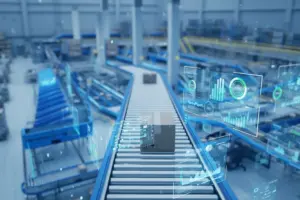
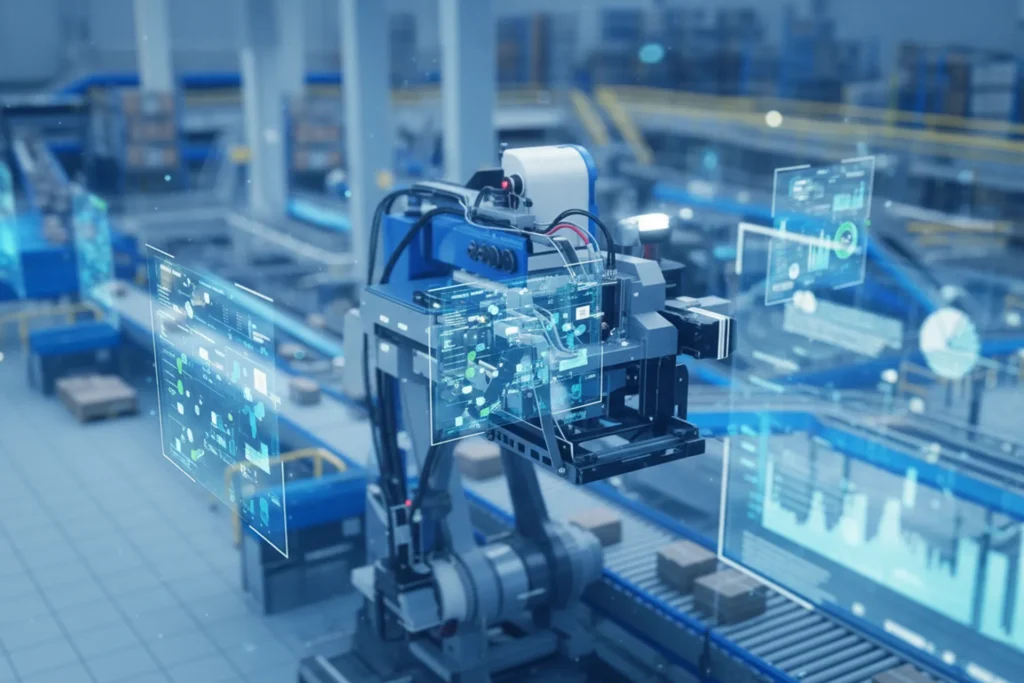
A digital twin is a virtual replica of a system or a process, which simulates real-time behavior and performance using data from various sources (such as ERP and –optionally- sensors). In logistics, digital twins provide a significant competitive advantage by optimizing complex warehouse operations. For instance, improving inventory management, throughput, OTIF and enhancing supply chain resilience. A digital twin of a warehouse, for example, allows companies to simulate and optimize picking routes, automate scheduling, create robust operational plannings and find solutions if e.g. less personnel show up.
One of the key benefits of digital twins in logistics is the ability to model different scenarios and test operational changes without disrupting actual workflows. This results in improved efficiency, reduced costs, and faster decision-making, all of which are critical in today’s fast-moving logistics environment.
Real-World Use Case: DHL’s Implementation of Digital Twins
A prime example of digital twin technology in logistics is the partnership between DHL and Tetra Pak, where they implemented the first digital twin warehouse. This digital twin allowed them to optimize operations in a highly dynamic and complex environment.
By integrating IoT sensors and AI-driven analytics, DHL can continuously monitor warehouse operations and simulate various scenarios to improve safety, productivity, and resource planning. Key benefits include enhanced spatial awareness, reduced risks, and efficient goods flow management. The solution also minimizes manual handling of heavy containers and improves safety.
Additionally, digital twins have enabled DHL to implement predictive maintenance strategies, minimizing equipment downtime and improving operational reliability
Unlocking End-to-End Supply Chain Growth
Digital twins are transforming the entire supply chain ecosystem according to the McKinsey publications. By creating virtual replicas of supply networks, organizations can:
- Enhance supply planning with better forecasting accuracy and inventory optimization
- Improve distribution networks through real-time routing optimization and warehouse simulations
- Enable scenario planning to test disruption responses before they occur
- Create customer-centric supply chains by integrating demand signals with operational capabilities
Leading logistical companies are implementing digital twins across three primary levels: individual distribution centers, regional clusters, and entire supply chains. This multi-tiered approach provides unprecedented visibility into operations, facilitating data-driven decision-making from the warehouse floor to the executive suite.
McKinsey researched this technology and its use in logistics.
According to their findings, companies implementing end-to-end digital twins in their supply chains have reported 15-20% reductions in inventory costs, 5-10% decreases in transportation and warehousing costs, and 10-20% improvements in service levels.
The Power of Pairing Digital Twins with Generative AI
The integration of generative AI with digital twins represents the cutting edge of supply chain innovation. McKinsey’s study “Digital twins and generative AI: a powerful pairing” found that this powerful combination of AI and Digital Twin enables:
- Autonomous operation where systems can self-optimize without human intervention
- Faster training of AI-models using Digital Twins: enhanced simulation capabilities that test thousands of scenarios simultaneously
- Intelligent optimization that continuously improves as more data becomes available
- Checks & balances: using digital twins to validate the outcome of LLM or NN – important in the world of logistics where one cannot afford deviations
Through “what if” simulations run by digital twins, users can fine-tune gen AI, enabling it to conduct predictive modeling, as opposed to the backward-looking view that most LLMs provide. Last, the digital-twin constraint engine can validate gen AI capabilities and boost gen AI accuracy, helping answers from gen AI adhere to physical limits and other constraints.
McKinsey stated that early adopters of this technology pairing report up to 30% improvements in operational efficiency and significant competitive advantages through faster innovation cycles
Embracing the Digital Future of Supply Chains
As digital twins and AI continue to reshape the supply chain landscape, forward-thinking organizations are recognizing the need for specialized expertise to navigate this transformation. The most successful implementations start with clear business objectives, focus on specific high-value use cases, and build upon a strong data foundation.
Companies that approach digital twin adoption as a strategic journey rather than a one-time project are seeing the greatest returns. While technology continues to evolve, the fundamental value proposition remains clear: enhanced visibility, improved decision-making, and increased operational resilience. For supply chain professionals, the question is no longer whether to adopt digital twins and AI, but how to implement them effectively to create sustainable competitive advantages in an increasingly complex global marketplace.
References
[1] McKinsey & Company. (n.d.). Digital twins and generative AI: A powerful pairing. Retrieved from
[2] DHL. (2019, October 1). DHL Supply Chain partners with Tetra Pak to implement first digital twin warehouse in Asia Pacific. Retrieved from
[3] McKinsey & Company. (n.d.). Digital twins: The key to unlocking end-to-end supply chain growth.
Learn more about AI, Digital Twins & Simulation
Explore our Expert Insights Series — a concise collection of articles on the latest in industrial automation, digital twins, AI, and simulation. Discover how these technologies are transforming manufacturing, logistics, and supply chains with real-world impact.


Visit us at LogiMAT 2026!
InControl will be exhibiting at LogiMAT 2026 — the leading international trade show for intralogistics solutions and process management!
Booth #4A65 / March 24–26, 2026