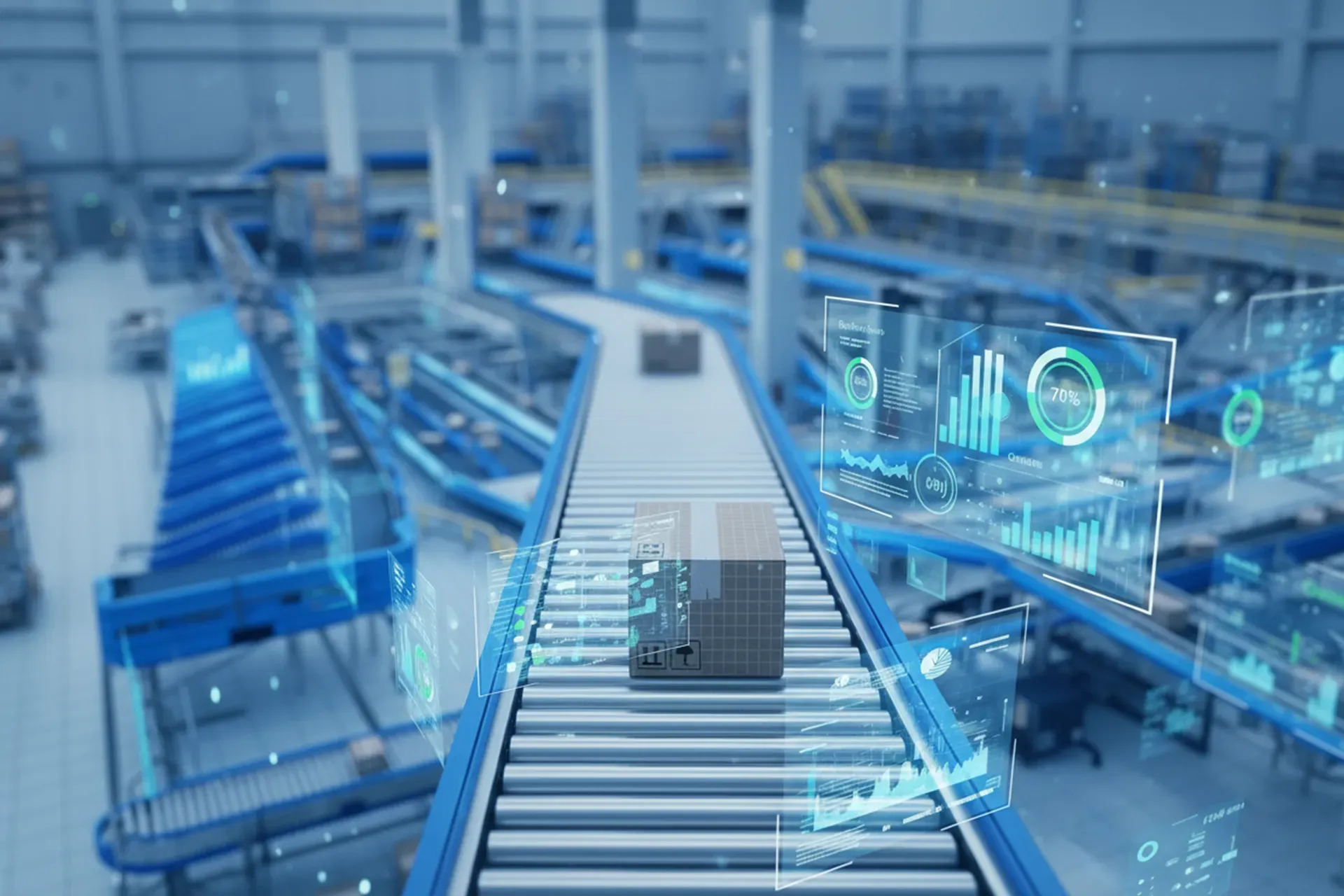
Warehouse automation simulation reduces risk in large capital projects by letting teams model, test, and validate an entire system before a single piece of equipment is installed. Instead of discovering design flaws after commissioning, engineers can run thousands of operational scenarios in a virtual environment and catch problems early, when changes are still inexpensive. The sections below unpack exactly how that works, from the types of risk simulation addresses to who should be in the room when a project kicks off.
What types of risk does warehouse automation simulation address?
Warehouse automation simulation addresses three broad categories of risk: design risk, operational risk, and investment risk. Design risk covers flaws in layout, conveyor routing, or system sizing that only become visible under realistic load conditions. Operational risk includes bottlenecks, resource conflicts, and throughput shortfalls that emerge during peak demand. Investment risk is the danger of committing capital to a solution that underperforms once it goes live.
Each of these risk categories can be explored in a virtual model before any physical commitment is made. A poorly sized sortation loop, for example, might look adequate on paper but collapse under a Black Friday order surge. In a simulation environment, that failure surfaces in minutes rather than months after go-live. Similarly, staffing assumptions that seem reasonable in a spreadsheet can be stress-tested against real order profiles, shift patterns, and equipment failure rates to reveal gaps that would otherwise only appear in production.
Beyond throughput and staffing, simulation also surfaces safety-related risks. Pedestrian and vehicle interaction points, emergency egress paths, and aisle congestion patterns can all be modeled and resolved before they become compliance or liability issues on the warehouse floor.
How does discrete-event simulation model a warehouse before it’s built?
Discrete-event simulation models a warehouse by representing every physical element and operational process as a sequence of time-stamped events. Conveyors, sorters, pick stations, automated storage and retrieval systems, and human workers are each defined by their capacity, speed, and behavior rules. The simulation engine then runs orders through this virtual system, tracking how each unit of work moves, waits, and is processed over time.
The practical result is a dynamic, time-accurate replica of a facility that does not yet exist. Engineers can observe queue build-up at a merge point during a peak hour, measure the utilization rate of every resource in the system, and identify exactly where throughput breaks down. Because the model runs in accelerated time, a full day of warehouse operations can be simulated in seconds, and hundreds of design variations can be evaluated in the time it would take to hold a single design review meeting.
Modern warehouse simulation software goes further by connecting to real data sources. When a DES simulation platform integrates with WMS and ERP systems, the virtual model can be fed with actual order histories, SKU profiles, and seasonal demand curves, making the results far more representative than any manually constructed test scenario.
Build your own simulation, your way
Enterprise Dynamics gives developers full control to model, scale, and integrate complex systems with C++, APIs, and real-time data.
Explore Enterprise DynamicsWhat is what-if scenario testing and how does it apply to automation projects?
What-if scenario testing is the practice of changing one or more variables in a simulation model and observing how those changes affect system performance. In the context of warehouse automation projects, it means asking structured questions such as: What happens to throughput if we add one more induction station? What if order volume doubles in three years? What if a conveyor section goes down for two hours during a peak shift?
This capability is particularly valuable during the design phase of a capital project, when decisions about equipment quantity, layout configuration, and system architecture are still open. Rather than selecting a configuration based on vendor claims or static calculations, project teams can directly compare alternatives under identical demand conditions. The simulation produces objective performance data for each scenario, giving decision-makers a clear basis for choosing between options.
What-if testing also extends into the operational future. Automation systems built today need to handle the volume and order profiles of five or ten years from now. Simulation allows teams to model anticipated growth trajectories and validate that the chosen design has enough headroom, or identify exactly what upgrade path will be needed and when.
How does simulation compare to spreadsheet-based planning for large projects?
Spreadsheet-based planning calculates average performance under assumed steady-state conditions. Discrete event simulation software models dynamic behavior over time, including variability, randomness, and the interaction effects between system components. For small, simple operations, spreadsheets can be sufficient. For large automation projects, they routinely produce dangerously optimistic results.
The core limitation of a spreadsheet is that it cannot capture what happens when multiple things occur simultaneously. When a conveyor merge point receives product from three upstream sources at the same moment, the resulting queue and its downstream consequences are a dynamic event, not an average. Spreadsheets smooth that complexity away. Simulation preserves it.
- Variability: Simulation accounts for processing time variation, equipment downtime, and demand fluctuation. Spreadsheets typically use fixed averages.
- Interaction effects: Simulation shows how a bottleneck in one area cascades into delays elsewhere in the system. Spreadsheets treat each process in isolation.
- Peak performance: Simulation can model your busiest hour of the busiest day. Spreadsheets model the average.
- Scenario breadth: Simulation can evaluate hundreds of configurations quickly. Each spreadsheet scenario requires manual rebuilding.
- Stakeholder communication: A 3D animated simulation model communicates system behavior far more clearly to non-technical stakeholders than a table of numbers.
For a project involving millions in capital expenditure, the cost of building and running a DES simulation model is a small fraction of the cost of discovering a design error after installation.
When in a capital project should warehouse simulation be introduced?
Warehouse simulation delivers the most value when introduced during the concept and design phase, before equipment is specified and contracts are signed. At this stage, the cost of changing a design is low and the range of options is still wide. Simulation findings can directly shape layout decisions, equipment selection, and system architecture rather than simply validating a design that has already been locked in.
That said, simulation adds value at multiple points in a project lifecycle:
- Concept phase: Evaluate competing design concepts and narrow the field based on performance data rather than assumptions.
- Detailed design phase: Validate the chosen concept under peak demand, failure scenarios, and growth projections.
- Pre-commissioning: Test control logic and operational procedures in the virtual model before go-live to reduce ramp-up time.
- Post-go-live optimization: Use an ongoing digital twin to test operational changes, staffing adjustments, and process improvements without disrupting live operations.
Introducing simulation only at commissioning, as a validation exercise, still adds value, but it limits the ability to act on what the model reveals. The earlier simulation enters the project, the greater the return.
Who should be involved in a warehouse simulation project?
A warehouse simulation project works best when it brings together operational expertise and technical knowledge from across the organization. The simulation model is only as good as the inputs it receives, and those inputs come from people with very different roles and perspectives.
Key stakeholders typically include operations managers who understand daily workflow and peak demand patterns, systems engineers who define equipment specifications and control logic, IT or data teams who can supply order history and WMS data, and finance or project leads who need to translate simulation outputs into investment decisions. In many organizations, procurement and vendor management teams also need to be involved, since simulation findings often affect which suppliers and system integrators are selected.
Involving this range of stakeholders early creates two practical benefits. First, the model is built on accurate, validated assumptions rather than guesses. Second, the results carry internal credibility. When a simulation shows that a proposed design will fall short of throughput targets during peak season, that finding is far more persuasive to a buying committee when the operations team, the engineers, and the finance lead all participated in building and reviewing the model.
How Enterprise Dynamics supports warehouse automation risk reduction
Enterprise Dynamics is our DES simulation software built specifically for the complexity of warehouse automation projects. It addresses the challenges described throughout this article in a direct, practical way:
- Drag-and-drop modeling: Pre-built atoms for conveyors, sorters, pick stations, and automated systems let teams build accurate virtual warehouses quickly, without custom development.
- 2D and 3D visualization: Animated models make it easy to communicate system behavior to technical and non-technical stakeholders alike, supporting alignment across buying committees.
- WMS and ERP integration: Real order data feeds directly into the simulation, replacing assumptions with evidence and producing results that reflect your actual demand profile.
- What-if scenario testing: Teams can evaluate hundreds of design configurations, staffing models, and growth scenarios in the time it would take to prepare a single static report.
- Digital twin capability: The model does not have to be retired after go-live. It can evolve into an ongoing digital twin warehouse software environment for continuous operational improvement.
If you are planning a warehouse automation project and want to understand how simulation can reduce your risk before capital is committed, get in touch with our team to discuss your specific situation.
Frequently Asked Questions
How long does it typically take to build a warehouse simulation model?
The timeline depends on project complexity, but a foundational simulation model for a mid-sized warehouse automation project can typically be built in two to four weeks when good input data is available. Platforms like Enterprise Dynamics accelerate this significantly through pre-built components for common equipment types, reducing custom development time. The bigger variable is usually data readiness — having clean order history, SKU profiles, and equipment specifications on hand from the start is the single most effective way to shorten the modeling timeline.
What data do I need to provide before a simulation can be run?
At a minimum, you need order volume data (ideally broken down by hour and day to capture peak patterns), SKU profiles, a facility layout or proposed floor plan, and equipment specifications such as conveyor speeds, sorter rates, and pick station capacities. The more granular and historical the order data, the more accurate and representative the simulation results will be. If you are early in the concept phase and some of this data does not yet exist, experienced simulation engineers can work with reasonable assumptions and clearly flag which outputs carry more uncertainty.
Can simulation be used to evaluate automation vendors and their proposed designs?
Yes, and this is one of the most powerful applications of simulation in a capital project. Rather than evaluating vendor proposals based solely on their own performance claims or static throughput calculations, you can load each proposed design into a neutral simulation model and test them under identical demand conditions. This gives procurement and project teams an objective, apples-to-apples comparison that is independent of any vendor’s marketing materials, significantly strengthening the selection process.
What happens to the simulation model after the warehouse goes live — is it still useful?
A well-maintained simulation model becomes increasingly valuable after go-live, not less. Once the physical system is operational, the model can be updated with real performance data and used as a digital twin to safely test operational changes — such as new staffing patterns, layout modifications, or process redesigns — before implementing them on the live floor. This eliminates the risk of disrupting operations during experimentation and provides a continuous improvement tool that compounds value over the lifetime of the facility.
How do we know whether the simulation results are accurate enough to trust for major investment decisions?
Simulation model credibility is established through a process called validation, where the model’s outputs are compared against known real-world data — for example, by running the model against a period of historical order data and checking whether the simulated throughput and resource utilization match what actually occurred in an existing facility. When working with a new design, sensitivity analysis is used to test how much results change when key assumptions are varied, which helps identify which inputs most influence outcomes and where additional data collection is worthwhile. A reputable simulation team will always be transparent about model assumptions and their potential impact on results.
What are the most common mistakes teams make when using warehouse simulation for the first time?
The most frequent mistake is treating simulation as a one-time validation exercise at the end of the design process rather than an iterative tool used throughout it. By the time simulation is run only to confirm a design already selected, the window for making high-impact changes has largely closed. A second common pitfall is using overly optimistic or averaged input data — particularly order volumes that reflect a typical day rather than a peak day — which produces results that look favorable but fail to predict real-world performance under stress. Engaging simulation specialists early and insisting on peak-demand testing from the outset avoids both of these traps.
Is warehouse automation simulation only relevant for very large projects, or can smaller operations benefit too?
While the return on investment is most immediately obvious for large capital projects where a single design error can cost millions to correct, simulation adds meaningful value at a range of project scales. For mid-sized operations, the benefit often shows up in right-sizing equipment — avoiding both the cost of over-specification and the performance risk of under-specification. The key threshold is whether the cost of a post-installation design change would exceed the cost of building the model, and for most automated warehouse projects, that threshold is crossed well before the project reaches enterprise scale.
Related Articles
- What are the four types of risks in the supply chain?
- How does warehouse layout simulation support investment decisions?
- How does warehouse simulation software support what-if scenario testing?
- What are the key performance indicators tracked by warehouse simulation software?
- How can supply chain simulation software prevent planning errors?