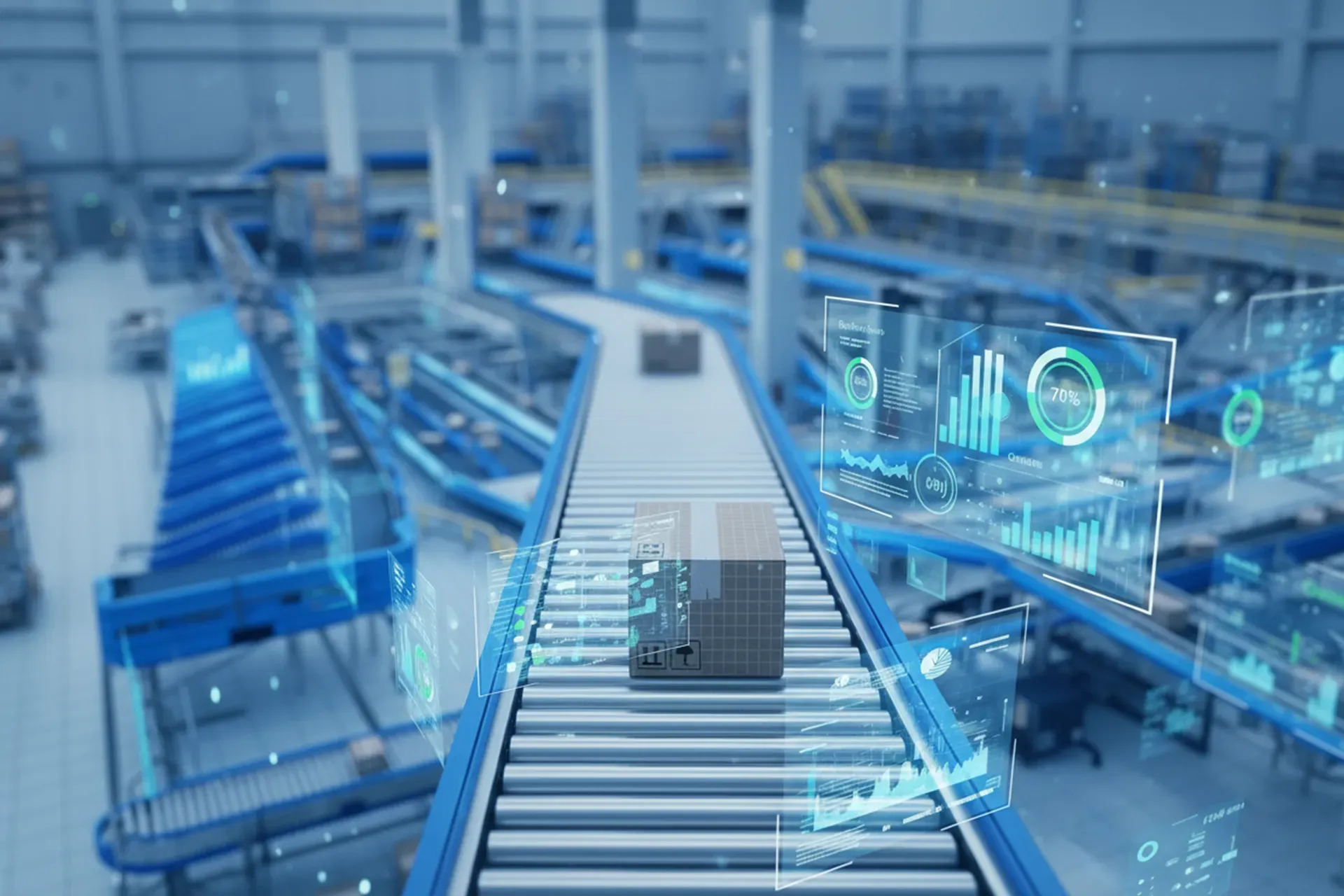
A digital twin of a warehouse is a live, virtual replica of a physical warehouse environment, including its layout, equipment, workflows, and inventory flows, that mirrors real-world operations in a dynamic model. Unlike a static floor plan or spreadsheet, a warehouse digital twin continuously reflects how the facility actually behaves. It gives operations and logistics teams a risk-free environment to analyze performance, test changes, and make smarter decisions without disrupting live operations. Below, we answer the most common questions about how warehouse digital twins work and what they can do for your facility.
How does a warehouse digital twin actually work?
A warehouse digital twin works by creating a virtual model of your warehouse that replicates physical assets, processes, and flows in real time or near-real time. The model simulates how goods, equipment, and people move through the facility, allowing you to observe system behavior, identify inefficiencies, and test operational changes before applying them in the real world.
At its core, the digital twin runs on a discrete event simulation engine that processes inputs, such as order volumes, conveyor speeds, picking strategies, and staffing levels, and calculates how the system responds over time. This is what distinguishes it from a simple 3D model or a dashboard: the digital twin is dynamic. It evolves, reacts, and produces outcomes based on the logic you define and the data you feed it.
The result is a virtual environment where you can run scenarios, stress-test assumptions, and answer questions like: What happens to throughput if order volume increases by 30%? Where does the system break down during peak hours? Which layout change delivers the biggest efficiency gain?
What data does a warehouse digital twin use?
A warehouse digital twin uses a combination of operational, physical, and behavioral data to build an accurate model of how the facility functions. The more precise and current the data, the more reliable the twin’s outputs.
Common data inputs include:
- Layout and infrastructure data – floor plans, rack configurations, conveyor routes, dock locations, and storage zones
- Equipment specifications – conveyor speeds, forklift capacities, sorter throughput rates, and automated system parameters
- Order and inventory data – order profiles, SKU volumes, pick frequencies, and inbound/outbound flow patterns
- Workforce data – staffing levels, shift patterns, task assignments, and walking distances
- WMS and ERP data – real-time operational data from warehouse management and enterprise resource planning systems
- Historical performance data – throughput records, error rates, cycle times, and peak period logs
Integrating with existing WMS and ERP systems is particularly valuable because it allows the digital twin to stay aligned with actual operational conditions rather than relying on assumptions or outdated figures.
Build your own simulation, your way
Enterprise Dynamics gives developers full control to model, scale, and integrate complex systems with C++, APIs, and real-time data.
Explore Enterprise DynamicsWhat can a warehouse digital twin be used for?
A warehouse digital twin can be used for a wide range of operational and strategic purposes, from day-to-day performance monitoring to long-term investment planning. Its core value lies in enabling decision-makers to test before they commit, reducing risk and improving confidence in every change they make.
The most common applications include:
- Throughput analysis – measuring how many orders, pallets, or units the warehouse can process under different conditions
- Bottleneck identification – pinpointing exactly where congestion, delays, or capacity constraints occur in the flow
- Layout optimization – evaluating alternative floor configurations to improve material flow and reduce travel distances
- Workforce planning – determining optimal staffing levels for different shift patterns and demand scenarios
- Investment validation – testing the impact of new automation, conveyors, or sortation systems before purchasing
- Peak period preparation – simulating high-demand periods like seasonal peaks to ensure the system can handle the load
- What-if scenario testing – exploring the effects of operational changes such as new picking strategies or altered storage policies
What’s the difference between a warehouse digital twin and warehouse simulation?
The key difference is that a warehouse digital twin is a persistent, connected model that continuously reflects the state of a real facility, while warehouse simulation is typically a project-based model built to answer specific questions at a point in time. In practice, the two concepts overlap significantly, and a well-built simulation often forms the foundation of a digital twin.
Warehouse simulation focuses on modeling a system to analyze performance and test scenarios. It is powerful for answering defined questions: Will this layout support our growth targets? What staffing level do we need for peak season? The model may be built once, used for analysis, and then updated as needed.
A digital twin extends this by maintaining an ongoing connection to live operational data. It is continuously updated to reflect current conditions, making it useful not just for one-off analysis but for ongoing monitoring and real-time decision support. Think of simulation as the engine that powers a digital twin: the twin adds the layer of real-world connectivity and continuous relevance.
For many organizations, the practical starting point is warehouse simulation software that can evolve into a full digital twin as data integration matures. Purpose-built DES simulation software for warehousing is particularly well suited to this journey, since it models the discrete, event-driven nature of intralogistics operations from the outset.
Which types of warehouses benefit most from a digital twin?
Warehouses with high complexity, high throughput, or significant automation investment benefit most from a digital twin. The more moving parts a facility has, in terms of equipment, processes, SKU variety, or order volume, the more value a dynamic virtual model delivers.
The strongest candidates include:
- E-commerce fulfillment centers – high order volumes, rapid SKU turnover, and tight delivery windows make material flow optimization critical
- Pharmaceutical distribution facilities – strict compliance requirements and high-value inventory make risk-free testing essential
- Retail distribution centers – seasonal demand swings and multi-channel complexity create constant planning challenges
- Automated warehouses – facilities with conveyors, sorters, AS/RS systems, or robotics benefit from warehouse automation simulation that models the interaction between automated and manual processes
- Large-scale third-party logistics (3PL) operations – managing multiple clients with different requirements demands flexible scenario planning
Smaller or simpler facilities can also benefit, particularly when planning a significant expansion or automation upgrade where the investment justifies thorough pre-validation.
How do you build a digital twin of a warehouse?
Building a digital twin of a warehouse involves five main steps: defining the scope and objectives, gathering and structuring data, building the virtual model, validating it against real-world behavior, and connecting it to live data sources for ongoing use.
Here is how the process typically unfolds:
- Define your objectives – Clarify what questions the digital twin needs to answer. Are you optimizing an existing facility, validating a new design, or preparing for automation? The scope drives every subsequent decision.
- Collect operational and physical data – Gather layout drawings, equipment specs, order data, staffing information, and historical performance records. Data quality at this stage directly affects model accuracy.
- Build the simulation model – Use discrete event simulation software to construct a virtual replica of the warehouse, including its flows, logic, and constraints. DES simulation modelling software is particularly effective here, capturing how goods and resources move through the system as a sequence of discrete events over time, from inbound receiving through to outbound dispatch.
- Validate the model – Run the model against historical data to verify that its outputs match known real-world results. Validation builds confidence that the twin accurately represents the physical system.
- Connect to live data and iterate – Integrate the model with WMS, ERP, or IoT data streams to keep it current. From here, the twin becomes a living tool for ongoing scenario testing and operational decision-making.
The process is iterative: models are refined as new data becomes available and as operational questions evolve. Starting with a well-scoped simulation project is often the most practical path to a fully operational digital twin.
How Enterprise Dynamics helps you build a warehouse digital twin
Our Enterprise Dynamics platform is purpose-built for exactly this kind of work. It is a proven DES simulation platform that brings together the modeling depth, data integration, and visualization capabilities you need to create a reliable digital twin of your warehouse, whether you are optimizing an existing facility or designing a new one from scratch.
Here is what Enterprise Dynamics brings to the table:
- Drag-and-drop modeling – build complex warehouse models quickly using pre-built atoms for conveyors, sorters, storage systems, workstations, and more
- WMS and ERP integration – connect directly to your existing systems to feed the model with real operational data
- 2D and 3D visualization – see your warehouse come to life in a dynamic virtual environment that stakeholders across the business can understand
- What-if scenario testing – run unlimited scenarios to compare layout options, staffing strategies, automation investments, and operational policies
- Bottleneck and throughput analysis – identify exactly where your system underperforms and quantify the impact of every proposed change
Whether you are a logistics engineer validating a major capital investment or an operations leader preparing for peak season, Enterprise Dynamics gives you the confidence to make decisions backed by data, not guesswork. Get in touch with our team to discuss how we can help you build a digital twin of your warehouse.
Frequently Asked Questions
How long does it take to build a warehouse digital twin?
The timeline depends on the complexity of the facility and the quality of data available, but most warehouse digital twin projects take anywhere from a few weeks to a few months. A focused simulation project with well-defined objectives and clean data can be completed in 4–8 weeks, while a fully integrated, enterprise-scale digital twin with live WMS and ERP connectivity may take 3–6 months to mature. Starting with a narrowly scoped model and expanding iteratively is often the most efficient approach.
How accurate does the data need to be before we can start building a digital twin?
Your data does not need to be perfect before you begin, but it does need to be representative enough to produce meaningful outputs. Most projects start with a combination of floor plans, equipment specs, and historical order data, then refine the model as better data becomes available. The validation step in the build process is specifically designed to surface gaps between the model and reality, so inaccuracies are identified and corrected before the twin is used for decision-making.
Can a warehouse digital twin be used for a facility that hasn't been built yet?
Yes, and this is one of the most valuable applications of warehouse simulation and digital twin technology. Greenfield projects — new warehouse designs that exist only on paper — benefit enormously from virtual modeling because it allows planners to test layout configurations, validate automation choices, and stress-test capacity assumptions before a single rack or conveyor is installed. This can prevent costly design errors and reduce the risk of commissioning a facility that underperforms against its targets.
What's the difference between a warehouse digital twin and a WMS dashboard?
A WMS dashboard shows you what is happening in your warehouse right now, presenting operational data like order status, inventory levels, and throughput metrics. A warehouse digital twin goes further by simulating how the system behaves under different conditions, allowing you to test scenarios, predict future performance, and evaluate changes before implementing them. The two tools are complementary: WMS data feeds the digital twin, while the twin provides the analytical depth that a dashboard alone cannot deliver.
Do we need dedicated simulation experts on our team to use a warehouse digital twin?
Not necessarily. Modern simulation platforms like Enterprise Dynamics are designed to be accessible to logistics engineers and operations professionals, not just simulation specialists. That said, building an accurate and well-validated model does require a solid understanding of warehouse processes and some familiarity with simulation concepts. Many organizations partner with experienced simulation consultants for the initial build and then manage ongoing scenario testing internally once the model is established.
What are the most common mistakes teams make when implementing a warehouse digital twin?
The most frequent pitfalls include defining objectives too broadly, underestimating the time needed for data collection, and skipping or rushing the validation step. A digital twin built on poor data or without proper validation can produce misleading results that lead to bad decisions, which is worse than having no model at all. Starting with a tightly scoped objective, investing in data quality upfront, and rigorously validating the model against real historical performance are the three practices that most reliably lead to a successful implementation.
How often should a warehouse digital twin be updated to stay useful?
The update frequency depends on how the twin is being used. If it is connected to live WMS and ERP data, it updates continuously and stays aligned with current operations automatically. If it is a project-based simulation model used periodically for scenario analysis, it should be refreshed whenever significant operational changes occur, such as a layout modification, a new automation system, a major shift in order profiles, or an upcoming peak season. A model that no longer reflects real conditions will produce unreliable outputs, so keeping it current is essential to maintaining its value.
Related Articles
- How does digital twin warehouse software connect to live warehouse systems?
- Which ERP is best for supply chain management?
- How does warehouse simulation software handle multi-threaded computing?
- How does simulation help warehouses adapt to changing order profiles?
- What can you test with supply chain simulation software?