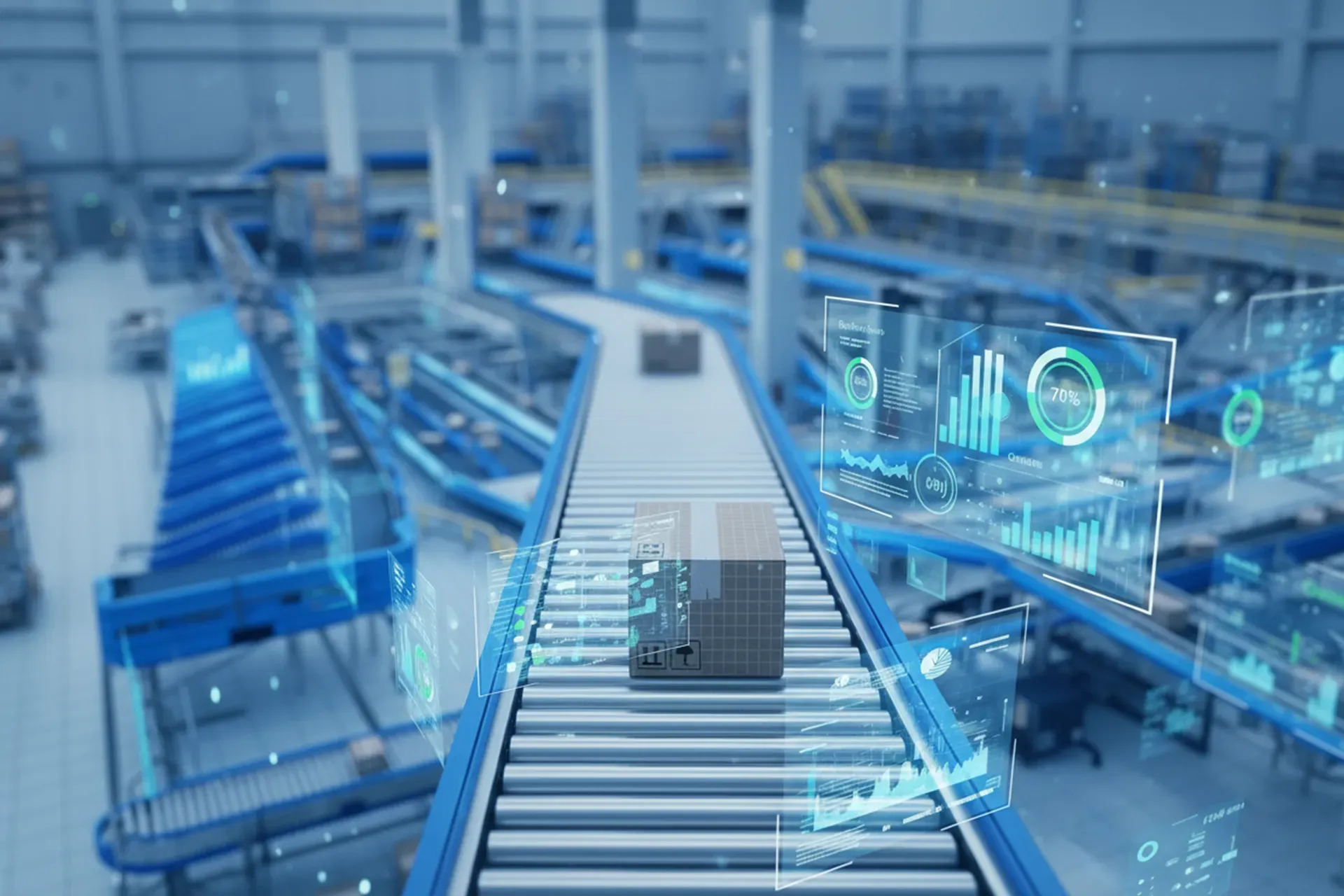
Integrating simulation with real-time data allows organizations to move from static, point-in-time analysis to continuously updated models that reflect actual operational conditions as they happen. This combination turns a simulation model into a living representation of your operation, enabling faster decisions, earlier problem detection, and more accurate planning. Below, we unpack the most common questions around this topic, from how real-time data changes model behavior to when your organization should make the switch.
How does real-time data change the way simulation models behave?
Real-time data transforms a simulation model from a fixed snapshot into a dynamic, self-updating system. Instead of running scenarios based on historical averages or assumed inputs, the model continuously receives live data from your operation, adjusting its state, recalculating outputs, and reflecting current conditions rather than projected ones.
In practical terms, this means the model no longer needs to be manually updated every time volumes shift, equipment goes down, or staffing levels change. The simulation responds to those changes automatically. This is particularly powerful in environments where conditions fluctuate throughout the day, such as distribution centers during peak periods or transport hubs managing irregular passenger flows.
The behavioral shift is significant: a static model tells you what might happen under a given set of assumptions. A real-time integrated model tells you what is happening and what is likely to happen next, based on the actual state of your operation right now.
What operational problems does real-time simulation actually solve?
Real-time simulation integration solves operational problems that traditional planning tools cannot address quickly enough. These include unplanned bottlenecks, resource imbalances, unexpected throughput drops, and the inability to test corrective actions before applying them to a live operation. Discrete event simulation software is particularly well suited to these challenges, since it models each event and resource interaction individually, making it possible to pinpoint exactly where and when problems emerge.
Some of the most common problems it addresses include:
- Bottleneck detection in real time: Instead of discovering a congestion point after it has already disrupted throughput, the model flags it as it develops.
- Resource reallocation decisions: When volumes spike or a piece of equipment goes offline, the model can evaluate whether shifting workers or rerouting flows will recover performance.
- Shift and capacity planning: Live data feeds allow planners to adjust staffing decisions based on what the model predicts will happen in the next few hours, not just what happened yesterday.
- Validation before intervention: Before implementing a change to a live operation, teams can test the proposed fix in the simulation first, eliminating the risk of making things worse.
These capabilities are especially valuable in high-throughput environments like pharmaceutical distribution or e-commerce fulfillment, where even short disruptions translate directly into missed service levels.
Build your own simulation, your way
Enterprise Dynamics gives developers full control to model, scale, and integrate complex systems with C++, APIs, and real-time data.
Explore Enterprise DynamicsWhat is the difference between a digital twin and a real-time simulation model?
A digital twin is a virtual replica of a physical system that is continuously synchronized with real-world data, while a real-time simulation model is a simulation that uses live inputs to run forward-looking scenarios. The key distinction is that a digital twin emphasizes ongoing mirroring of current state, whereas a real-time simulation emphasizes predictive and analytical capability using live data as its starting point.
In practice, the two concepts overlap significantly and are often used together. A digital twin of a warehouse, for example, reflects the current position of inventory, the status of conveyors, and the workload of each pick zone. A real-time warehouse simulation built on top of that twin can then answer questions like: if we receive an additional 2,000 orders in the next hour, where will the system break down first?
The distinction matters most when scoping a project. A digital twin is primarily a monitoring and visualization tool. A real-time simulation is an analytical and decision-support tool. Organizations that want both situational awareness and the ability to test responses to changing conditions typically need both working in combination.
Which industries benefit most from real-time simulation integration?
Industries with high operational complexity, time-sensitive decisions, and significant consequences for getting those decisions wrong benefit most from real-time simulation integration. These are environments where conditions change quickly and the cost of reacting too slowly, or incorrectly, is high.
The industries that gain the most include:
- Material handling and intralogistics: Warehouses, distribution centers, and fulfillment operations deal with variable order volumes, equipment variability, and tight service windows. Intralogistics simulation and material flow simulation give operators the visibility to stay ahead of throughput problems before they escalate.
- Pharmaceutical distribution: Compliance requirements and cold-chain sensitivity make it critical to understand operational state in real time and predict where delays might occur.
- Transportation and passenger flow: Rail networks and airports manage dynamic passenger volumes and equipment constraints. Real-time simulation helps operators respond to disruptions without guessing.
- Retail and e-commerce fulfillment: Demand spikes during promotions or peak seasons require rapid capacity adjustments that static planning tools cannot support. Logistics simulation software enables planners to model these scenarios and respond with confidence.
- Manufacturing and assembly: Production lines benefit from real-time visibility into WIP levels, machine availability, and downstream constraints. Manufacturing simulation software and production line simulation tools make it possible to identify and address these issues before they affect output.
What data sources can be connected to a simulation model in real time?
A simulation model can be connected in real time to any data source that produces structured, machine-readable output on a continuous or near-continuous basis. The most common sources include Warehouse Management Systems, ERP platforms, conveyor and sortation control systems, IoT sensors, and order management systems.
More specifically, the data types that feed real-time simulation models typically include:
- Order and volume data from WMS or OMS systems, reflecting what work is queued, in progress, or completed.
- Equipment status data from PLCs or SCADA systems, indicating which conveyors, sorters, or machines are active, idle, or faulted. Conveyor simulation and AGV simulation models rely heavily on this type of feed to reflect real-time equipment behavior accurately.
- Inventory positions from WMS, showing stock levels, putaway locations, and replenishment triggers.
- Workforce data from time and attendance or labor management systems, reflecting actual staffing by zone or shift.
- Sensor and IoT data from devices measuring occupancy, throughput rates, queue lengths, or environmental conditions.
- ERP data covering production schedules, purchase orders, or supply chain events that affect downstream operations.
The quality and granularity of these data sources directly determine how accurate and useful the real-time simulation will be. Clean, timely data produces reliable predictions. Delayed or incomplete feeds reduce the model’s ability to reflect actual conditions.
When should an organization move from static simulation to real-time integration?
An organization should consider moving from static simulation to real-time integration when operational decisions need to be made faster than a traditional modeling cycle allows, and when the cost of reacting to problems after they occur consistently exceeds the cost of preventing them. If your team is regularly surprised by performance drops that a better-informed model could have predicted, that is a strong signal.
Specific triggers that indicate readiness for real-time integration include:
- Your operation has reached a level of complexity where manual monitoring and spreadsheet-based planning can no longer keep up with daily variability.
- You have already implemented a static simulation model and are now looking to extend its value beyond project-phase analysis.
- Your WMS, ERP, or control systems already produce structured data that could be connected to a simulation without major infrastructure changes.
- Operational disruptions are recurring and the response time from detection to correction is too slow to prevent downstream impact.
- Leadership is making significant investment decisions, in automation, layout, or capacity, that require confidence in how the operation will perform under real conditions.
Organizations that are still in the early stages of simulation adoption often benefit from starting with static discrete event simulation software to build modeling maturity before adding real-time data feeds. The two approaches are not mutually exclusive: real-time integration is typically an evolution, not a replacement.
How Enterprise Dynamics supports real-time simulation and digital twin integration
Our warehouse simulation software, Enterprise Dynamics, is built to bridge the gap between static analysis and live operational intelligence. As a DES simulation platform, it connects directly with WMS and ERP systems to create a continuously updated digital twin of your warehouse or distribution operation, giving your team the insight needed to act before problems escalate.
With Enterprise Dynamics, your organization can:
- Build accurate models of complex logistics and material handling environments using drag-and-drop atom libraries
- Integrate live data from WMS, ERP, and control systems to keep the model synchronized with real operational conditions
- Run what-if scenarios against the current state of your operation to test corrective actions before applying them
- Identify bottlenecks, analyze throughput, and validate investment decisions in a risk-free virtual environment
- Visualize operations in 2D and 3D to communicate findings clearly across technical and non-technical stakeholders
- Model warehouse automation simulation scenarios, including AS/RS simulation and AGV simulation, to evaluate how automated components perform within the broader material flow
Whether you are evaluating automation investments, optimizing an existing distribution center, or preparing for seasonal demand peaks, Enterprise Dynamics gives you the analytical foundation to make those decisions with confidence. Get in touch with our team to explore how real-time simulation integration can work for your operation.
Frequently Asked Questions
How long does it typically take to implement real-time simulation integration, and what does the process look like?
Implementation timelines vary depending on the complexity of your operation and the readiness of your existing data infrastructure, but most organizations can expect a phased process spanning several weeks to a few months. The typical stages include scoping the data connections needed, validating the quality and format of incoming data feeds, building or adapting the simulation model to accept live inputs, and running parallel testing before going live. Organizations that already have a mature static simulation model and clean, structured data from their WMS or ERP systems tend to move through this process significantly faster.
What if our data quality is inconsistent or our systems don't produce clean, structured outputs — can we still integrate real-time data?
Inconsistent or incomplete data is one of the most common challenges organizations face when moving toward real-time integration, and it doesn’t necessarily block the project — but it does need to be addressed. A common approach is to implement a data cleansing or transformation layer between your source systems and the simulation model, so that gaps, delays, or formatting inconsistencies are handled before they affect model accuracy. It’s also worth starting with the highest-quality data streams you have and expanding connectivity incrementally as data hygiene improves, rather than waiting for a perfect data environment that may never arrive.
How do we know if our simulation model is accurately reflecting real operational conditions once it's connected to live data?
Model validation is a critical step that should happen both before go-live and on an ongoing basis. The standard approach is to run the real-time model in parallel with your actual operation for a defined period, comparing model outputs — such as predicted throughput, queue lengths, and cycle times — against what is actually observed on the floor. Significant and consistent deviations typically point to either data feed issues, incorrect model logic, or assumptions in the model that no longer match how the operation actually runs. Building in regular calibration checkpoints ensures the model stays accurate as your operation evolves over time.
Can real-time simulation integration work alongside automation systems like AS/RS, AGVs, or automated sorters?
Yes, and this is actually one of the most powerful use cases. Automated systems like AS/RS units, AGVs, and sorters typically generate rich, high-frequency data through their control systems, PLCs, or WCS platforms, making them ideal data sources for real-time simulation. Connecting these feeds allows the model to track equipment utilization, detect faults or slowdowns in real time, and simulate how the rest of the operation responds when a specific automated component underperforms. For organizations investing heavily in automation, real-time simulation becomes a key tool for maximizing the return on that investment by ensuring the automated systems are operating within the broader flow as intended.
What's the most common mistake organizations make when starting a real-time simulation integration project?
The most frequent mistake is trying to connect too many data sources at once before validating the quality and reliability of any single feed. Organizations often underestimate how much time data preparation and integration testing requires, and rushing this phase leads to a model that receives noisy or delayed inputs, producing outputs that operators quickly lose trust in. A more effective approach is to start with two or three high-value, high-quality data connections — typically order volume and equipment status — demonstrate value with those, and then expand the integration incrementally. Trust in the model is built through consistent accuracy, not through the number of data feeds connected.
Do we need dedicated simulation expertise in-house to maintain a real-time integrated model, or can this be managed by operational staff?
The answer depends on the complexity of the model and how frequently it needs to be updated as the operation changes. For day-to-day use — running scenarios, interpreting outputs, and making operational decisions — the interface can typically be designed so that planners and operations managers without deep simulation expertise can use it effectively. However, structural changes to the model, such as adding new processes, updating logic after a layout change, or reconfiguring data connections, generally require someone with simulation modeling knowledge. Many organizations address this through a combination of internal champions who are trained on the platform and ongoing support from their simulation vendor for more complex model updates.
How does real-time simulation integration affect ROI compared to using static simulation alone?
Static simulation delivers ROI primarily at the project or planning phase — it helps you make better design and investment decisions before committing resources. Real-time integration extends that ROI into daily operations by enabling faster response to disruptions, reducing the cost of reactive decision-making, and improving service level consistency over time. The ongoing operational value — measured in avoided disruptions, better resource utilization, and reduced firefighting — often compounds significantly in high-throughput environments where even small efficiency gains translate to meaningful cost savings. Organizations that have already invested in a static simulation model are particularly well-positioned to capture this additional ROI, since the foundational modeling work is already done.