The organizations that run the world’s most critical operations — warehouses, distribution networks, supply chains, transportation systems — share a common vulnerability…
Continue readingSoftware Update: Enterprise Dynamics 10.7
We are excited to announce the release of Enterprise Dynamics® 10.7, the latest version of our industry-leading Discrete-Event Simulation software.
Continue readingVirtual Commissioning: Facilitating Industrial Automation
Expert Insights Series: AI and Digital Twins in shaping the future of Supply Chains.
Virtual Commissioning: Facilitating Industrial Automation
Enterprise Resource Planning (ERP) systems are essential for modern warehouse and supply chain operations. Boehringer Ingelheim, a global pharmaceutical company, faced challenges in optimizing its logistics and warehouse operations. To address these issues, the company decided to use “virtual commissioning” as part of its SAP ERP implementation. This article explains how virtual commissioning works and what the benefits of this approach for Boehringer Ingelheim were.
What is a digital twin?
A digital twin is a copy of reality that mirrors real-world operations, allowing businesses to plan, test, and control scenarios and select the optimal configuration.
Using Enterprise Dynamics® from InControl, a Digital Twin of the warehouse was created. This allowed the company to test various “what-if” scenarios, analyze bottlenecks, and optimize processes before implementing changes in the real-world environment.
What is Virtual Commissioning?
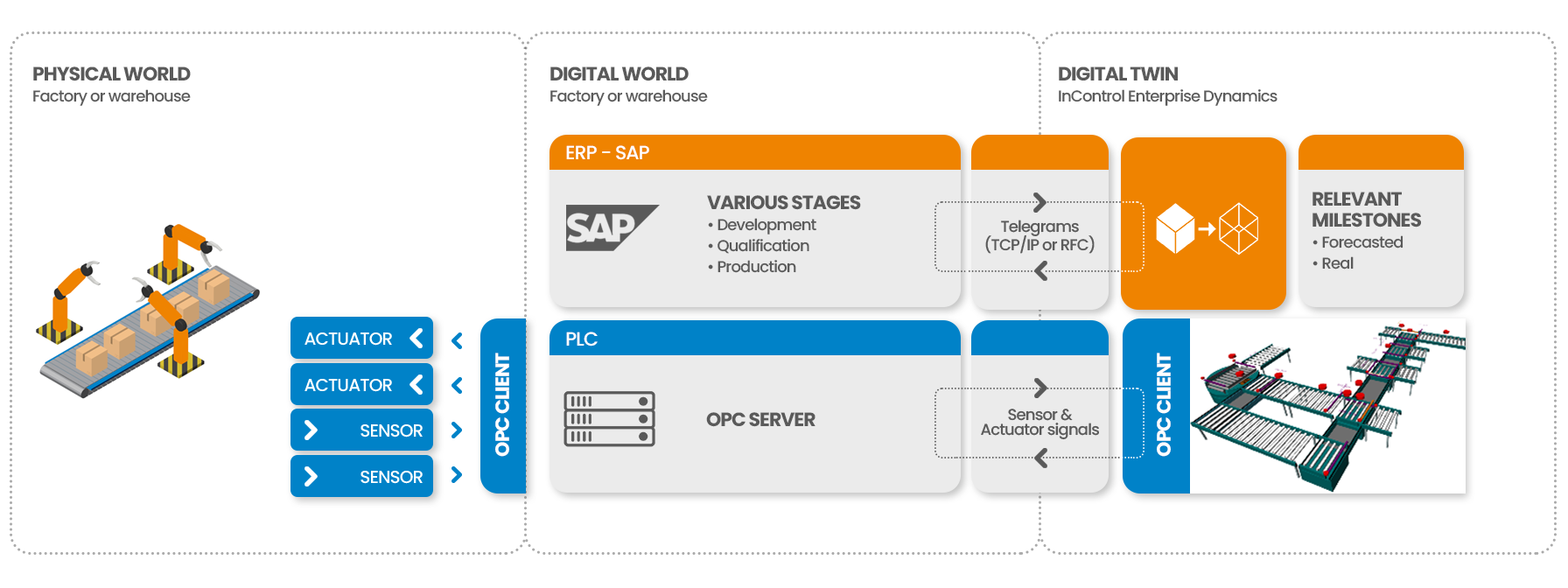
Virtual commissioning is a cutting-edge approach that integrates digital simulation and emulation tools with industrial control systems. It is an integration of physical and digital worlds and it allows businesses to test, optimize, and validate material flow and logistics operations before actually deploying physical systems.
By creating a digital twin, virtual commissioning enables seamless interaction between enterprise resource planning (ERP) systems, material flow controllers (MFCs), and programmable logic controllers (PLCs), ensuring a smooth transition from design to operational execution. This removes the need to implement and test all the logic and communication between the ERP system on one side and the physical machines in the factory or warehouse.
How Virtual Commissioning Works
Virtual Commissioning is the process of testing and validating control systems, automation logic, and mechanical designs in a virtual environment before deploying them in the real world. Finding and solving bugs will happen much more efficiently in a digital environment instead of in – a more expensive – real production environment.
Testing Through Virtual Commissioning enabled Boehringer to:
- Conduct intensive testing of control software before deployment.
- Validate system performance and ensure seamless PLC (Programmable Logic Controller) integration.
- Identify and rectify errors early in the development phase, reducing the risk of costly post-deployment modifications.
SAP ERP Integration with Material Flow Control (MFC)
The SAP EWM-MFC (Extended Warehouse Management – Material Flow Control) system was integrated with the simulation model based on Enterprise Dynamics. The integration works as follows:
- A material flow computer (MFC) receives transport orders from ERP systems (e.g., SAP EWM-MFC) to manage inventory and warehouse logistics.
- Communication occurs at the telegram level, where transport orders define movements of loading devices within the system.
- The simulation model integrates PLC logic, allowing real-time testing and validation of control algorithms.
- Mixed simulation approaches enable hybrid testing by incorporating physical PLCs for some system areas while relying on digital models for others.
Business Benefits of Virtual Commissioning
Implementing virtual commissioning delivers significant advantages:
- Time Savings: Faster commissioning leads to earlier operational readiness, reducing downtime and expediting production launches.
- Cost Reduction: Businesses lower testing and commissioning expenses by identifying and resolving issues before deployment.
- Risk Mitigation: Simulated testing prevents costly errors, ensuring all system elements function as expected before physical implementation.
Real-World Application with InControl’s Digital Twin
InControl’s Enterprise Dynamics® platform facilitates virtual commissioning by integrating:
- Control Level: PLC logic and sensor-actuator interactions.
- Process Control Level: Material flow and system-wide data exchange.
- Production Control Level: Integration with ERP/MES systems for a seamless digital transformation.
This holistic approach enables businesses to simulate warehouse layouts, optimize logistics chains, and test automation solutions before physical implementation, leading to improved efficiency and reduced operational costs.
“
Implementing SAP in a live production environment comes with high demands and inherent risks. With InControl’s Digital Twin, we were able to thoroughly and risk-free test this complex process. This resulted in significant time and cost savings and a flawless commissioning.
Boehringer Pharma GmbH & Co. KG
Conclusion
The SAP EWM implementation at Boehringer, based on virtual commissioning and digital twin technology, sets a benchmark for modern warehouse and logistics optimization. Virtual commissioning reduces costs and time in SAP EWM implementations by bridging the gap between physical and digital operations. Companies leveraging this technology can achieve faster commissioning, lower resource consumption, and minimized downtime.
With Enterprise Dynamics® from InControl, businesses gain a competitive edge by enhancing reliability, scalability, and operational efficiency through data-driven decision-making. As industrial digitalization advances, virtual commissioning is set to become the standard solution for ERP implementations.
Learn more about AI, Digital Twins & Simulation
Explore our Expert Insights Series — a concise collection of articles on the latest in industrial automation, digital twins, AI, and simulation. Discover how these technologies are transforming manufacturing, logistics, and supply chains with real-world impact.
Visit us at LogiMAT 2026!
InControl will be exhibiting at LogiMAT 2026 — the leading international trade show for intralogistics solutions and process management!
Booth #4A65 / March 24–26, 2026
Unlocking End-to-End Growth with Digital Twins and Generative AI
The logistics industry is undergoing a transformation, driven by cutting-edge technologies like digital twins and artificial intelligence. Recent McKinsey research highlights how companies are leveraging these innovations.
Continue readingThe Role of Simulation in AI Applications for Production and Logistics
Artificial intelligence (AI) is gaining ever more traction with the latest trends of large language
models, generative AI, and autonomous agents bringing capabilities to the attention of millions
outside of its classic computer science domain.
AI and Simulation: A Powerful Combination for Smart Supply Chains
Expert Insights Series: AI and Digital Twins in shaping the future of Supply Chains.
AI and Simulation: A Powerful Combination for Smart Supply Chains
As AI continues to revolutionize industries, its integration with simulation tools is opening new doors for efficiency, risk management, and decision-making in supply chains. We spoke with Kees van der Klauw, former Chairman of the Netherlands AI Coalition and former Research Executive at Philips, about the synergy between AI and simulation, and what the future holds for smart supply chains.
Can you share your background and how you became involved in AI and innovation?
My career started at Philips, where I was involved in digital transformations across various domains—semiconductors, LCD displays, TV innovations, and LED lighting systems. Over a decade ago, in Philips Research, we already explored AI applications such as automated design of electronic circuits and customer preference analysis. Later, I played a key role in establishing AIOTI (now a leading IoT and Edge Computing initiative) and led the strategy and development of the Netherlands AI Coalition. This coalition now consists of over 500 parties and nearly 2,000 experts working on AI applications across multiple industries.
What is simulation? What is AI? How do they complement each other?
Simulation is used to predict outcomes in scenarios that are too complex, costly, or risky to test in real life. With advancements in computing power, we can now create highly detailed simulations, but they still require strong domain knowledge. AI, on the other hand, is built on statistical models trained on massive datasets. While simulation models are generally based on known physical principles, AI finds correlations within data, sometimes revealing hidden insights. The great opportunity we now have is not to replace the one with the other but to augment simulation models (which usually have a very limited number of parameters) with AI algorithms that add statistical intelligence on effects that until now were too complex or simply unnoticed to include in simulation tools.
Where does AI running on a digital twin differ from AI running on raw input data?
Many AI models are trained on large datasets to detect patterns and correlations, but this does not necessarily mean they understand causal relationships. Training AI solely on raw data requires extensive resources, while digital twins integrate domain knowledge, providing faster, more accurate, and explainable insights. By combining AI with simulation models, we leverage expert knowledge for efficient and precise system behavior predictions. This hybrid approach enables accurate manufacturing simulations while accounting for unpredictable factors like human behavior or equipment failures, ultimately leading to smarter decision-making.
How is simulation shaping supply chain management, and how will AI enhance it?
Simulation has already revolutionized the supply chain industry, particularly in material handling and manufacturing, where internal goods flow management relies heavily on simulation models. Today, these models extend across multiple production sites, enabling integrated and efficient operations. Smart Industry initiatives further enhance this by facilitating programmable manufacturing lines where production stages communicate seamlessly. In complex assembly lines with multiple suppliers, ship-to-line logistics has become a standard practice.
Optimizing logistics—covering warehouse space utilization, cycle times, time-critical deliveries, loading, transport costs, and more—is achievable through simulation. However, a key challenge remains: various stages, sites, machines, and transport systems are often managed by different entities and suppliers. Since these elements are not always part of a unified simulation model, fine-tuning is essential to ensure accuracy. To achieve this, models must be parametrically adjustable, tuned by domain experts, and supported by strong data-sharing collaboration across the value chain. This need for seamless data exchange becomes even more critical with AI integration.
With advancements in AI, we will soon be able to create highly accurate digital twins of complex logistics flows—both within individual companies and across entire supply chains. These digital twins will not only drive efficiency and support risk analysis but also act as real-time decision-making companions during supply chain disruptions. Beyond optimizing logistics, AI-powered simulation will contribute to sustainability by tracking CO₂ footprints, improving reliability and flexibility, and ensuring compliance with regulations.
How can the combination of AI and simulation improve decision-making?
Simulation provides outcomes based on set parameters, but human decision-makers must still interpret the results, considering aspects like regulations, financial risks, and operational constraints. AI can enhance this process by augmenting simulation engines with AI models (not replacing them), creating comprehensive digital twins that support real-time, data-driven decision-making.
“
AI is not just an efficiency tool – it is a competitive necessity.
What industries are leading the way in AI and simulation innovation?
Advancements are happening across many industries, but the most impactful innovations transform tedious yet expertise-driven tasks. Key sectors benefiting from AI include logistics, manufacturing, healthcare, cybersecurity, and energy. AI is optimizing everything from transportation flows to medical diagnostics, driving efficiency and accuracy. There is also an impressive contribution by AI in advertising and marketing and administrative processes.
However, because data usage is subject to privacy and security regulations, AI adoption is progressing fastest in less sensitive areas—focusing on machines rather than personal data. In supply chain management, the potential is enormous, offering opportunities to enhance efficiency, resilience, and decision-making on an unprecedented scale.
What excites you most about AI developments in simulation software?
While there is a lot of hype around generative AI and large language models, I believe the most meaningful advancements will come from dedicated machine learning models tailored to specific fields such as supply chain management, healthcare diagnostics and drug development, education, security, energy, and transportation. Machine Learning will drive major improvements in efficiency, quality, and cost reduction by automating tedious human tasks. Additionally, I foresee AI-powered simulation tools becoming more efficient, running on small-footprint systems rather than energy-intensive data centers.
This could mean local servers within companies or even AI-driven IoT devices embedded in equipment or transport vehicles. Such a distributed approach offers significant advantages, including enhanced cybersecurity, resilience, and in energy management, making AI adoption more sustainable and practical across industries.
How do you see AI contributing to sustainability in supply chain operations?
Sustainability is complex, often requiring trade-offs between different environmental and economic factors. AI models can process large-scale, statistical data to develop more holistic sustainability strategies. By integrating AI with simulation, businesses can automate environmental impact assessments, optimize energy usage, and improve waste management.
“
The great opportunity we now have is not to replace the one with the other but to augment simulation models (which usually have a very limited number of parameters) with AI algorithms that add statistical intelligence on effects that until now were too complex or simply unnoticed to include in simulation tools.
What are the biggest challenges companies face when integrating AI into their systems?
The primary challenge is the availability and quality of data to train AI systems. Many companies struggle to collect and extract meaningful insights from dispersed systems. Key data—such as machine uptime, cycle times, and waiting times for transport robots—often remains siloed and underutilized.
Another challenge is acquiring the right expertise. Companies typically need to bring in data scientists or partner with startups, as existing personnel may lack the specialized skills for AI projects. At the same time, experienced employees are vital for identifying high-value use cases and offering domain knowledge.
Finally, strong management commitment is crucial. Leaders must educate themselves on AI’s broader implications, including dependencies on external platforms and control over key business processes, rather than simply following trends.
However, because data usage is subject to privacy and security regulations, AI adoption is progressing fastest in less sensitive areas—focusing on machines rather than personal data. In supply chain management, the potential is enormous, offering opportunities to enhance efficiency, resilience, and decision-making on an unprecedented scale.
What key skills should companies develop to maximize AI in simulation?
Companies should first master simulation for their core processes, ensuring that AI enhances rather than replaces their models. Additionally, data management expertise is crucial, as AI depends on high-quality data. Businesses must also educate employees on AI’s role helping them in their daily work, fostering a culture of data-driven decision-making.
This could mean local servers within companies or even AI-driven IoT devices embedded in equipment or transport vehicles. Such a distributed approach offers significant advantages, including enhanced cybersecurity, resilience, and in energy management, making AI adoption more sustainable and practical across industries.
“
With advancements in AI, we will soon be able to create highly accurate digital twins of complex logistics flows—both within individual companies and across entire supply chains.
What are the biggest pitfalls executives should watch for?
Executives must differentiate between primary and secondary processes when applying AI. For example, using AI for marketing content generation is a low-risk secondary process, while using AI in core operations—such as supply chain optimization—requires deep expertise and business control. Another pitfall is relying too heavily on external AI platforms, which can create long-term dependencies instead of offering real competitive advantages for one’s business.
What if companies do not adopt AI technology?
AI is not just an efficiency tool—it is a competitive necessity. Companies that fail to adopt AI risk losing market relevance as AI-powered competitors optimize costs, mitigate risks, and unlock new business models. However, adopting AI should be strategic, ensuring it enhances core competencies rather than creating dependencies.
Final Toughts
AI and simulation are not competing technologies—they are complementary tools that, when combined, create more accurate, scalable, and intelligent digital twins. As businesses navigate an increasingly complex and unpredictable world, AI-enhanced simulation will be a game-changer for supply chain optimization, sustainability, and decision-making.
With AI advancing rapidly, companies must embrace innovation, invest in expertise, and develop a data-driven strategy to stay ahead in the ever-evolving supply chain landscape.
Learn more about AI, Digital Twins & Simulation
Explore our Expert Insights Series — a concise collection of articles on the latest in industrial automation, digital twins, AI, and simulation. Discover how these technologies are transforming manufacturing, logistics, and supply chains with real-world impact.
Visit us at LogiMAT 2026!
InControl will be exhibiting at LogiMAT 2026 — the leading international trade show for intralogistics solutions and process management!
Booth #4A65 / March 24–26, 2026
Enterprise Dynamics 10.6.1
Introducing Enterprise Dynamics® 10.6.1: Discover What's New
We are excited to announce the latest release of our Digital Twin simulation software, Enterprise Dynamics® 10.6.1.
Enterprise Dynamics® is the leading simulation software for material handling, logistics, warehousing, and manufacturing. It plays a vital role across all project phases, from design to implementation and operations.
With Enterprise Dynamics®, you gain valuable insights to facilitate well-informed decisions. It enables you to construct business cases based on your organization’s real data. Utilize its 3-D visualization capabilities to enhance systems, demonstrate the impact of various scenarios, and convey decisions in a comprehensible manner. Our software is equipped to help you address a wide range of challenges effectively.
In version 10.6.1, we’ve introduced new technical features and enhanced the user experience to streamline workflows and accelerate model creation.
Key Features of Enterprise Dynamics® 10.6.1:
- Starting Debugger on Code
Debugging just got more efficient. You can now start the debugger directly on specific code, without manual activation. Simply place the EnterDebugger command with a parameter of 1 or True, and the debugger will automatically activate when the code runs. Without a parameter, the debugger only executes if already active. - Customizable Channel Size
To improve usability on high-resolution monitors, the size of channels connecting atoms can now be adjusted. This enhancement makes it significantly easier to connect channels, offering greater precision and flexibility.
- Autosaving and Auto-loading the Interact
Enhance your workflow with the ability to automatically save and load your Interact configurations. When enabled in the preferences, the Interact data is saved alongside your simulation model as a .4DSi file. Upon loading the model, the Interact will automatically reload. Additionally, .4DSi files can be easily reused in other models by right-clicking the tab and selecting the desired file via Load Tabs.
For more details on these new features and additional improvements, view the Release Highlights document (pdf).
Experience Enterprise Dynamics® 10.6.1:
Curious about how Enterprise Dynamics® can optimize your business operations and drive value for your customers?
Reach out to our team today to learn more, or experience the software firsthand by downloading the free trial. Start exploring the possibilities with Enterprise Dynamics® and see how it can transform your decision-making processes.
For more information, or to see the software in action, please contact us and schedule a demo.
Related new items
Enterprise Dynamics 10.6 Now Available
Enterprise Dynamics® 10.5 released!
Enterprise Dynamics 10.6 Now Available
Enterprise Dynamics® 10.6 Now Available!
We are excited to announce the latest release of our Digital Twin simulation software, Enterprise Dynamics® 10.6.
Enterprise Dynamics® is the leading simulation software for material handling, logistics, warehousing, and manufacturing. It plays a vital role across all project phases, from design to implementation and operations.
With Enterprise Dynamics®, you gain valuable insights to facilitate well-informed decisions. It enables you to construct business cases based on your organization’s real data. Utilize its 3-D visualization capabilities to enhance systems, demonstrate the impact of various scenarios, and convey decisions in a comprehensible manner. Our software is equipped to help you address a wide range of challenges effectively.
In this latest release, our developers have worked hard to introduce new technical features and enhance user-friendliness. These improvements streamline your workflow, enabling quicker model creation.
Key Highlights Include:
- Introducing Function Editor Atom
Export and Import Functions. Easily transfer functions between models, saving time and improving collaboration. - Improved Product table availability
Now, with updated conveyor functionality using data containers, you can store essential information on the product table, no longer restricted by conveyor behavior. - Improved User Event Code Handling:
We’ve enhanced the system to check and restore the User Event code on reset. Error-free code is restored as intended, while any errors are displayed for easy debugging. - Node Atom Enhancements:
Customize travel distances for each node, improving clarity and flexibility in network setup. Easily switch between user-defined and physical distances for a better user experience.
For a comprehensive overview of the Enterprise Dynamics® 10.6 release features, download the release highlights document.
Curious about the capabilities of Enterprise Dynamics® and how it can benefit your company and customers? Feel free to contact us or try our software free of charge.
Related new items
Enterprise Dynamics® 10.5 released!
Digital Twin Software contributes to the warehouse of the future
Warehouses and distribution centers are facing major challenges. During the pandemic, consumer demands increased exponentially, consumers expected short lead times, high product availability, flexibility, and variation in delivery and return options. Companies started to build up more stocks to meet those expectations during this period. Now there are large stocks, but demand is falling as a result of the high inflation.
The global supply chain has been forced to adapt quickly to changes in demand, automation can help to build safer, more productive operations and boost the ability to respond to rapid changes in demand. Warehouses turned out as crucial breaking points in the supply chain. Therefore, optimization and efficiency in this industry are very important.
To meet these expectations, warehouses need to become smarter, faster, and more flexible, but how to prepare your warehouse for the future? Promises of superfast fulfillment are leading organizations with warehouses to explore digital twin technology, enabling them to mirror the operational setting and run experiments to experience and understand how it can be optimized, and how new technologies can be rolled into play.
By 2025, 50% of the work activities could be replaced by next-level process optimization and visualization. Applications will be impacted by e.g., Robotization: Robots, Cobots (collaborative robots) and RPA (Robotic Process Automation), and Process Virtualization by Digital Twins and AI (McKinsey & Company report: Top Trends in Tech, 2020). We see simulation as an inseparable part of AI, combining visions, (historical)data, algorithms, and assumptions to get insight and therefore grip on supply chain processes.
Simulation modeling is a powerful method for designing, planning, and optimizing warehouse operations. By creating a digital twin of a warehouse, companies can design, simulate, and test within current and new warehouse operations, including (semi) automatic order picking, batching algorithms, stock allocation, (empty) tote management, tracking and tracing temporary storage, and shelving virtually.
The challenge is to achieve the most efficient warehouse operation. Simulation modeling can contribute to the selection of the best order-picking module, conveyor and sorting systems, or automated storage and retrieval systems (ASRS). Using simulation software, warehouse managers can easily plan during peak days and determine when these peak moments are. By integrating the Warehouse Management System (WMS) with the simulation model, data from the inventory can be used for accurate simulation studies.
Questions that can be easily answered using Digital Twin Software are:
- How to deal with capacity shortages both in operation and in design?
- How many extra Shifts and/or resources are required?
- How much surplus capacity do you accept during the rest of the year to handle your peak day? E.g. Do you leave an entire floor empty for a whole year, which you then only use during your peak period? How and when to fill up this floor. What measures to take to ensure sufficient stock?
- What do you do if a part of your system breaks down (contingency)?
- What are the lead times and are they short and stable enough to ensure product safety in case of, e.g., chilled foods?
- What is the reason to implement a shuttle system and robots.
- How to optimize your and 3rd Party equipment, staff and logistics?
From an emulation perspective, managers can get insight into the operation. How is the performance on a peak day/period? What extra dynamics do peak days provide? For example, during special offers on black Friday, there might be flows that would normally never be seen. How to cope with these challenges?
Enterprise Dynamics® is a powerful and robust software platform that provides a Digital Twin where you can safely explore a solution without impacting day-to-day operations. By using a virtual model to validate and visualize current and future operations, optimizations and innovations will demand less costs, risks, effort and time. So, supporting maximal operational performance.
Simulation software can give insight in:
- Overall performance
- Steering optimization, innovation and control
- Bottleneck detection
- The stability of the warehouse design under different loads
- The impact of failures on the warehouse
- Batching algorithms
- Stock allocation
- Empty Tote Management
- Implementation and scale up a shuttle system and robots
- Required and right seize capacities.
Curious how our Digital Twin software can help to prepare your warehouse for the future? Download our free trial or contact us, we are happy to tell you about the capabilities of our software and expertise.
Related news articles
Enterprise Dynamics® 10.5 released!
Software tool for development and planning of logistic nodes
InControl Enterprise Dynamics appoints new CEO for EMEA
InControl Enterprise Dynamics appoints new CEO for EMEA.
Woerden, January 31st
Louis Schijve, the founder and owner of InControl Enterprise Dynamics, is stepping down as CEO of the company after a period of 34 years. The board of directors is pleased to announce the appointment of Geert-Jan van Nunen as the new CEO for the EMEA region. Geert-Jan is a seasoned manager with a proven track record of implementation and growth of software and platform technologies in the telecom and automotive industries.
Before joining InControl, Geert-Jan held various management positions. Understanding technology to accelerate business growth has been central to his career. Experienced with IoT, AI, platform technology, and integrated software systems. Previously he grew businesses from scratch to multimillion revenues. In his most recent role, he was responsible for the growth of a German AI technology scale-up.
Geert-Jan van Nunen. CEO InControl Enterprise Dynamics EMEA region.
His mission is growing InControl as a partner of choice for customers that use digital simulation and digital twins as tools to better plan and operate their core processes; and to establish InControl as the leading emulation and simulation software provider for large-scale and complex operations.
“We are happy to have Geert-Jan van Nunen as the new CEO for EMEA. He is a proven leader with the vision and experience to expand on the success that InControl has been building over the past 34 years and take the company into its next phase of growth and innovation.”
– Louis Schijve, Founder and Chairman of the board of directors –
About InControl Enterprise Dynamics
InControl Enterprise Dynamics is a global software company that provides simulation software and services for the safety and sustainability of critical infrastructures such as warehouses, manufacturing plants, logistics, airports, railroads, border control, public events, etc. By accurately simulating the flow of people and goods we enable our clients to better plan and optimize their core business processes making their business more efficient, robust, and safer. InControl’s Simulation Platform delivers customers essential insights to continuously improve and optimize complex infrastructures and physical business processes.
Find more information about our software here.