Digital Twins Revolution: Transforming Airport Management

Digital Twins Revolution: Transforming Airport Management by InControl and Business Partners

The Evolving Aviation Landscape

The global aviation industry is soaring back to pre-pandemic levels, and the future promises even more expansion. In North America, the FAA predicts that U.S. commercial air travel will grow at a steady 2.6% annually, surpassing 1 billion passengers by 2033. Meanwhile, Dubai International Airport is preparing to accommodate over 90 million passengers annually by 2026, reinforcing the Middle East’s role as a pivotal global hub.

Across the Pacific, China’s aviation market is on track to become the world’s largest by 2035, with passenger numbers tripling compared to pre-pandemic levels. Europe, despite its mature infrastructure, anticipates a 50% surge in air travel by 2040—posing challenges for already congested facilities. Latin America, too, is experiencing unprecedented growth. Mexico, for instance, is set to double its passenger movements to 137 million by 2043.

Yet, this expansion does not come without its challenges. The aviation industry is undergoing a transformation: the shift toward net-zero emissions, the emergence of electric aircraft and advanced air mobility, and a new era of passenger expectations—all demanding smarter, more agile airport management.

The Strategic Agility Imperative

Airport operators must embrace a new kind of strategic agility to navigate these evolving demands. This means not just reacting to change but staying ahead of it:

  • They must anticipate capacity needs across all operational areas, ensuring they’re ready for fluctuating passenger volumes.
  • When disruptions arise—whether from weather, security incidents, or staffing shortages—airports must adapt quickly and efficiently to minimize delays.
  • Airports can no longer operate in isolation. Coordinating at a network level, rather than optimizing a single facility, will be key to sustaining smooth global travel.
  • The airports that will thrive are those that can continuously evolve, leveraging real-time intelligence to enhance operations.

From Reactive to Proactive: A Data-Driven Approach to Airport Management

Imagine an airport where every decision—whether about passenger flow, baggage handling, or security checkpoints—is driven by real-time data. Instead of reacting to problems as they arise, airport managers anticipate bottlenecks before they happen. Delays are minimized, staff is deployed efficiently, and passenger journeys are seamless.

This is the impact of Total Airport Management (TAM), supported by Digital Twin technology. By integrating real-time data from airside, landside, and terminal operations, airports can transition from a fragmented approach to a unified, data-informed ecosystem.

With predictive analytics, an airport can foresee potential congestion points—whether at security lines or immigration—and resolve them before passengers even notice an issue. Scenario modelling allows operators to test different strategies in a risk-free virtual environment, evaluating how changes in staffing or gate assignments might impact efficiency.

Cross-functional teams gain a shared situational awareness, ensuring that from the control tower to the check-in counter, everyone is working towards the same operational goals. Performance indicators are continuously tracked, aligning airport management with broader strategic objectives.

The Seamless Journey: Engineering Exceptional Passenger Experiences

For today’s PAX, efficiency isn’t enough—they want a seamless, stress-free experience from booking their flight to arriving at their final destination. But what does that really mean?

Consider a PAX arriving at a major international airport. Instead of long queues, they breeze through security, thanks to biometric verification. Their luggage is tracked in real-time via an app, giving them confidence it will arrive at their final destination. Smart wayfinding guides them intuitively through the airport, eliminating the confusion of navigating a complex terminal.

Waiting time becomes value-added time—instead of frustration, the passenger enjoys well-designed lounges, personalized retail options, and entertainment experiences tailored to their interests. Even during disruptions, airports maintain service quality through proactive rescheduling and instant communication.

Digital Twin Simulation for Airports: A Game-Changer in Decision-Making

To make this seamless experience a reality, airports need powerful tools that help them predict and prepare for any scenario. This is where InControl’s digital twin simulation comes in.

With over 26 years of expertise in airport operations, InControl offers an advanced simulation platform that allows airport operators to test, visualize, and optimize every aspect of their ecosystem before making real-world investments.

Using historical data, real-time inputs, and predictive algorithms, this digital twin provides a risk-free environment to experiment with changes before implementing them. Whether it’s baggage handling, border control, cargo operations, or multimodal transportation, the platform ensures airports operate at peak efficiency.

Key capabilities:

Comprehensive system modeling
Digital representations of all airport subsystems allow simulations of complex interactions, such as how passenger flow affects baggage handling or how infrastructure constraints impact turnaround times

Predictive scenario planning
By analyzing historical trends and real-time data, airports can forecast the impact of operational strategies before executing them.

Resource optimization
Airports can fine-tune staffing, equipment deployment, and facility usage to balance operational efficiency with passenger comfort.

Future Ready
With this technology, airports can confidently enhance efficiency, reduce costs, and improve passenger satisfaction—all while preparing for the future.

The Power of Integrated Expertise:
A Collaborative Approach to Solving Complex Challenges

Transforming airport operations isn’t just about technology—it requires the right mix of expertise. That’s why InControl Enterprise Dynamics has partnered with Boosten Consultancy, EDUMATECH, and Mijksenaar, creating a powerhouse team that combines:

InControl

Cutting-edge simulation technology

Boosten Consultancy

Strategic consulting to align digital twin insights with business objectives

Mijksenaar

Human-centered design to optimize passenger flow and airport usability

Together, this partnership delivers both data-driven insights and strategic decision-making support, ensuring that every change benefits both operational efficiency and human experience.

At an operational level, real-time data integrated with predictive models enables airports to continuously adjust staff schedules, equipment deployment, and facility usage—ensuring resources are allocated where they’re needed most.

And most importantly, the human element is never forgotten. Whether designing intuitive wayfinding systems, creating efficient work environments for airport staff, or engaging stakeholders in long-term planning, this approach ensures that airports remain people-centric, despite their increasing complexity.

The Way Forward: Building the Airports of Tomorrow, Today

As global airports face mounting pressure to expand, enhance sustainability, and improve passenger experiences, digital twin technology presents a transformative solution. By leveraging advanced simulation, strategic consulting, and human-centred design, airport operators can build facilities that are not only efficient and profitable but also adaptable to the ever-changing demands of the future.

Through cross-disciplinary collaboration and cutting-edge technology, InControl and its partners are shaping the next generation of airports—ones that seamlessly connect people with their destinations while delivering exceptional experiences along the way.

Contact information

To learn more about how digital twin technology and total airport management can transform your airport operations, connect with the experts:

Frank van Poeteren
InControl Enterprise Dynamics
Frank.van.Poeteren@incontrolsim.com

Geert Boosten
Boosten Consultancy
Geert.Boosten@boostenconsultancy.nl

Aad Kalkman
Mijksenaar
Kalkman@mijksenaar.com

Enterprise Dynamics 10.6.1

Introducing Enterprise Dynamics® 10.6.1: Discover What's New

We are excited to announce the latest release of our Digital Twin simulation software, Enterprise Dynamics® 10.6.1.

Enterprise Dynamics® is the leading simulation software for material handling, logistics, warehousing, and manufacturing. It plays a vital role across all project phases, from design to implementation and operations.

With Enterprise Dynamics®, you gain valuable insights to facilitate well-informed decisions. It enables you to construct business cases based on your organization’s real data. Utilize its 3-D visualization capabilities to enhance systems, demonstrate the impact of various scenarios, and convey decisions in a comprehensible manner. Our software is equipped to help you address a wide range of challenges effectively.

In version 10.6.1, we’ve introduced new technical features and enhanced the user experience to streamline workflows and accelerate model creation.

Key Features of Enterprise Dynamics® 10.6.1:
  1. Starting Debugger on Code
    Debugging just got more efficient. You can now start the debugger directly on specific code, without manual activation. Simply place the EnterDebugger command with a parameter of 1 or True, and the debugger will automatically activate when the code runs. Without a parameter, the debugger only executes if already active.

  2. Customizable Channel Size
    To improve usability on high-resolution monitors, the size of channels connecting atoms can now be adjusted. This enhancement makes it significantly easier to connect channels, offering greater precision and flexibility.
  1. Autosaving and Auto-loading the Interact
    Enhance your workflow with the ability to automatically save and load your Interact configurations. When enabled in the preferences, the Interact data is saved alongside your simulation model as a .4DSi file. Upon loading the model, the Interact will automatically reload. Additionally, .4DSi files can be easily reused in other models by right-clicking the tab and selecting the desired file via Load Tabs.

For more details on these new features and additional improvements, view the Release Highlights document (pdf).

Experience Enterprise Dynamics® 10.6.1:

Curious about how Enterprise Dynamics® can optimize your business operations and drive value for your customers?

Reach out to our team today to learn more, or experience the software firsthand by downloading the free trial. Start exploring the possibilities with Enterprise Dynamics® and see how it can transform your decision-making processes.

For more information, or to see the software in action, please contact us and schedule a demo.

Related new items  

How Wageningen University & Research Integrates Simulation Software in Education

How Wageningen University & Research Integrates Simulation Software in Education

Last week, we had the pleasure of hosting Rene Haijema, Associate Professor at Wageningen University & Research (WUR). Rene is Associate Professor in Business Analytics (Data Science & Operations Research) with strong interests in practice oriented and scientific research directed to improve business processes/decisions by quantitative data driven and model-based research. He explained the usage of quantitative methods (Machine learning, Optimization, and Simulation) to evaluate and improve (Food) Supply Chain Management and in particular Inventory management.

During his insightful presentation he explained how he incorporates our Enterprise Dynamics® discrete event simulation software into his courses. The InControl team was impressed by the real-world cases he shared, from sectors like Food, Agriculture, Pharma, and harbor logistics, showcasing how he provides students with both theoretical knowledge and practical experience in simulating complex systems. These hands-on skills are essential for preparing students for their future careers. Rene proved to be a genuine ambassador of WUR.

Wageningen University and Research institute (WUR) is a world-renowned institution specializing in life sciences, agriculture, and environmental studies. Based in the Netherlands, it is recognized for its pioneering research and education in key areas such as food production, sustainable agriculture, climate change, and biodiversity. WUR is world’s most sustainable university and is rated (by students) for 18 years in row as the best university in The Netherlands. WUR’s mission is to enhance the quality of life through scientific innovation and interdisciplinary collaboration with stakeholders in the Wageningen domain.

Following the presentation, Rene spoke with our Manager of Research and Education Nienke Valkhoff, CCO Frank Van Poeteren, and the ERS (Enterprise Resource Simulator) development team to discuss our next-generation simulation platform, ERS. The ERS platform can perform multi-threaded simulation and therefore remove the existing inhibitors (the required computational power and time). This new platform is multi-formalistic, supports multi-threaded simulations, and offers multi-language capabilities, opening exciting possibilities for the future of simulation technology.

We are proud to see Enterprise Dynamics® is playing a key role in education, helping shape the next generation of professionals by our simulation software licenses, tutorials, video’s, cases and guest lectures, we continue to support academic and professional development.

Transforming Manufacturing through Data: The Digital Factory of the Future Project (DFOF)

Transforming Manufacturing through Data: The Digital Factory of the Future Project

InControl is proud to contribute to the Digital Factory of the Future (DFoF) project. The project aims to provide insights and proof that implementation improvements within the factory can be obtained by using data-driven initiatives. It is conducted in a consortium of multiple companies e.g., KMWE, IJssel, De Cromvoirtse, Omron, Neways; academic institutes TU/e and Fontys, and research institutions e.g., TNO.

In the ever-evolving landscape of manufacturing, the Digital Factory of the Future (DFoF) project emerges as an innovative initiative aimed at transforming traditional production processes through the power of data. At the heart of the DFoF project lies a visionary blueprint that holds the potential to reshape data storage, utilized, and shared within manufacturing ecosystems.

To showcase the potential for companies, the Multi-Agent System (MAS) in combination with the use of the International Data Space (IDS) is demonstrated, tested, and visualized in a simulation environment. InControl sponsors this research and will train and support a master’s and bachelor’s thesis student, a PhD, and researchers of Fontys to build the simulation in Enterprise Dynamics®, InControl’s software for Digital Twins.

The project
The Digital Factory of the Future (DFoF) project aims to create a blueprint Digital Twin, including the building blocks necessary to better store and utilize data.

This data can be used to implement improvements within the factory, ranging from the production processes to the entire planning of the supply chain. The goal of the blueprint Digital Twin is also to use and create open standards in order to share data within and between companies. Examples of these open standards are the “Smart Connected Supplier Network” (SCSN), Asset Administration Shells (AAS), and the International Data Space (IDS).

The basis for this digitization of data is a digital copy of the factory where (inter)activity of processes, goods, machines, inventory, and people can accurately be captured and tested. InControl is an expert leader in providing specialist software for building and storing such Digital Twins of factories.

An important aspect of the project is also to showcase to (potential) companies how new data-driven initiatives can help to improve various KPIs throughout their companies, for example, through the connection of data and simulations in order to increase the flexibility of production systems.

An example of this is through the use of a MAS, where, through the use of collected data from the shop floor, agents autonomously learn from their environment in order to improve the production planning and scheduling process, as well as control assets on the shop floor. Results from this project have already showed to be promising. In order to showcase the potential for companies, a state-of-the-art Digital Twin (simulation and visualization) that utilizes the proposed MAS planning and control solution of a (real) shop floor is required. Enterprise Dynamics®, InControl’s software is ideal to build such a Digital Twin.

A Digital Twin has multiple benefits:

Analyzing the implementation of various “what-if” scenarios (i.o.w. experiment within the shop floor without the need to implement them in real life)

Increasing efficiency and productivity by simulating new planning approaches, highlighting possible inefficiencies

Showing the real-time situation of the shop floor, providing an enhanced way of giving feedback on the status of the shop floor.

Overall, the proposed solution can help companies to understand the importance of digitalization of a factory or operational plant and to make clear what benefits such a Digital Twin is able to bring.


Results:
InControl supports the students and researchers during this thesis project by providing its leading software for the creation of a digital factory. In addition, InControl actively will train, guide, and support the students in building a reliable digital twin model of the DFoF. The results of the research project will be presented beginning next year.

InControl is a trusted and pro-active partner in many joint research projects that InControl also sponsors or invests in. InControl contributes to academia with free software licenses to use its leading simulation software. In addition, we support students and professors with guest lectures, ready-to-go student assignments, training & support on the use of our software, and our years of experience building and running simulations.

Contact dr. Nienke Valkhoff at research@incontrolsim.com if you need a solid Digital Twin for research, teaching, or thesis.

To design, integrate and operationalize Digital Twins into your organization, please contact us.

Get inspired by other research projects

InControl achieves ISO 9001 Certification

InControl achieves ISO 9001 Certification

We are excited to announce that InControl Enterprise Dynamics has been officially awarded the ISO 9001 certification. This milestone showcases our commitment to quality and continuous improvement.

Why ISO certification?

The ISO 9001 certification signifies our commitment to consistently delivering products and services that meet and exceed customer expectations. This is now officially recognized by TÜV Nord, a globally recognized ISO-certification company. It underscores our commitment to the quality of our digital twin software and services; setting a high standard of professionalism; and laying a strong foundation for future growth.

Feedback TÜV NORD Nederland:

On top of the recognition, InControl received positive feedback from the Lead Auditor:

“What made this audit interesting was the combination of technology and its impact on the safety and sustainability of logistical processes and movements of people. It was inspiring to see how customers use the software to gain efficiency but also reducing risks and enabling a safer environment for people.

I was explained how the software simulates various scenarios, ranging from logistical processes in distribution centers to the planning of public transportation and major events. The employees I spoke were very knowledgeable and enthusiastic. They were passionate about the impact their product has on improving the safety and sustainability of crucial infrastructures.

Furthermore, they were open and willing to share their knowledge. During the demonstration, they patiently explained how the software works, how it simulates different scenarios, and how it can help companies identify and manage potential risks. The team’s openness to share insights and collaborate on continuous improvements made the audit not only informative but also enjoyable.

 All in all, this resulted in a positive assessment. A good start has been made, and now the challenge is to sustain it. An effective management system is flexible to adapt changing needs and settings while maintaining consistency and quality in all aspects of business operations. I look forward to the next audit for continuous improvement.”

–  Quote of Stacey Martodikromo, Lead Auditor, TÜV Nederland  –

To our current and future customers, this quality stamp forms an objective “proof of confidence” in our work. In addition, it expands our market as we can now serve customers that demand ISO certification.  

At InControl, we believe that quality is the cornerstone of the satisfaction of customers and business partners. This certification is an official and external confirmation of our operational excellence, which is based on a robust quality management system.

We would like to express our appreciation to our team for their professionalism and dedication demonstrated throughout the certification process. Last but not least, we want to thank our customers and business partners for their continued trust and collaboration and look forward to working with you even more.

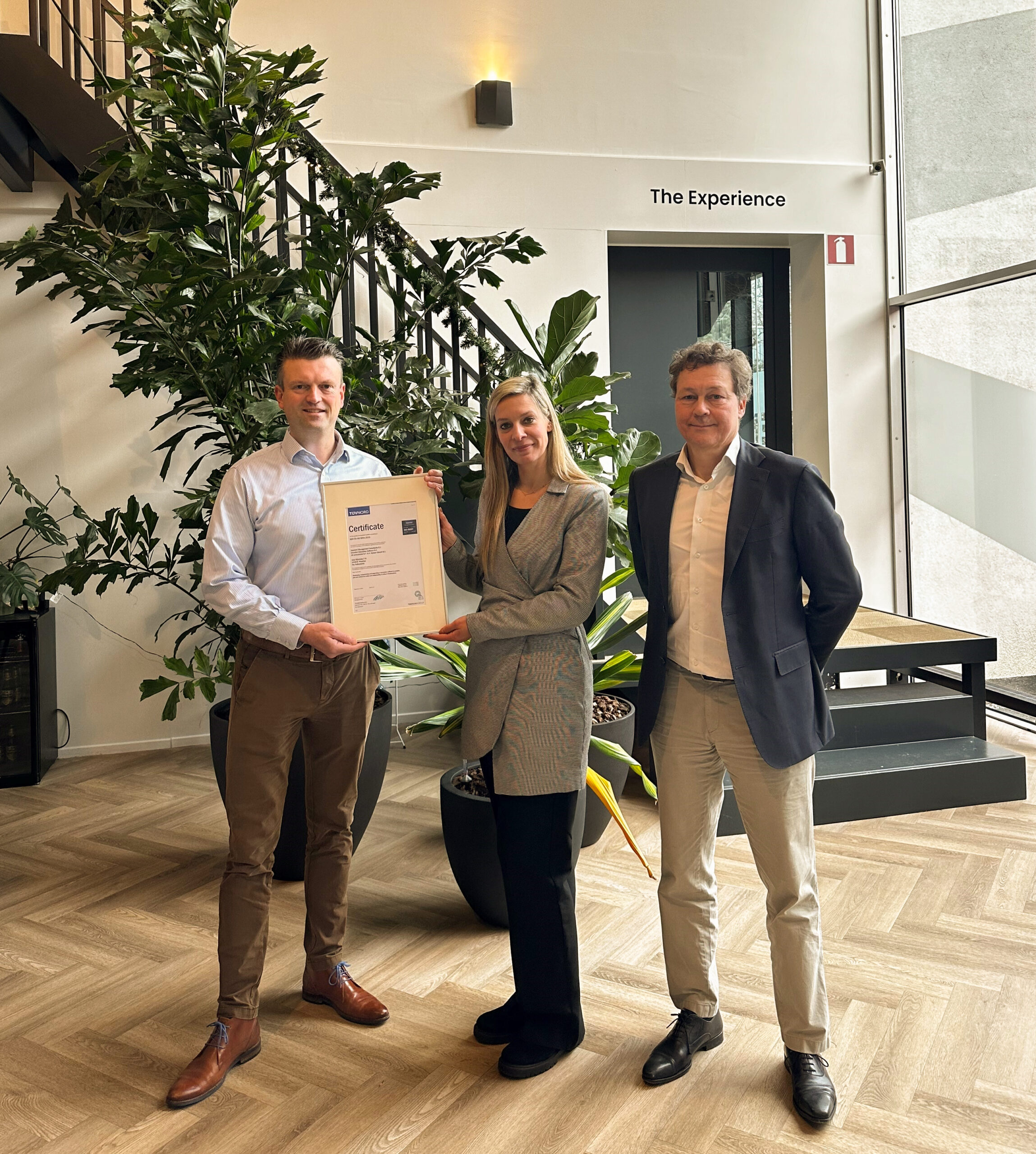
Marcia Konings of TÜV NORD Nederland officially presents the ISO 9001 Certificate.

ISO

The International Organization for Standardization, is a globally recognized organization that develops and publishes international standards. ISO 9001 specifically concerns quality management systems, setting criteria for organizations to demonstrate their commitment to delivering high-quality products and services.

www.iso.org

TÜV NORD Nederland

TÜV NORD is a technical and business service provider specializing in independent assessments such as the certification process of ISO 9001. Since 1981, they have been promoting safety, quality, reliability, and environmental well-being for organizations, government, and society.

www.tuv.nl

Enterprise Dynamics 10.6 Now Available

Enterprise Dynamics® 10.6 Now Available!

We are excited to announce the latest release of our Digital Twin simulation software, Enterprise Dynamics® 10.6.

Enterprise Dynamics® is the leading simulation software for material handling, logistics, warehousing, and manufacturing. It plays a vital role across all project phases, from design to implementation and operations.

With Enterprise Dynamics®, you gain valuable insights to facilitate well-informed decisions. It enables you to construct business cases based on your organization’s real data. Utilize its 3-D visualization capabilities to enhance systems, demonstrate the impact of various scenarios, and convey decisions in a comprehensible manner. Our software is equipped to help you address a wide range of challenges effectively.

In this latest release, our developers have worked hard to introduce new technical features and enhance user-friendliness. These improvements streamline your workflow, enabling quicker model creation.

Key Highlights Include:
  • Introducing Function Editor Atom
    Export and Import Functions. Easily transfer functions between models, saving time and improving collaboration.
  • Improved Product table availability
    Now, with updated conveyor functionality using data containers, you can store  essential information on the product table, no longer restricted by conveyor behavior.
  • Improved User Event Code Handling:
    We’ve enhanced the system to check and restore the User Event code on reset. Error-free code is restored as intended, while any errors are displayed for easy debugging.
  • Node Atom Enhancements:
    Customize travel distances for each node, improving clarity and flexibility in network setup. Easily switch between user-defined and physical distances for a better user experience.

For a comprehensive overview of the Enterprise Dynamics® 10.6 release features, download the release highlights document.

Curious about the capabilities of Enterprise Dynamics® and how it can benefit your company and customers? Feel free to contact us or try our software free of charge.

Related new items  

Digital Twin Software contributes to the warehouse of the future

Digital Twin Software contributes to the warehouse of the future

Warehouses and distribution centers are facing major challenges. During the pandemic, consumer demands increased exponentially, consumers expected short lead times, high product availability, flexibility, and variation in delivery and return options. Companies started to build up more stocks to meet those expectations during this period. Now there are large stocks, but demand is falling as a result of the high inflation.

The global supply chain has been forced to adapt quickly to changes in demand, automation can help to build safer, more productive operations and boost the ability to respond to rapid changes in demand. Warehouses turned out as crucial breaking points in the supply chain. Therefore, optimization and efficiency in this industry are very important.

To meet these expectations, warehouses need to become smarter, faster, and more flexible, but how to prepare your warehouse for the future? Promises of superfast fulfillment are leading organizations with warehouses to explore digital twin technology, enabling them to mirror the operational setting and run experiments to experience and understand how it can be optimized, and how new technologies can be rolled into play.

By 2025, 50% of the work activities could be replaced by next-level process optimization and visualization. Applications will be impacted by e.g., Robotization: Robots, Cobots (collaborative robots) and RPA (Robotic Process Automation), and Process Virtualization by Digital Twins and AI (McKinsey & Company report: Top Trends in Tech, 2020). We see simulation as an inseparable part of AI, combining visions, (historical)data, algorithms, and assumptions to get insight and therefore grip on supply chain processes.

Simulation modeling is a powerful method for designing, planning, and optimizing warehouse operations. By creating a digital twin of a warehouse, companies can design, simulate, and test within current and new warehouse operations, including (semi) automatic order picking, batching algorithms, stock allocation, (empty) tote management, tracking and tracing temporary storage, and shelving virtually.

The challenge is to achieve the most efficient warehouse operation. Simulation modeling can contribute to the selection of the best order-picking module, conveyor and sorting systems, or automated storage and retrieval systems (ASRS). Using simulation software, warehouse managers can easily plan during peak days and determine when these peak moments are. By integrating the Warehouse Management System (WMS) with the simulation model, data from the inventory can be used for accurate simulation studies.

Questions that can be easily answered using Digital Twin Software are:

  • How to deal with capacity shortages both in operation and in design?
  • How many extra Shifts and/or resources are required?
  • How much surplus capacity do you accept during the rest of the year to handle your peak day? E.g. Do you leave an entire floor empty for a whole year, which you then only use during your peak period? How and when to fill up this floor. What measures to take to ensure sufficient stock?
  • What do you do if a part of your system breaks down (contingency)?
  • What are the lead times and are they short and stable enough to ensure product safety in case of, e.g., chilled foods?
  • What is the reason to implement a shuttle system and robots.
  • How to optimize your and 3rd Party equipment, staff and logistics?

From an emulation perspective, managers can get insight into the operation. How is the performance on a peak day/period? What extra dynamics do peak days provide? For example, during special offers on black Friday, there might be flows that would normally never be seen. How to cope with these challenges?

Enterprise Dynamics® is a powerful and robust software platform that provides a Digital Twin where you can safely explore a solution without impacting day-to-day operations. By using a virtual model to validate and visualize current and future operations, optimizations and innovations will demand less costs, risks, effort and time. So, supporting maximal operational performance.

Simulation software can give insight in:

  • Overall performance
  • Steering optimization, innovation and control
  • Bottleneck detection
  • The stability of the warehouse design under different loads
  • The impact of failures on the warehouse
  • Batching algorithms
  • Stock allocation
  • Empty Tote Management
  • Implementation and scale up a shuttle system and robots
  • Required and right seize capacities.

Curious how our Digital Twin software can help to prepare your warehouse for the future? Download our free trial or contact us, we are happy to tell you about the capabilities of our software and expertise.

Related news articles

The Role of ERTMS in Transforming Europe’s Railway System

Simulation contributes to the future of Rail Transport

The railway industry is expected to experience steady growth in the foreseeable future. According to the European Rail Research Advisory Council (ERRAC), the railway sector will become the backbone of Europe’s sustainable mobility system, serving both passengers and freight. For passengers, the railway system must provide seamless access to a variety of sustainable door-to-door mobility options. For freight, the goal is to transform rail freight into a highly efficient and sustainable backbone transport system for Europe’s multimodal logistics industry. However, to achieve this vision and increase transportation demand, innovative measures are required.

One significant challenge facing the railway industry is the implementation of the European Rail Traffic Management System (ERTMS). ERTMS is a unique train control system in Europe that aims to gradually replace incompatible systems in the region. The deployment of ERTMS will enable the creation of a seamless European railway system and increase European railway competitiveness. By improving the competitiveness of the rail sector, ERTMS helps to level the playing field with road and air transport bringing substantial environmental gains. Global railway companies are interested in this European leap forward.

This transition will benefit the railway industry by improving international freight and passenger transport. ERTMS offers several advantages, including cost-effective maintenance, increased safety, reliability, punctuality, and traffic capacity, which will help achieve the vision of a sustainable railway industry.

Contribution of Simulation

The transition from an analog to a digital system requires a lot from the sector and is a major task. ProRail, the Dutch infrastructure company, uses The Flexible Rail Infra Simulation of Operations (FRISO) Application developed by InControl to evaluate the effect of innovative measures and systems before putting them into practice. After implementation, the new technology will be integrally monitored by FRISO as well.

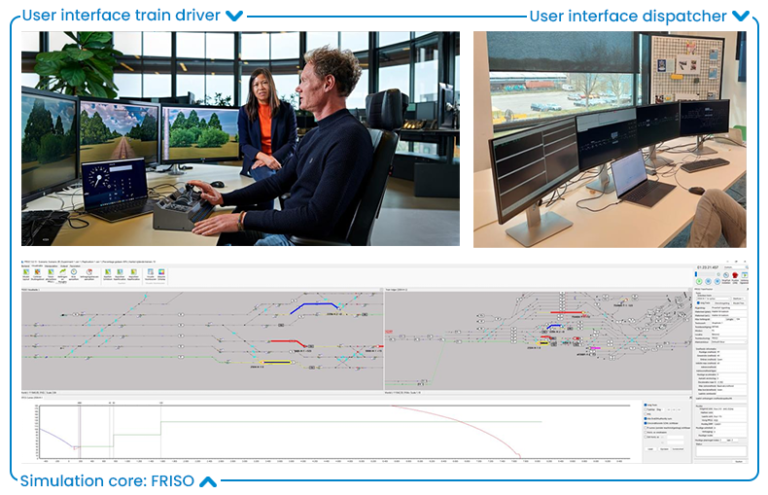
To investigate the impact of ERTMS and technical leaps, ProRail launched the SiGMaT (Simulation of Driver and Train Dispatcher User Processes) project. By using simulation the impact of ERTMS and in particular, ERTMS user processes will be investigated. ERTMS user processes describe the interaction between technology, the driver, the train dispatcher, and other users. As the supplier of simulation software, InControl is proud to contribute to the development of the Simulation environment for the SiGMaT Project.

ERTMS Development Simulation Suite

ERTMS in The Netherlands

The Operational Knowledge Centre ERTMS (OKE) aims to involve users in the preparation and implementation of ERTMS in the Netherlands. By testing ERTMS user processes with railway employees for situations where ERTMS is in use, the system can be tested to ensure that it really works in the future.

In the twelfth edition of the ERTMS OKE Talkshow “I ❤️ User Processes”, viewers are taken into the world of ERTMS user processes. In an interview with Jos Schoenmaker (project manager at ProRail ICT), the SiGMaT project is discussed, in which the EOSS (ERTMS Development Simulation Suite) simulation environment is used to perform system analyses to test ERTMS user processes.

Jos Schoenmaker outlines the SiGMaT project’s objective of connecting the world of train drivers and dispatchers by simulating user processes. The project entails a collaborative effort among experts from various carriers, OKE, ProRail, and four external parties, with InControl being one of them.

The FRISO application forms the simulation core, simulating systems to be developed and expanded in the ERTMS field. By combining the train driver and dispatcher’s worlds, the simulation can closely mirror reality.

The key benefit of simulation is that it allows for a thorough evaluation of the proposed ERTMS implementation, enabling stakeholders to assess its feasibility and identify any issues and challenges beforehand.

Watch the full episode here, please note that the talk show is in Dutch:

Related news articles

InControl Enterprise Dynamics appoints new CEO for EMEA

InControl Enterprise Dynamics appoints new CEO for EMEA.

Woerden, January 31st 

Louis Schijve, the founder and owner of InControl Enterprise Dynamics, is stepping down as CEO of the company after a period of 34 years. The board of directors is pleased to announce the appointment of Geert-Jan van Nunen as the new CEO for the EMEA region. Geert-Jan is a seasoned manager with a proven track record of implementation and growth of software and platform technologies in the telecom and automotive industries.

Before joining InControl, Geert-Jan held various management positions. Understanding technology to accelerate business growth has been central to his career. Experienced with IoT, AI, platform technology, and integrated software systems. Previously he grew businesses from scratch to multimillion revenues. In his most recent role, he was responsible for the growth of a German AI technology scale-up.

geert-jan van nunen

Geert-Jan van Nunen. CEO InControl Enterprise Dynamics EMEA region.

His mission is growing InControl as a partner of choice for customers that use digital simulation and digital twins as tools to better plan and operate their core processes; and to establish InControl as the leading emulation and simulation software provider for large-scale and complex operations.

“We are happy to have Geert-Jan van Nunen as the new CEO for EMEA. He is a proven leader with the vision and experience to expand on the success that InControl has been building over the past 34 years and take the company into its next phase of growth and innovation.”

 –  Louis Schijve, Founder and Chairman of the board of directors  – 

About InControl Enterprise Dynamics

InControl Enterprise Dynamics is a global software company that provides simulation software and services for the safety and sustainability of critical infrastructures such as warehouses, manufacturing plants, logistics, airports, railroads, border control, public events, etc. By accurately simulating the flow of people and goods we enable our clients to better plan and optimize their core business processes making their business more efficient, robust, and safer. InControl’s Simulation Platform delivers customers essential insights to continuously improve and optimize complex infrastructures and physical business processes.

Find more information about our software here.

Related news articles

Simulation contributes to the future of Rail Transport

Simulation contributes to the future of Rail Transport

For over 30 years, InControl develops innovative customized railway-traffic simulators and is an expert in railway simulation. InControl’s simulation software platform enables the development of applications. One example is a high-performance railway application designed, built, and maintained by InControl for organizations responsible for rail infrastructures and passengers. It supports the decisions related to system (future) performances and the effects of innovations. At this moment rail organizations have to implement efficiency and security-related programs like ERTMS*, ATO*, or TMS* and passenger flows at public transport hubs in cities and metropole areas.

InControl’s Dutch railway simulator application called “FRISO” is developed for ProRail, the Dutch infrastructure company. It allows users to simulate and visualize large networks on a microscopic level including tracks, switches, signals, etc. The application supports users by automatic generation of a complete simulation model based on several databases. The benefits are valid data and information provisioning in a short timeframe. Visualization of the (sub)systems, insights into conflicting planning of rolling stock and staff, and multi-organizational and discipline staff training are part of the application services.

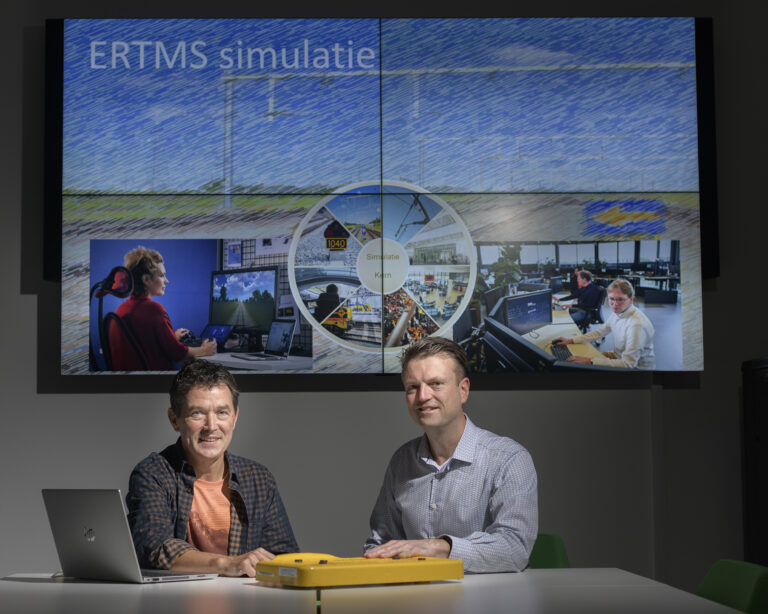
ERTMS affects the entire rail sector, so collaboration is a must. How does that work in practice? Last month, Joris Steneker, Team Manager Public Transport at InControl, and Dick Middelkoop, Program Manager ProRail Innovation, were invited by ERTMS Flash to discuss the long-lasting relationship. The original interview is in Dutch, for the English version please click here.

Source: Text Eveline Bets and foto Fokke Eenhoorn

Het ideale samenwerkingsmodel (geen simulatie, maar realiteit)
ERTMS raakt de hele spoorsector, dus samenwerken is een must. Hoe gaat dat in de praktijk?

Source: Fokke Eenhoorn

Hoe kennen jullie elkaar?
Dick
: “Als programmamanager Modelontwikkeling houd ik me bezig met de ontwikkeling van simulatiemodellen en optimalisatievraagstukken. ProRail heeft een lange geschiedenis in simulaties, maar onze software was niet goed ingericht op de steeds complexere ontwikkelingen. Toen we jaren geleden op zoek gingen naar een flexibeler systeem met meer mogelijkheden, kwamen we terecht bij een platform dat is ontwikkeld door InControl.”

Joris: “Ik kwam er later bij, in 2006 geloof ik, toen ik als teammanager Public Transport verantwoordelijk werd voor simulatiemodellen voor onder andere het spoor.”


Aan welke simulatie(s) werken jullie op dit moment?
Joris
: “Actueel is een groot project waarin we de ERTMS-gebruikersprocessen hebben nagebouwd in een simulator. Doel is het valideren van die processen, en betere communicatie tussen machinist en treindienstleider. De simulator bootst de treindienst na in een soort 3D-omgeving van het spoor.”

Dick: “Het gaat dus om testen of we het goed hebben uitgedacht, nog niet om het trainen van de mensen die ermee gaan werken. Dat komt later.”


Kunnen jullie het doel van de samenwerking omschrijven?
Dick
: “Ons doel is dat we op een efficiënte manier de toekomst van het spoor in beeld brengen en zo kunnen beleven, en dat we inzicht krijgen in die complexiteit.”

Joris: “Ja, dus gezamenlijk dingen beproeven en ontwikkelen. Dat is ook de kracht van simulatie. Een mooi voorbeeld is dat we na zo’n sessie van machinisten en treindienstleiders terugkregen: ‘Nou, dat ga ik in de praktijk nooit zo doen.’”

Dick: “Of omgekeerd: ‘Dit scenario is niet goed, kunnen we dat nog aanpassen?’ Dat vond ik een mooie les. Het werkt dus twee kanten op. Zo verbeteren we de praktijk.”

Joris: “En daar worden we heel blij van!”

Kom je ook knelpunten tegen en zo ja: hoe lossen jullie dit op?
Dick
: “Ja, mijn werk is een leuke, maar uitdagende puzzel. Dat vraagt om chemie in de samenwerking en gebruik maken van elkaars kwaliteiten.”

Joris: “ProRail stelt ons soms uitdagende vragen. Bijvoorbeeld: ontwikkel een wiskundig optimalisatie-algoritme voor Automatic Train Operation. Dan is het best spannend of we dat ook kunnen leveren.”

Dick: “Meestal leidt het tot goede resultaten. Of het valt nu nog niet in goede aarde, maar later wel. Dan zijn we onze tijd vooruit.”

Wat is er volgens jullie nodig voor goede samenwerking? En zie je dat terug bij elkaar?
Dick
: “Eerlijkheid, duidelijkheid, een open houding, doen wat je zegt.”

Joris: “Ja, Dick is inderdaad open en duidelijk. Er is daarnaast ruimte voor creativiteit, dat vind ik ook belangrijk.”

Dick: “Joris doet wat hij belooft. En hij verrast mij niet alleen met zijn diepgaande inhoudelijke kennis, maar kan ook uitleggen dat niet alles wat ik wil als opdrachtgever relevant is.”

Joris: “Dick heeft ook veel kennis en stelt kritische vragen. En hij kan mensen overtuigen. Ik vind Dick wel een echte ambassadeur. Het leukste is als we samen aan anderen enthousiast vertellen wat we doen!”

Tot slot: kunnen jullie samen door 1 deur? Waarom?
Dick
: “Zeker. Omdat we niet bang zijn een beetje in te schikken als die deur, laten we zeggen, wat smal zou zijn.”

Joris: “Dan proberen we die deur breder te maken.”

Dick: “Zodat er nog meer mensen mee kunnen lopen.”

English version:

The ideal collaboration model (not simulation, but reality)
ERTMS affects the entire rail sector, so collaboration is a must. How does that work in practice?

Source: Fokke Eenhoorn

How do you know each other?
Dick
: “As a Model Development program manager, I am involved in the development of simulation models and optimization issues. ProRail has a long history in simulations, but our software was not well equipped for the increasingly complex developments. Years ago, when we were looking for a more flexible system with more options, we ended up with a platform developed by InControl.”

Joris: “I joined later, in 2006 I believe, when I became responsible for simulation models for rail, among other things, as team manager Public Transport.”

Which simulation(s) are you currently working on?
Joris: “Currently we are involved in a major project in which we have recreated the ERTMS user processes in a simulator. The aim is to validate those processes and improve communication between the train driver and train traffic controller. The simulator simulates the train service in a kind of 3D environment in which the railway system is modelled.”

Dick: “It is therefore about testing whether we have thought it through properly, not yet about training the people who will work with it. That will come later.”

Can you describe the purpose of the collaboration?
Dick
: “Our goal is to visualize and experience the future of rail in an efficient way, and to gain insight into that complexity.”

Joris: “Yes, so testing and developing things together. That is also the power of simulation. A good example is that after such a session we received feedback from drivers and train controllers: ‘Well, I will never do that in practice.'”

Dick: “Or vice versa: ‘This scenario is not good; can we still adjust it?’ I thought that was a good lesson. So, it works both ways. This is how we improve practice.”

Joris: “And that makes us very happy!”

Do you also encounter bottlenecks and if so: how do you solve them?
Dick: “Yes, my work is a fun, but challenging puzzle. That requires chemistry in the collaboration and making use of each other’s qualities.”

Joris: “ProRail sometimes asks us challenging questions. For example: develop a mathematical optimization algorithm for Automatic Train Operation. Then it is quite exciting whether we can also deliver that.”

Dick: “It usually leads to good results. Or it may not be well received now, but it will later. Then we are ahead of our time.”

What do you think is necessary for good cooperation? And do you see that back together?
Dick
: “Honesty, clarity, an open attitude, do what you say.”

Joris: “Yes, Dick is indeed open and clear. There is also room for creativity, which is also important to me.”

Dick: “Joris does what he promises. And he not only surprises me with his in-depth substantive knowledge but can also explain that not everything I want as a client is relevant.”

Joris: “Dick also has a lot of knowledge and asks critical questions. And he can convince people. I think Dick is a real ambassador. The best part is when we enthusiastically tell others about what we do!”

Finally: Are you both on good terms with each other? Why?
Dick
: “Certainly, because neither of us is afraid to compromise a little if necessary.”

Joris: “Then we try to create more space for each other.”

Dick: “So that in the end more people can join us and benefit from our efforts.”

Abbreviations:
* ERTMS: European Rail Traffic Management System
* ATO: Automatic Train Operation
* TMS: Traffic Management System

Are you interested in our contributions to the Rail Transportation Industry? Contact us, we are happy to tell you more about our expertise and experience.

Related news articles