Virtual Commissioning: Facilitating Industrial Automation

Expert Insights Series: AI and Digital Twins in shaping the future of Supply Chains.

Virtual Commissioning: Facilitating Industrial Automation

Enterprise Resource Planning (ERP) systems are essential for modern warehouse and supply chain operations. Boehringer Ingelheim, a global pharmaceutical company, faced challenges in optimizing its logistics and warehouse operations. To address these issues, the company decided to use “virtual commissioning” as part of its SAP ERP implementation. This article explains how virtual commissioning works and what the benefits of this approach for Boehringer Ingelheim were.

What is a digital twin?

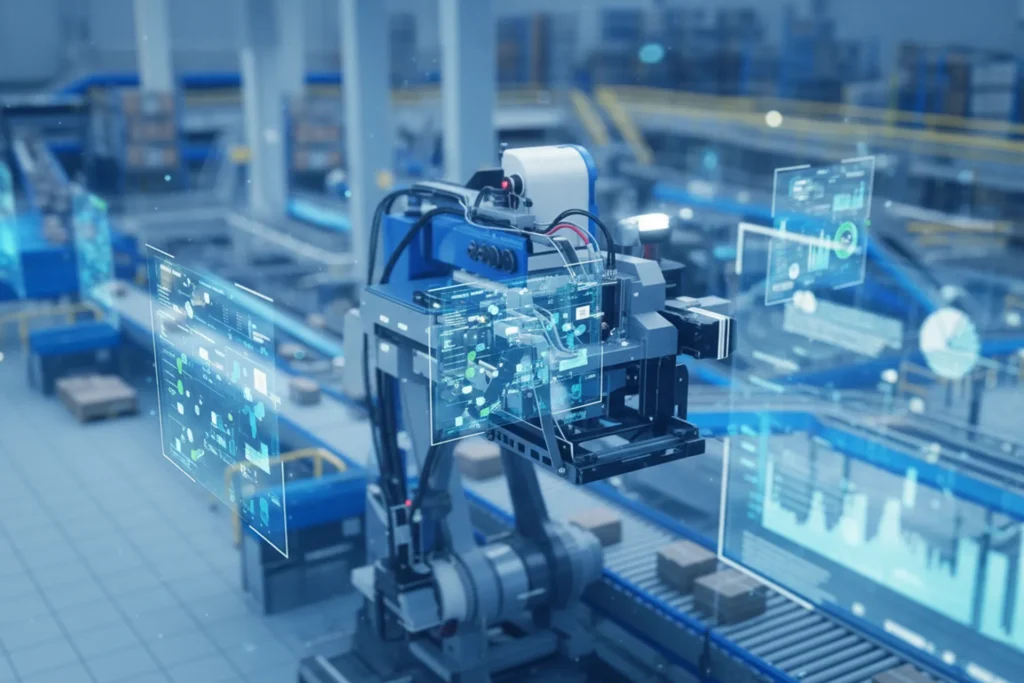
A digital twin is a copy of reality that mirrors real-world operations, allowing businesses to plan, test, and control scenarios and select the optimal configuration.

Using Enterprise Dynamics® from InControl, a Digital Twin of the warehouse was created. This allowed the company to test various “what-if” scenarios, analyze bottlenecks, and optimize processes before implementing changes in the real-world environment.

What is Virtual Commissioning?

Virtual commissioning is a cutting-edge approach that integrates digital simulation and emulation tools with industrial control systems. It is an integration of physical and digital worlds and it allows businesses to test, optimize, and validate material flow and logistics operations before actually deploying physical systems.

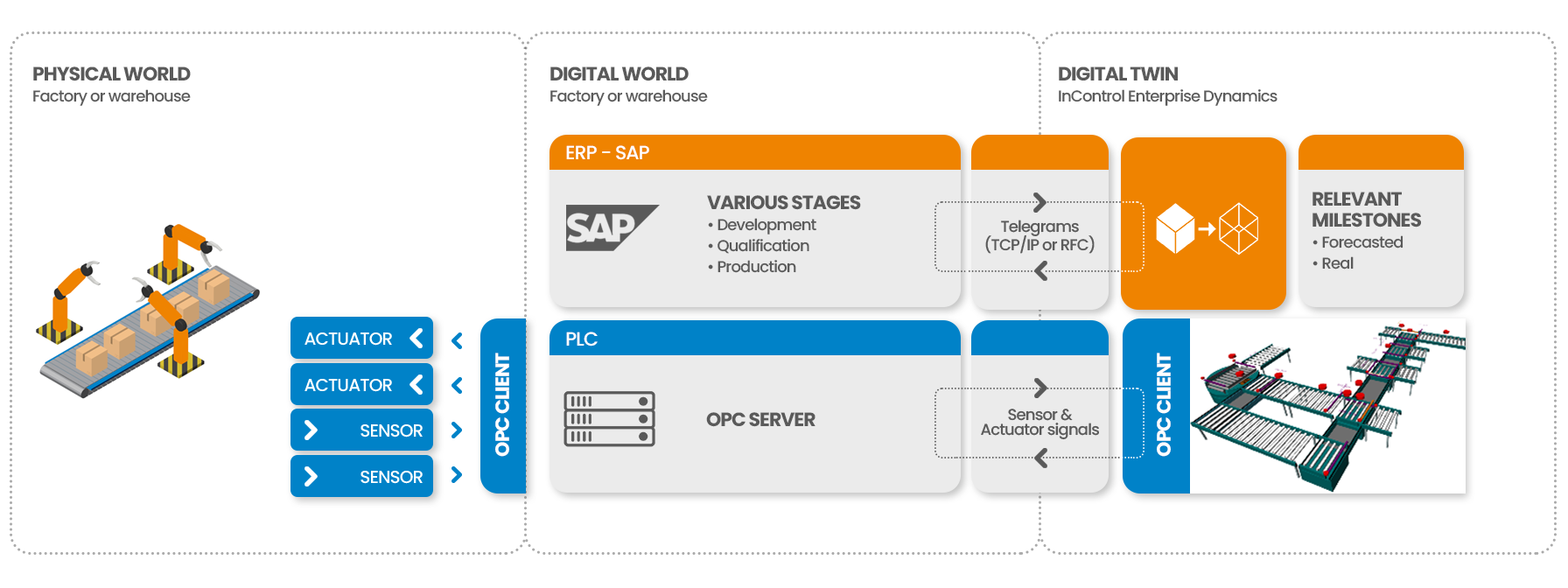
By creating a digital twin, virtual commissioning enables seamless interaction between enterprise resource planning (ERP) systems, material flow controllers (MFCs), and programmable logic controllers (PLCs), ensuring a smooth transition from design to operational execution. This removes the need to implement and test all the logic and communication between the ERP system on one side and the physical machines in the factory or warehouse.

How Virtual Commissioning Works

Virtual Commissioning is the process of testing and validating control systems, automation logic, and mechanical designs in a virtual environment before deploying them in the real world. Finding and solving bugs will happen much more efficiently in a digital environment instead of in – a more expensive – real production environment.
Testing Through Virtual Commissioning enabled Boehringer to:

  • Conduct intensive testing of control software before deployment.
  • Validate system performance and ensure seamless PLC (Programmable Logic Controller) integration.
  • Identify and rectify errors early in the development phase, reducing the risk of costly post-deployment modifications.

SAP ERP Integration with Material Flow Control (MFC)

The SAP EWM-MFC (Extended Warehouse Management – Material Flow Control) system was integrated with the simulation model based on Enterprise Dynamics. The integration works as follows:

  • A material flow computer (MFC) receives transport orders from ERP systems (e.g., SAP EWM-MFC) to manage inventory and warehouse logistics.
  • Communication occurs at the telegram level, where transport orders define movements of loading devices within the system.
  • The simulation model integrates PLC logic, allowing real-time testing and validation of control algorithms.
  • Mixed simulation approaches enable hybrid testing by incorporating physical PLCs for some system areas while relying on digital models for others.

Business Benefits of Virtual Commissioning

Implementing virtual commissioning delivers significant advantages:

  • Time Savings: Faster commissioning leads to earlier operational readiness, reducing downtime and expediting production launches.
  • Cost Reduction: Businesses lower testing and commissioning expenses by identifying and resolving issues before deployment.
  • Risk Mitigation: Simulated testing prevents costly errors, ensuring all system elements function as expected before physical implementation.

Real-World Application with InControl’s Digital Twin

InControl’s Enterprise Dynamics® platform facilitates virtual commissioning by integrating:

  • Control Level: PLC logic and sensor-actuator interactions.
  • Process Control Level: Material flow and system-wide data exchange.
  • Production Control Level: Integration with ERP/MES systems for a seamless digital transformation.

This holistic approach enables businesses to simulate warehouse layouts, optimize logistics chains, and test automation solutions before physical implementation, leading to improved efficiency and reduced operational costs.

Implementing SAP in a live production environment comes with high demands and inherent risks. With InControl’s Digital Twin, we were able to thoroughly and risk-free test this complex process. This resulted in significant time and cost savings and a flawless commissioning.

Boehringer Pharma GmbH & Co. KG

Conclusion

The SAP EWM implementation at Boehringer, based on virtual commissioning and digital twin technology, sets a benchmark for modern warehouse and logistics optimization. Virtual commissioning reduces costs and time in SAP EWM implementations by bridging the gap between physical and digital operations. Companies leveraging this technology can achieve faster commissioning, lower resource consumption, and minimized downtime.

With Enterprise Dynamics® from InControl, businesses gain a competitive edge by enhancing reliability, scalability, and operational efficiency through data-driven decision-making. As industrial digitalization advances, virtual commissioning is set to become the standard solution for ERP implementations.

Learn more about AI, Digital Twins & Simulation

Explore our Expert Insights Series — a concise collection of articles on the latest in industrial automation, digital twins, AI, and simulation. Discover how these technologies are transforming manufacturing, logistics, and supply chains with real-world impact.

AI and Simulation: A Powerful Combination for Smart Supply Chains

Expert Insights Series: AI and Digital Twins in shaping the future of Supply Chains.

AI and Simulation: A Powerful Combination for Smart Supply Chains

As AI continues to revolutionize industries, its integration with simulation tools is opening new doors for efficiency, risk management, and decision-making in supply chains. We spoke with Kees van der Klauw, former Chairman of the Netherlands AI Coalition and former Research Executive at Philips, about the synergy between AI and simulation, and what the future holds for smart supply chains.

Can you share your background and how you became involved in AI and innovation?

My career started at Philips, where I was involved in digital transformations across various domains—semiconductors, LCD displays, TV innovations, and LED lighting systems. Over a decade ago, in Philips Research, we already explored AI applications such as automated design of electronic circuits and customer preference analysis. Later, I played a key role in establishing AIOTI (now a leading IoT and Edge Computing initiative) and led the strategy and development of the Netherlands AI Coalition. This coalition now consists of over 500 parties and nearly 2,000 experts working on AI applications across multiple industries.

What is simulation? What is AI? How do they complement each other?

Simulation is used to predict outcomes in scenarios that are too complex, costly, or risky to test in real life. With advancements in computing power, we can now create highly detailed simulations, but they still require strong domain knowledge. AI, on the other hand, is built on statistical models trained on massive datasets. While simulation models are generally based on known physical principles, AI finds correlations within data, sometimes revealing hidden insights. The great opportunity we now have is not to replace the one with the other but to augment simulation models (which usually have a very limited number of parameters) with AI algorithms that add statistical intelligence on effects that until now were too complex or simply unnoticed to include in simulation tools.

Where does AI running on a digital twin differ from AI running on raw input data?

Many AI models are trained on large datasets to detect patterns and correlations, but this does not necessarily mean they understand causal relationships. Training AI solely on raw data requires extensive resources, while digital twins integrate domain knowledge, providing faster, more accurate, and explainable insights. By combining AI with simulation models, we leverage expert knowledge for efficient and precise system behavior predictions. This hybrid approach enables accurate manufacturing simulations while accounting for unpredictable factors like human behavior or equipment failures, ultimately leading to smarter decision-making.

How is simulation shaping supply chain management, and how will AI enhance it?

Simulation has already revolutionized the supply chain industry, particularly in material handling and manufacturing, where internal goods flow management relies heavily on simulation models. Today, these models extend across multiple production sites, enabling integrated and efficient operations. Smart Industry initiatives further enhance this by facilitating programmable manufacturing lines where production stages communicate seamlessly. In complex assembly lines with multiple suppliers, ship-to-line logistics has become a standard practice.

Optimizing logistics—covering warehouse space utilization, cycle times, time-critical deliveries, loading, transport costs, and more—is achievable through simulation. However, a key challenge remains: various stages, sites, machines, and transport systems are often managed by different entities and suppliers. Since these elements are not always part of a unified simulation model, fine-tuning is essential to ensure accuracy. To achieve this, models must be parametrically adjustable, tuned by domain experts, and supported by strong data-sharing collaboration across the value chain. This need for seamless data exchange becomes even more critical with AI integration.

With advancements in AI, we will soon be able to create highly accurate digital twins of complex logistics flows—both within individual companies and across entire supply chains. These digital twins will not only drive efficiency and support risk analysis but also act as real-time decision-making companions during supply chain disruptions. Beyond optimizing logistics, AI-powered simulation will contribute to sustainability by tracking CO₂ footprints, improving reliability and flexibility, and ensuring compliance with regulations.

How can the combination of AI and simulation improve decision-making?

Simulation provides outcomes based on set parameters, but human decision-makers must still interpret the results, considering aspects like regulations, financial risks, and operational constraints. AI can enhance this process by augmenting simulation engines with AI models (not replacing them), creating comprehensive digital twins that support real-time, data-driven decision-making.

AI is not just an efficiency tool – it is a competitive necessity.

What industries are leading the way in AI and simulation innovation?

Advancements are happening across many industries, but the most impactful innovations transform tedious yet expertise-driven tasks. Key sectors benefiting from AI include logistics, manufacturing, healthcare, cybersecurity, and energy. AI is optimizing everything from transportation flows to medical diagnostics, driving efficiency and accuracy. There is also an impressive contribution by AI in advertising and marketing and administrative processes.

However, because data usage is subject to privacy and security regulations, AI adoption is progressing fastest in less sensitive areas—focusing on machines rather than personal data. In supply chain management, the potential is enormous, offering opportunities to enhance efficiency, resilience, and decision-making on an unprecedented scale.

What excites you most about AI developments in simulation software?

While there is a lot of hype around generative AI and large language models, I believe the most meaningful advancements will come from dedicated machine learning models tailored to specific fields such as supply chain management, healthcare diagnostics and drug development, education, security, energy, and transportation. Machine Learning will drive major improvements in efficiency, quality, and cost reduction by automating tedious human tasks. Additionally, I foresee AI-powered simulation tools becoming more efficient, running on small-footprint systems rather than energy-intensive data centers.

This could mean local servers within companies or even AI-driven IoT devices embedded in equipment or transport vehicles. Such a distributed approach offers significant advantages, including enhanced cybersecurity, resilience, and in energy management, making AI adoption more sustainable and practical across industries.

How do you see AI contributing to sustainability in supply chain operations?

Sustainability is complex, often requiring trade-offs between different environmental and economic factors. AI models can process large-scale, statistical data to develop more holistic sustainability strategies. By integrating AI with simulation, businesses can automate environmental impact assessments, optimize energy usage, and improve waste management.

The great opportunity we now have is not to replace the one with the other but to augment simulation models (which usually have a very limited number of parameters) with AI algorithms that add statistical intelligence on effects that until now were too complex or simply unnoticed to include in simulation tools.

What are the biggest challenges companies face when integrating AI into their systems?

The primary challenge is the availability and quality of data to train AI systems. Many companies struggle to collect and extract meaningful insights from dispersed systems. Key data—such as machine uptime, cycle times, and waiting times for transport robots—often remains siloed and underutilized.

Another challenge is acquiring the right expertise. Companies typically need to bring in data scientists or partner with startups, as existing personnel may lack the specialized skills for AI projects. At the same time, experienced employees are vital for identifying high-value use cases and offering domain knowledge.

Finally, strong management commitment is crucial. Leaders must educate themselves on AI’s broader implications, including dependencies on external platforms and control over key business processes, rather than simply following trends.

However, because data usage is subject to privacy and security regulations, AI adoption is progressing fastest in less sensitive areas—focusing on machines rather than personal data. In supply chain management, the potential is enormous, offering opportunities to enhance efficiency, resilience, and decision-making on an unprecedented scale.

What key skills should companies develop to maximize AI in simulation?

Companies should first master simulation for their core processes, ensuring that AI enhances rather than replaces their models. Additionally, data management expertise is crucial, as AI depends on high-quality data. Businesses must also educate employees on AI’s role helping them in their daily work, fostering a culture of data-driven decision-making.

This could mean local servers within companies or even AI-driven IoT devices embedded in equipment or transport vehicles. Such a distributed approach offers significant advantages, including enhanced cybersecurity, resilience, and in energy management, making AI adoption more sustainable and practical across industries.

With advancements in AI, we will soon be able to create highly accurate digital twins of complex logistics flows—both within individual companies and across entire supply chains.

What are the biggest pitfalls executives should watch for?

Executives must differentiate between primary and secondary processes when applying AI. For example, using AI for marketing content generation is a low-risk secondary process, while using AI in core operations—such as supply chain optimization—requires deep expertise and business control. Another pitfall is relying too heavily on external AI platforms, which can create long-term dependencies instead of offering real competitive advantages for one’s business.

What if companies do not adopt AI technology?

AI is not just an efficiency tool—it is a competitive necessity. Companies that fail to adopt AI risk losing market relevance as AI-powered competitors optimize costs, mitigate risks, and unlock new business models. However, adopting AI should be strategic, ensuring it enhances core competencies rather than creating dependencies.

Final Toughts

AI and simulation are not competing technologies—they are complementary tools that, when combined, create more accurate, scalable, and intelligent digital twins. As businesses navigate an increasingly complex and unpredictable world, AI-enhanced simulation will be a game-changer for supply chain optimization, sustainability, and decision-making.

With AI advancing rapidly, companies must embrace innovation, invest in expertise, and develop a data-driven strategy to stay ahead in the ever-evolving supply chain landscape.

Learn more about AI, Digital Twins & Simulation

Explore our Expert Insights Series — a concise collection of articles on the latest in industrial automation, digital twins, AI, and simulation. Discover how these technologies are transforming manufacturing, logistics, and supply chains with real-world impact.

Digital Twins Revolution: Transforming Airport Management

Digital Twins Revolution: Transforming Airport Management by InControl and Business Partners

The Evolving Aviation Landscape

The global aviation industry is soaring back to pre-pandemic levels, and the future promises even more expansion. In North America, the FAA predicts that U.S. commercial air travel will grow at a steady 2.6% annually, surpassing 1 billion passengers by 2033. Meanwhile, Dubai International Airport is preparing to accommodate over 90 million passengers annually by 2026, reinforcing the Middle East’s role as a pivotal global hub.

Across the Pacific, China’s aviation market is on track to become the world’s largest by 2035, with passenger numbers tripling compared to pre-pandemic levels. Europe, despite its mature infrastructure, anticipates a 50% surge in air travel by 2040—posing challenges for already congested facilities. Latin America, too, is experiencing unprecedented growth. Mexico, for instance, is set to double its passenger movements to 137 million by 2043.

Yet, this expansion does not come without its challenges. The aviation industry is undergoing a transformation: the shift toward net-zero emissions, the emergence of electric aircraft and advanced air mobility, and a new era of passenger expectations—all demanding smarter, more agile airport management.

The Strategic Agility Imperative

Airport operators must embrace a new kind of strategic agility to navigate these evolving demands. This means not just reacting to change but staying ahead of it:

  • They must anticipate capacity needs across all operational areas, ensuring they’re ready for fluctuating passenger volumes.
  • When disruptions arise—whether from weather, security incidents, or staffing shortages—airports must adapt quickly and efficiently to minimize delays.
  • Airports can no longer operate in isolation. Coordinating at a network level, rather than optimizing a single facility, will be key to sustaining smooth global travel.
  • The airports that will thrive are those that can continuously evolve, leveraging real-time intelligence to enhance operations.

From Reactive to Proactive: A Data-Driven Approach to Airport Management

Imagine an airport where every decision—whether about passenger flow, baggage handling, or security checkpoints—is driven by real-time data. Instead of reacting to problems as they arise, airport managers anticipate bottlenecks before they happen. Delays are minimized, staff is deployed efficiently, and passenger journeys are seamless.

This is the impact of Total Airport Management (TAM), supported by Digital Twin technology. By integrating real-time data from airside, landside, and terminal operations, airports can transition from a fragmented approach to a unified, data-informed ecosystem.

With predictive analytics, an airport can foresee potential congestion points—whether at security lines or immigration—and resolve them before passengers even notice an issue. Scenario modelling allows operators to test different strategies in a risk-free virtual environment, evaluating how changes in staffing or gate assignments might impact efficiency.

Cross-functional teams gain a shared situational awareness, ensuring that from the control tower to the check-in counter, everyone is working towards the same operational goals. Performance indicators are continuously tracked, aligning airport management with broader strategic objectives.

The Seamless Journey: Engineering Exceptional Passenger Experiences

For today’s PAX, efficiency isn’t enough—they want a seamless, stress-free experience from booking their flight to arriving at their final destination. But what does that really mean?

Consider a PAX arriving at a major international airport. Instead of long queues, they breeze through security, thanks to biometric verification. Their luggage is tracked in real-time via an app, giving them confidence it will arrive at their final destination. Smart wayfinding guides them intuitively through the airport, eliminating the confusion of navigating a complex terminal.

Waiting time becomes value-added time—instead of frustration, the passenger enjoys well-designed lounges, personalized retail options, and entertainment experiences tailored to their interests. Even during disruptions, airports maintain service quality through proactive rescheduling and instant communication.

Digital Twin Simulation for Airports: A Game-Changer in Decision-Making

To make this seamless experience a reality, airports need powerful tools that help them predict and prepare for any scenario. This is where InControl’s digital twin simulation comes in.

With over 26 years of expertise in airport operations, InControl offers an advanced simulation platform that allows airport operators to test, visualize, and optimize every aspect of their ecosystem before making real-world investments.

Using historical data, real-time inputs, and predictive algorithms, this digital twin provides a risk-free environment to experiment with changes before implementing them. Whether it’s baggage handling, border control, cargo operations, or multimodal transportation, the platform ensures airports operate at peak efficiency.

Key capabilities:

Comprehensive system modeling
Digital representations of all airport subsystems allow simulations of complex interactions, such as how passenger flow affects baggage handling or how infrastructure constraints impact turnaround times

Predictive scenario planning
By analyzing historical trends and real-time data, airports can forecast the impact of operational strategies before executing them.

Resource optimization
Airports can fine-tune staffing, equipment deployment, and facility usage to balance operational efficiency with passenger comfort.

Future Ready
With this technology, airports can confidently enhance efficiency, reduce costs, and improve passenger satisfaction—all while preparing for the future.

The Power of Integrated Expertise:
A Collaborative Approach to Solving Complex Challenges

Transforming airport operations isn’t just about technology—it requires the right mix of expertise. That’s why InControl Enterprise Dynamics has partnered with Boosten Consultancy, EDUMATECH, and Mijksenaar, creating a powerhouse team that combines:

InControl

Cutting-edge simulation technology

Boosten Consultancy

Strategic consulting to align digital twin insights with business objectives

Mijksenaar

Human-centered design to optimize passenger flow and airport usability

Together, this partnership delivers both data-driven insights and strategic decision-making support, ensuring that every change benefits both operational efficiency and human experience.

At an operational level, real-time data integrated with predictive models enables airports to continuously adjust staff schedules, equipment deployment, and facility usage—ensuring resources are allocated where they’re needed most.

And most importantly, the human element is never forgotten. Whether designing intuitive wayfinding systems, creating efficient work environments for airport staff, or engaging stakeholders in long-term planning, this approach ensures that airports remain people-centric, despite their increasing complexity.

The Way Forward: Building the Airports of Tomorrow, Today

As global airports face mounting pressure to expand, enhance sustainability, and improve passenger experiences, digital twin technology presents a transformative solution. By leveraging advanced simulation, strategic consulting, and human-centred design, airport operators can build facilities that are not only efficient and profitable but also adaptable to the ever-changing demands of the future.

Through cross-disciplinary collaboration and cutting-edge technology, InControl and its partners are shaping the next generation of airports—ones that seamlessly connect people with their destinations while delivering exceptional experiences along the way.

Contact information

To learn more about how digital twin technology and total airport management can transform your airport operations, connect with the experts:

Frank van Poeteren
InControl Enterprise Dynamics
Frank.van.Poeteren@incontrolsim.com

Geert Boosten
Boosten Consultancy
Geert.Boosten@boostenconsultancy.nl

Aad Kalkman
Mijksenaar
Kalkman@mijksenaar.com

Enterprise Dynamics 10.6.1

Introducing Enterprise Dynamics® 10.6.1: Discover What's New

We are excited to announce the latest release of our Digital Twin simulation software, Enterprise Dynamics® 10.6.1.

Enterprise Dynamics® is the leading simulation software for material handling, logistics, warehousing, and manufacturing. It plays a vital role across all project phases, from design to implementation and operations.

With Enterprise Dynamics®, you gain valuable insights to facilitate well-informed decisions. It enables you to construct business cases based on your organization’s real data. Utilize its 3-D visualization capabilities to enhance systems, demonstrate the impact of various scenarios, and convey decisions in a comprehensible manner. Our software is equipped to help you address a wide range of challenges effectively.

In version 10.6.1, we’ve introduced new technical features and enhanced the user experience to streamline workflows and accelerate model creation.

Key Features of Enterprise Dynamics® 10.6.1:
  1. Starting Debugger on Code
    Debugging just got more efficient. You can now start the debugger directly on specific code, without manual activation. Simply place the EnterDebugger command with a parameter of 1 or True, and the debugger will automatically activate when the code runs. Without a parameter, the debugger only executes if already active.

  2. Customizable Channel Size
    To improve usability on high-resolution monitors, the size of channels connecting atoms can now be adjusted. This enhancement makes it significantly easier to connect channels, offering greater precision and flexibility.
  1. Autosaving and Auto-loading the Interact
    Enhance your workflow with the ability to automatically save and load your Interact configurations. When enabled in the preferences, the Interact data is saved alongside your simulation model as a .4DSi file. Upon loading the model, the Interact will automatically reload. Additionally, .4DSi files can be easily reused in other models by right-clicking the tab and selecting the desired file via Load Tabs.

For more details on these new features and additional improvements, view the Release Highlights document (pdf).

Experience Enterprise Dynamics® 10.6.1:

Curious about how Enterprise Dynamics® can optimize your business operations and drive value for your customers?

Reach out to our team today to learn more, or experience the software firsthand by downloading the free trial. Start exploring the possibilities with Enterprise Dynamics® and see how it can transform your decision-making processes.

For more information, or to see the software in action, please contact us and schedule a demo.

Related new items  

Enterprise Dynamics 10.6 Now Available

Enterprise Dynamics® 10.6 Now Available! We are excited to announce the latest release of our Digital Twin simulation software, Enterprise Dynamics® 10.6. Enterprise Dynamics® is
Read More

Enterprise Dynamics® 10.5 released!

Enterprise Dynamics® 10.5 released! Are you designing, validating, and optimizing your supply chain including specific issues related to manufacturing, (re-)allocation, and logistics? With simulation software
Read More

How Wageningen University & Research Integrates Simulation Software in Education

How Wageningen University & Research Integrates Simulation Software in Education

Last week, we had the pleasure of hosting Rene Haijema, Associate Professor at Wageningen University & Research (WUR). Rene is Associate Professor in Business Analytics (Data Science & Operations Research) with strong interests in practice oriented and scientific research directed to improve business processes/decisions by quantitative data driven and model-based research. He explained the usage of quantitative methods (Machine learning, Optimization, and Simulation) to evaluate and improve (Food) Supply Chain Management and in particular Inventory management.

During his insightful presentation he explained how he incorporates our Enterprise Dynamics® discrete event simulation software into his courses. The InControl team was impressed by the real-world cases he shared, from sectors like Food, Agriculture, Pharma, and harbor logistics, showcasing how he provides students with both theoretical knowledge and practical experience in simulating complex systems. These hands-on skills are essential for preparing students for their future careers. Rene proved to be a genuine ambassador of WUR.

Wageningen University and Research institute (WUR) is a world-renowned institution specializing in life sciences, agriculture, and environmental studies. Based in the Netherlands, it is recognized for its pioneering research and education in key areas such as food production, sustainable agriculture, climate change, and biodiversity. WUR is world’s most sustainable university and is rated (by students) for 18 years in row as the best university in The Netherlands. WUR’s mission is to enhance the quality of life through scientific innovation and interdisciplinary collaboration with stakeholders in the Wageningen domain.

Following the presentation, Rene spoke with our Manager of Research and Education Nienke Valkhoff, CCO Frank Van Poeteren, and the ERS (Enterprise Resource Simulator) development team to discuss our next-generation simulation platform, ERS. The ERS platform can perform multi-threaded simulation and therefore remove the existing inhibitors (the required computational power and time). This new platform is multi-formalistic, supports multi-threaded simulations, and offers multi-language capabilities, opening exciting possibilities for the future of simulation technology.

We are proud to see Enterprise Dynamics® is playing a key role in education, helping shape the next generation of professionals by our simulation software licenses, tutorials, video’s, cases and guest lectures, we continue to support academic and professional development.

Transforming Manufacturing through Data: The Digital Factory of the Future Project (DFOF)

Transforming Manufacturing through Data: The Digital Factory of the Future Project

InControl is proud to contribute to the Digital Factory of the Future (DFoF) project. The project aims to provide insights and proof that implementation improvements within the factory can be obtained by using data-driven initiatives. It is conducted in a consortium of multiple companies e.g., KMWE, IJssel, De Cromvoirtse, Omron, Neways; academic institutes TU/e and Fontys, and research institutions e.g., TNO.

In the ever-evolving landscape of manufacturing, the Digital Factory of the Future (DFoF) project emerges as an innovative initiative aimed at transforming traditional production processes through the power of data. At the heart of the DFoF project lies a visionary blueprint that holds the potential to reshape data storage, utilized, and shared within manufacturing ecosystems.

To showcase the potential for companies, the Multi-Agent System (MAS) in combination with the use of the International Data Space (IDS) is demonstrated, tested, and visualized in a simulation environment. InControl sponsors this research and will train and support a master’s and bachelor’s thesis student, a PhD, and researchers of Fontys to build the simulation in Enterprise Dynamics®, InControl’s software for Digital Twins.

The project
The Digital Factory of the Future (DFoF) project aims to create a blueprint Digital Twin, including the building blocks necessary to better store and utilize data.

This data can be used to implement improvements within the factory, ranging from the production processes to the entire planning of the supply chain. The goal of the blueprint Digital Twin is also to use and create open standards in order to share data within and between companies. Examples of these open standards are the “Smart Connected Supplier Network” (SCSN), Asset Administration Shells (AAS), and the International Data Space (IDS).

The basis for this digitization of data is a digital copy of the factory where (inter)activity of processes, goods, machines, inventory, and people can accurately be captured and tested. InControl is an expert leader in providing specialist software for building and storing such Digital Twins of factories.

An important aspect of the project is also to showcase to (potential) companies how new data-driven initiatives can help to improve various KPIs throughout their companies, for example, through the connection of data and simulations in order to increase the flexibility of production systems.

An example of this is through the use of a MAS, where, through the use of collected data from the shop floor, agents autonomously learn from their environment in order to improve the production planning and scheduling process, as well as control assets on the shop floor. Results from this project have already showed to be promising. In order to showcase the potential for companies, a state-of-the-art Digital Twin (simulation and visualization) that utilizes the proposed MAS planning and control solution of a (real) shop floor is required. Enterprise Dynamics®, InControl’s software is ideal to build such a Digital Twin.

A Digital Twin has multiple benefits:

Analyzing the implementation of various “what-if” scenarios (i.o.w. experiment within the shop floor without the need to implement them in real life)

Increasing efficiency and productivity by simulating new planning approaches, highlighting possible inefficiencies

Showing the real-time situation of the shop floor, providing an enhanced way of giving feedback on the status of the shop floor.

Overall, the proposed solution can help companies to understand the importance of digitalization of a factory or operational plant and to make clear what benefits such a Digital Twin is able to bring.


Results:
InControl supports the students and researchers during this thesis project by providing its leading software for the creation of a digital factory. In addition, InControl actively will train, guide, and support the students in building a reliable digital twin model of the DFoF. The results of the research project will be presented beginning next year.

InControl is a trusted and pro-active partner in many joint research projects that InControl also sponsors or invests in. InControl contributes to academia with free software licenses to use its leading simulation software. In addition, we support students and professors with guest lectures, ready-to-go student assignments, training & support on the use of our software, and our years of experience building and running simulations.

Contact dr. Nienke Valkhoff at research@incontrolsim.com if you need a solid Digital Twin for research, teaching, or thesis.

To design, integrate and operationalize Digital Twins into your organization, please contact Frank van Poeteren (CCO) at frank.van.poeteren@incontrolsim.com.

Get inspired by other research projects