A warehouse management system (WMS) and warehouse simulation software solve fundamentally different problems. A WMS manages and records what is happening in your warehouse right now. Warehouse simulation software models what will happen under conditions that do not yet exist. The two tools are complementary, not competing, and understanding the distinction helps you decide when each one is the right instrument for the job.
Below, we work through the most common questions operations and logistics teams ask when comparing these two types of software.
Can a WMS tell you what will happen before you change anything?
No. A WMS is built to manage current operations, not to predict future outcomes. It records transactions, tracks inventory positions, directs warehouse tasks, and reports on what has already occurred. When you ask a WMS what will happen if you add a new conveyor line, change your pick strategy, or double throughput volumes, it has no mechanism to answer that question.
This is not a weakness of WMS design. These systems are optimized for real-time execution and historical reporting. Predictive analysis of complex, dynamic systems requires a different approach entirely, one that can model time, movement, queuing, and variability simultaneously. That is exactly the problem warehouse simulation software is built to solve.
What does warehouse simulation software actually do?
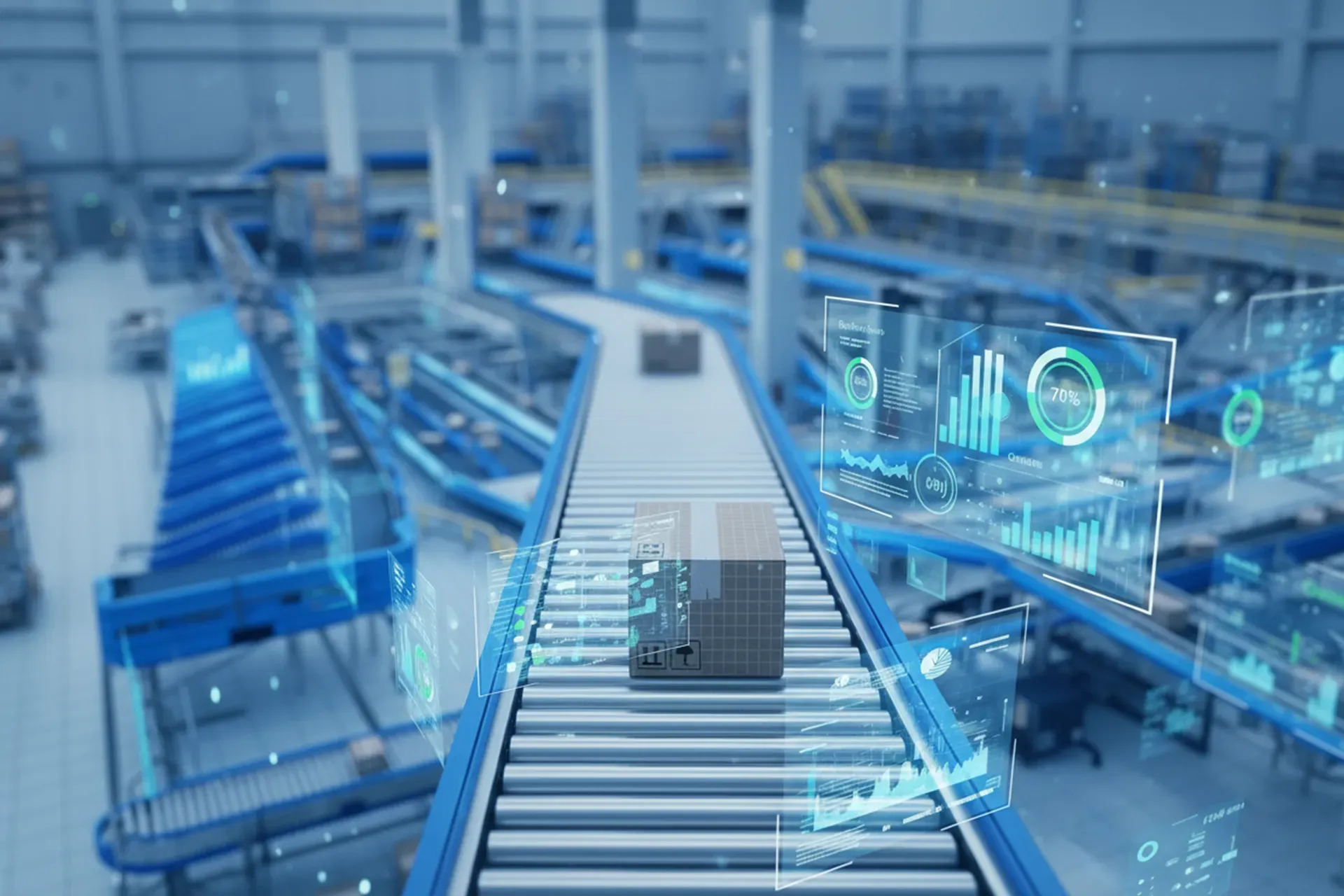
Warehouse simulation software creates a virtual replica of your warehouse, including its layout, equipment, workflows, and operational rules, and then runs that model forward in time to show how the system behaves under different conditions. It accounts for variability, timing, resource contention, and process interdependencies in ways that spreadsheets and static planning tools cannot.
In practical terms, a warehouse simulation model allows you to:
- Identify bottlenecks before they appear in a live environment
- Test changes to layout, staffing, or equipment without disrupting operations
- Validate capital investment decisions by seeing projected outcomes in advance
- Run what-if scenarios across dozens of configurations in hours rather than months
- Analyze throughput capacity under peak, average, and worst-case demand profiles
The most advanced platforms, including discrete event simulation software like Enterprise Dynamics, use drag-and-drop model building with prebuilt component libraries, 2D and 3D visualization, and integration with real operational data to produce models that closely reflect actual warehouse behavior. As a purpose-built DES simulation platform for warehousing and intralogistics, Enterprise Dynamics makes it possible to explore complex system dynamics — including material flow simulation and conveyor simulation — without any risk to live operations.
Build your own simulation, your way
Enterprise Dynamics gives developers full control to model, scale, and integrate complex systems with C++, APIs, and real-time data.
Explore Enterprise DynamicsWhat does a WMS do that simulation software doesn’t?
A WMS manages the execution of warehouse operations in real time. It directs workers and automated systems, controls inventory accuracy, processes orders, and ensures that the right goods move to the right place at the right time. Simulation software does none of this. It does not connect to physical equipment, it does not issue task assignments, and it does not track live inventory.
Think of the distinction this way: a WMS is an operational control system, while simulation software is a planning and analysis tool. The WMS runs your warehouse. Simulation software helps you design, test, and improve it before and during major changes.
When should you use simulation instead of relying on your WMS data?
You should turn to warehouse simulation software when a decision involves significant complexity, risk, or investment that your WMS data alone cannot evaluate. WMS data tells you what happened. Simulation tells you what is likely to happen next, and under what conditions things could go wrong.
Specific situations where simulation adds clear value include:
- Designing a new facility or expansion – before construction begins, simulation validates whether the planned layout and equipment will meet throughput targets.
- Evaluating automation investments – conveyors, sorters, autonomous mobile robots, and automated storage and retrieval systems carry large price tags. DES simulation software shows whether the projected gains are realistic under your actual demand profile, including detailed AS/RS simulation and AGV simulation where needed.
- Preparing for volume surges – peak seasons, promotional events, or new customer contracts can stress a warehouse in unpredictable ways. Simulation stress-tests your system in advance.
- Changing operational processes – shifting pick strategies, adding new product lines, or restructuring workflows all carry risk. Simulation lets you test the change safely first.
- Resolving persistent bottlenecks – when WMS reports show recurring delays but the root cause is unclear, intralogistics simulation can isolate exactly where and why the constraint occurs.
Can warehouse simulation software and a WMS work together?
Yes, and this combination is where both tools deliver their greatest value. When warehouse simulation software is connected to real data from a WMS or ERP system, it becomes a digital twin of your warehouse. The simulation model is fed with actual order volumes, inventory positions, and process parameters, making its outputs significantly more accurate and actionable.
This integration means that instead of building a simulation model from assumptions, you are testing future scenarios against the reality your WMS already captures. The WMS continues to run daily operations while the DES simulation environment runs parallel experiments on strategic and operational questions that have not yet been implemented.
For organizations managing complex intralogistics systems, this connected approach reduces the gap between planning and execution and gives decision-makers a much stronger evidence base before committing to change.
How Enterprise Dynamics supports warehouse planning and optimization
Enterprise Dynamics is our discrete event simulation software platform built specifically for the complexity of warehouse, logistics, and material handling environments. It addresses the core challenge this article describes: giving operations teams the ability to test decisions before they make them. Whether you need DES software for warehousing, supply chain simulation, or broader intralogistics simulation, Enterprise Dynamics provides the tools to model, analyze, and optimize your operation with confidence.
Here is what Enterprise Dynamics brings to warehouse simulation:
- Seamless WMS and ERP integration to build accurate digital twin models driven by real operational data
- Drag-and-drop model building with prebuilt atom libraries covering conveyors, sorters, workstations, and more
- 2D and 3D visualization to communicate simulation results clearly to both technical and non-technical stakeholders
- Throughput analysis and bottleneck identification to pinpoint exactly where a warehouse loses capacity, including material flow optimization across the full intralogistics system
- What-if scenario testing across layout changes, staffing models, automation investments, and process redesigns
If you are evaluating a warehouse expansion, planning an automation investment, or trying to understand why your current operation is not hitting its targets, simulation gives you answers your WMS cannot. Get in touch with our team to discuss how Enterprise Dynamics can support your next warehouse planning project.
Frequently Asked Questions
How long does it typically take to build a warehouse simulation model?
The timeline depends on the complexity of your warehouse and the quality of data available. A basic model for a single-zone operation can be built in a matter of days, while a full-facility model with automation, multiple workflows, and integrated WMS data may take several weeks. Modern platforms like Enterprise Dynamics significantly reduce build time through prebuilt component libraries and drag-and-drop model construction, meaning you spend more time analyzing results and less time building infrastructure.
What data do I need to get started with warehouse simulation?
At a minimum, you need your warehouse layout or floor plan, a description of your core workflows and operational rules, equipment specifications, and historical order or throughput data. The more accurate and granular your input data, the more reliable your simulation outputs will be. If your WMS already captures order volumes, task times, and inventory movement, much of this data can be exported directly into the simulation model, which is one of the key advantages of integrating the two systems.
Can simulation software help if we're not planning a major change — just trying to improve day-to-day performance?
Absolutely. While simulation is especially valuable for large capital decisions, it is equally useful for diagnosing and resolving ongoing performance issues. If your WMS reports show recurring delays, missed throughput targets, or uneven resource utilization but the root cause is not obvious, a simulation model can isolate exactly where the constraint originates and test targeted fixes before you implement them. Even incremental process improvements — such as adjusting pick sequences or reallocating staff between zones — can be validated through simulation to confirm the expected gain.
What is the difference between a digital twin and a warehouse simulation model?
A warehouse simulation model is a virtual representation of your facility built to test specific scenarios or decisions. A digital twin takes this a step further by continuously synchronizing the model with live or near-live data from your WMS, ERP, or equipment systems, so it reflects the current state of your warehouse at all times. Think of a simulation model as a controlled experiment environment and a digital twin as an always-on mirror of your real operation. Most organizations start with simulation models and evolve toward a digital twin as their data integration matures.
Do we need specialized engineers or programmers to use warehouse simulation software?
Not necessarily, though some technical familiarity with logistics processes and data is helpful. Modern simulation platforms are designed to be accessible to operations engineers, industrial engineers, and logistics planners without requiring software development skills. Platforms like Enterprise Dynamics use visual, drag-and-drop model building so that subject-matter experts can construct and modify models themselves. For highly complex integrations or custom logic, working with a simulation specialist during the initial build can accelerate the process and ensure the model accurately reflects your real-world constraints.
How do we know if a simulation model's results are accurate enough to trust?
The standard practice is model validation and verification, which involves running the simulation against historical data from your WMS and comparing the model’s outputs to what actually happened in your warehouse during that period. If the simulation closely replicates known past performance, you can have confidence in its predictions for future scenarios. The accuracy of your outputs is directly tied to the quality of your input data, which is why integrating real WMS data into the model is strongly recommended over building a model based purely on estimates or assumptions.
At what point in a warehouse project should simulation be brought in?
The earlier, the better. Simulation delivers the most value when it is used before major decisions are locked in — ideally during the design or feasibility phase of a new facility, expansion, or automation project. Bringing simulation in after construction has started or equipment has been ordered significantly limits your ability to act on what the model reveals. That said, simulation is also valuable mid-project for validating implementation details, and post-launch for continuous optimization, so there is no stage at which it stops being useful.
Related Articles
- What is the benefit of real-time data integration in digital twin warehouse software?
- How do distribution centers benefit from supply chain simulation software?
- What industries benefit most from supply chain simulation software?
- How can supply chain simulation software prevent planning errors?
- What are the four types of models in simulation?