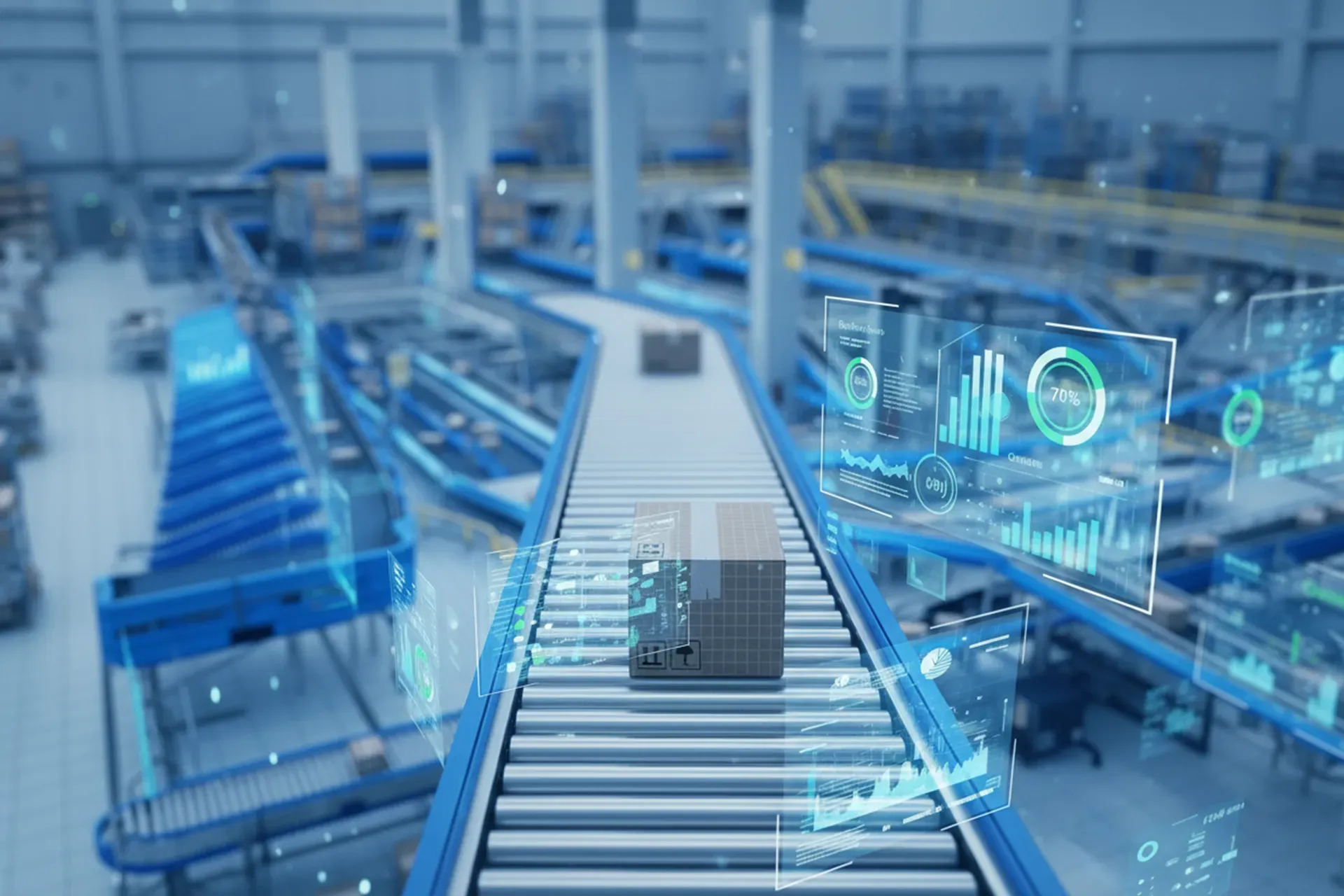
Digital twin warehouse software is a virtual replica of a physical warehouse environment that mirrors real-world operations in real time or near real time. It combines data from your actual facility with simulation logic to model how goods, people, equipment, and processes interact. Organizations use it to test changes, predict outcomes, and optimize performance without disrupting live operations.
The technology is especially valuable in complex distribution and fulfillment environments where even small inefficiencies compound quickly into significant costs. Unlike static planning tools, a digital twin evolves alongside your warehouse, making it a living model rather than a one-time snapshot.
Below, we answer the most common questions about digital twin warehouse software, from how it works to when it makes sense to invest.
How does a digital twin warehouse actually work?
A digital twin warehouse works by building a detailed virtual model of your facility, including layout, equipment, workflows, and resource constraints, and then running that model using real or representative operational data. The simulation engine processes how orders flow, where conveyors move product, how staff are deployed, and where bottlenecks form, all without touching the physical environment.
The core components typically include:
- A virtual model of the warehouse layout, equipment, and processes
- Data inputs such as order volumes, SKU profiles, and throughput targets
- Simulation logic that replicates how the system behaves under different conditions
- A visualization layer that shows 2D or 3D animations of the modeled operations
- An analysis engine that reports KPIs, flags bottlenecks, and compares scenarios
When connected to live systems like a WMS or ERP, the digital twin can reflect current operational conditions and help teams respond to changes proactively. Even without a live data feed, a well-calibrated model built on historical data provides enormous decision-making value.
What’s the difference between a digital twin and warehouse simulation software?
The key distinction is connectivity and continuity. Warehouse simulation software creates a model of your facility to test specific scenarios, typically as a project-based activity. A digital twin takes that a step further by maintaining an ongoing, synchronized virtual replica that updates as real-world conditions change. In practice, the two concepts overlap significantly and are often used together.
Think of it this way:
- Simulation software answers: “What would happen if we changed our picking strategy or added a sorter?”
- A digital twin answers: “What is happening right now, and what will happen tomorrow if conditions shift?”
For most warehouses, the journey starts with discrete event simulation software to validate a design or stress-test a process. Over time, that model can evolve into a digital twin as more live data integrations are added. The distinction matters less than the outcome: both approaches help you make better decisions with less risk.
Build your own simulation, your way
Enterprise Dynamics gives developers full control to model, scale, and integrate complex systems with C++, APIs, and real-time data.
Explore Enterprise DynamicsWhat problems does digital twin warehouse software solve?
Digital twin warehouse software directly addresses the challenge of making high-stakes decisions without reliable data on how those decisions will play out. In warehouse operations, the consequences of a wrong call, whether that is an undersized conveyor, an inefficient slotting strategy, or insufficient staffing during peak periods, can be costly and difficult to reverse.
The most common problems it solves include:
- Bottleneck identification: Pinpointing exactly where throughput slows down, whether at a pick station, a merge point, or a loading dock, so teams can address root causes rather than symptoms.
- Investment validation: Testing whether a proposed automation investment will actually deliver the expected throughput before committing capital.
- Peak planning: Simulating high-demand periods to ensure staffing levels, equipment capacity, and workflows can handle volume spikes without breaking down.
- Layout optimization: Comparing alternative floor plans or flow configurations to find the most efficient arrangement before construction begins. Material flow optimization at this stage can prevent expensive redesigns later.
- Risk reduction: Running hundreds of what-if scenarios in a risk-free virtual environment, so operational changes are tested before they go live.
Beyond these operational challenges, digital twin software also supports sustainability goals by helping teams identify where energy use or waste can be reduced without sacrificing throughput.
Which industries use digital twin technology for warehouses?
Digital twin technology for warehouses is used across any industry that depends on high-volume, time-sensitive distribution operations. The technology is most prevalent where complexity is high, margins are tight, and the cost of downtime or errors is significant.
Industries that rely on it most heavily include:
- E-commerce and retail fulfillment: Where order volumes fluctuate sharply and fulfillment speed is a competitive differentiator
- Pharmaceutical distribution: Where compliance, temperature control, and accuracy requirements add layers of operational complexity
- Automotive and manufacturing: Where just-in-time supply chains require precise sequencing and minimal buffer stock
- Food and beverage: Where shelf life constraints demand fast, accurate throughput and efficient slotting
- Third-party logistics (3PL): Where facilities serve multiple clients with different SKU profiles and service level agreements simultaneously
In each of these sectors, the ability to model complex interactions between people, equipment, and inventory, and to test changes before implementing them, provides a measurable operational advantage. Intralogistics simulation is particularly valuable here, as it captures the full picture of internal material flows, conveyor systems, AGV routing, and AS/RS operations within a single environment.
When should a warehouse invest in digital twin software?
A warehouse should invest in digital twin software when the cost and complexity of operational decisions outweigh the cost of building and maintaining a virtual model. This threshold is lower than most teams expect. If your facility handles significant daily order volumes, operates automated equipment, or is planning a major expansion or system change, the return on a simulation investment is typically strong.
Specific triggers that signal it is the right time include:
- Planning a new warehouse build or a significant redesign of an existing facility
- Evaluating an automation investment such as an AS/RS, sorter, or goods-to-person system
- Experiencing recurring bottlenecks that traditional analysis has failed to resolve
- Preparing for a significant increase in order volume, such as a new retail contract or seasonal peak
- Needing to justify a capital expenditure to senior leadership or a buying committee
The earlier in the planning process a digital twin is introduced, the more value it delivers. Retrofitting a design is far more expensive than optimizing it virtually before a single beam is installed.
How Enterprise Dynamics supports your warehouse operations
Enterprise Dynamics is our DES simulation platform built specifically for the complexity of modern warehouse and intralogistics environments. It gives engineering and operations teams the tools to build accurate virtual models of their facilities and test any scenario, from a simple process change to a full-scale automation rollout, in a risk-free environment.
Here is what Enterprise Dynamics brings to your warehouse challenges:
- Drag-and-drop modeling with prebuilt atoms for conveyors, sorters, pick stations, and more, so models can be built quickly without deep programming knowledge
- 2D and 3D visualization that makes simulation results clear and compelling for both engineers and decision-makers
- WMS and ERP integration to feed real operational data directly into the model, enabling accurate, data-driven scenario testing
- Throughput analysis and bottleneck identification to pinpoint exactly where performance improvements will have the greatest impact
- What-if scenario testing to compare layout options, staffing strategies, and automation configurations before committing to any of them
Whether you are validating a new facility design, preparing a business case for automation, or trying to understand why throughput falls short during peak periods, Enterprise Dynamics gives your team the confidence to make the right call. Get in touch with us to discuss how we can help you model your warehouse operations and move forward with certainty.
Frequently Asked Questions
How long does it take to build a digital twin of an existing warehouse?
The timeline depends on the complexity of your facility and the availability of operational data, but most warehouse digital twins can be built and calibrated within a few weeks to a few months. Simpler facilities with clean data and standard equipment configurations come together faster, while highly automated or multi-client environments with complex workflows take longer to model accurately. Starting with a well-defined scope, such as a single process area or a specific bottleneck, can dramatically reduce initial build time while still delivering immediate value.
What data do I need to get started with warehouse simulation software?
At a minimum, you need facility layout drawings, equipment specifications, order volume data, and SKU profiles to build a functional simulation model. Historical throughput data, staffing levels, and shift patterns add significant accuracy, but a well-structured model can still deliver meaningful insights even when some data must be estimated. The more representative your input data is of real operational conditions, the more reliable your scenario results will be, which is why data quality is worth investing in before the modeling process begins.
Can digital twin software integrate with our existing WMS or ERP system?
Yes, most enterprise-grade digital twin and simulation platforms, including Enterprise Dynamics, are designed to connect with WMS, ERP, and other operational data sources. These integrations allow the model to be fed real order data, inventory levels, and throughput metrics, making scenario testing far more accurate and actionable. The complexity of the integration depends on your systems and data formats, but even a one-time data export from your WMS can be enough to calibrate a highly useful simulation model.
What are the most common mistakes teams make when implementing digital twin technology?
The most common mistake is over-engineering the model before validating core assumptions, spending weeks building a highly detailed twin before confirming the model actually reflects real operational behavior. Another frequent pitfall is treating the digital twin as a one-time project rather than a living tool that should be updated as operations evolve. Teams also sometimes underestimate the importance of stakeholder alignment, building a technically accurate model but failing to present results in a way that drives executive buy-in or operational change.
How do I know if my warehouse is too small or too simple to benefit from a digital twin?
Size alone is rarely the deciding factor. A smaller warehouse with high SKU complexity, tight service level agreements, or a pending automation investment can benefit just as much as a large distribution center. The better question is whether the cost of a wrong operational decision, a misallocated capital investment, a layout that creates chronic bottlenecks, exceeds the cost of building a model. For most facilities planning any significant change, the answer is yes, and even a scoped, targeted simulation of a single process area can deliver a strong return.
How is the ROI of digital twin warehouse software typically measured?
ROI is most commonly measured through avoided costs and performance improvements, such as the capital savings from right-sizing equipment before purchase, the throughput gains identified through bottleneck resolution, or the labor efficiency improvements achieved through optimized staffing models. Teams also capture value in risk reduction, avoiding costly redesigns, construction rework, or automation deployments that fail to meet throughput targets. Because these benefits often run into hundreds of thousands or millions of dollars, even a single successful simulation project can deliver a return that far exceeds the software and consulting investment.
Can digital twin software help us make the business case for warehouse automation to leadership?
Absolutely, and this is one of the most practical and high-impact use cases for the technology. A simulation model lets you demonstrate, with data and visual evidence, exactly how a proposed automation system will perform under realistic order volumes, peak conditions, and failure scenarios. Rather than presenting leadership with vendor projections and assumptions, you can show independently validated throughput numbers, staffing comparisons, and payback scenarios built from your own operational data, making the business case significantly more credible and easier to approve.