
Simulation Improves Operational and Investment Decision-Making
Originally published in Het Financieele Dagblad on 31 August 2026
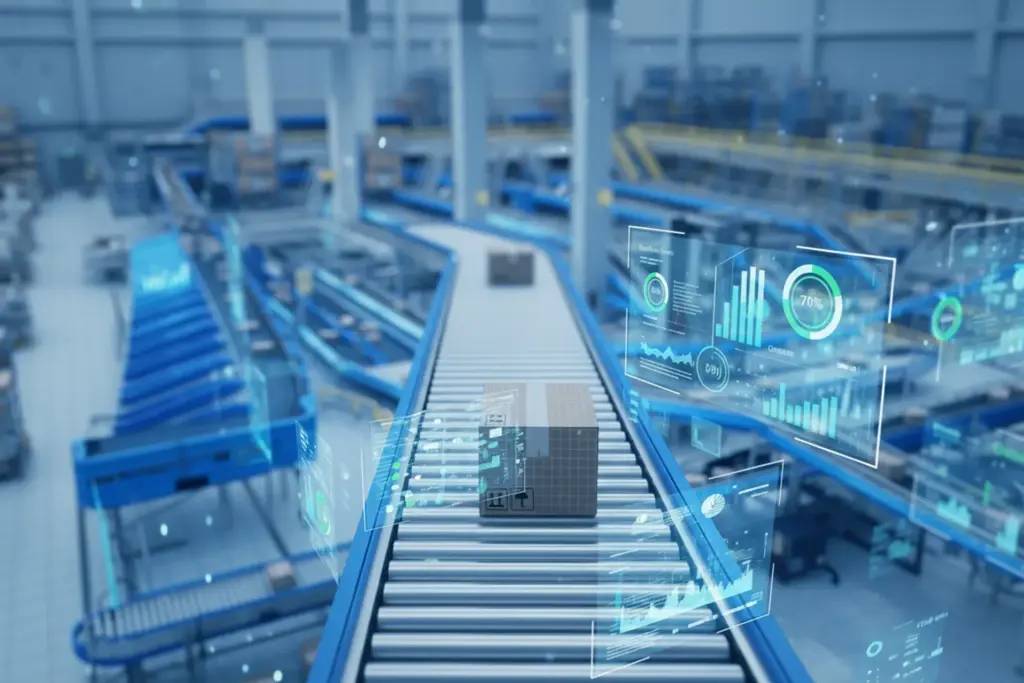
For complex manufacturing companies, it can be difficult to predict in advance how a new factory or logistics hub will perform in practice. Simulation helps reduce this uncertainty by allowing different investment and operational scenarios to be tested digitally before they are implemented.
Geert-Jan van Nunen, CEO of InControl Enterprise Dynamics, explains: “Simulation is the ideal tool for situations where experience, spreadsheets, or traditional planning software fall short.”
His company develops simulation software that enables organizations to model and predict complex physical processes. This complexity can arise, for example, from highly variable volumes, numerous interdependencies, or complicated material flows. Even a sorting machine involves so many variables that simulation is needed to reliably assess different configurations, peak loads, and product formats in advance.
Investing Without Surprises
Van Nunen: “For major investments, simulation can be seen as a relatively inexpensive ‘insurance premium.’ Once a factory has been built in concrete and steel, making changes becomes extremely costly. With a simulation model, you can identify potential bottlenecks before construction begins. In practice, this regularly leads customers to adjust their designs before they are built.”
Operational Decision-Making
The value of simulation is not limited to new facilities. Digital twins and simulation models are increasingly being used in day-to-day operations, for example for production planning, job sequencing, workforce deployment, and the optimization of logistics flows.
This allows a company to test different scenarios and evaluate the outcomes in terms of efficiency, delivery reliability, or robustness.
According to Van Nunen, an organization does not need to create a complete virtual replica of its factory or distribution center from the outset. A clearly defined problem can provide a logical starting point, after which the model can gradually be expanded.
“A customer might start with a single sorting machine or a specific bottleneck. Once it becomes clear that the model enables better decision-making, the need to model the operation end-to-end often develops naturally. In this way, simulation grows alongside the needs of the business.”
Real-World AI
Another development is the combination of simulation and artificial intelligence. Van Nunen specifically refers to this as real-world AI: applications that make predictions and directly influence day-to-day operations.
This makes AI applicable to operational environments where only reliable predictions of exact locations and timing are useful.
Simulation plays an essential dual role in this development. On the one hand, it generates synthetic data that can be used to train AI models. On the other hand, it validates the reliability of an AI model before it is deployed in real-world operations.
“AI learns patterns from historical data, while simulation replicates the causal behavior of a system. This means you can also investigate scenarios for which no historical examples exist. That is precisely why simulation is indispensable for real-world AI.”
For executives and decision-makers, simulation therefore goes straight to the heart of investment and operational decision-making. It is not the digital model itself that ultimately matters, but the ability to test in advance which decisions will hold up in practice and which will ultimately deliver the greatest return.