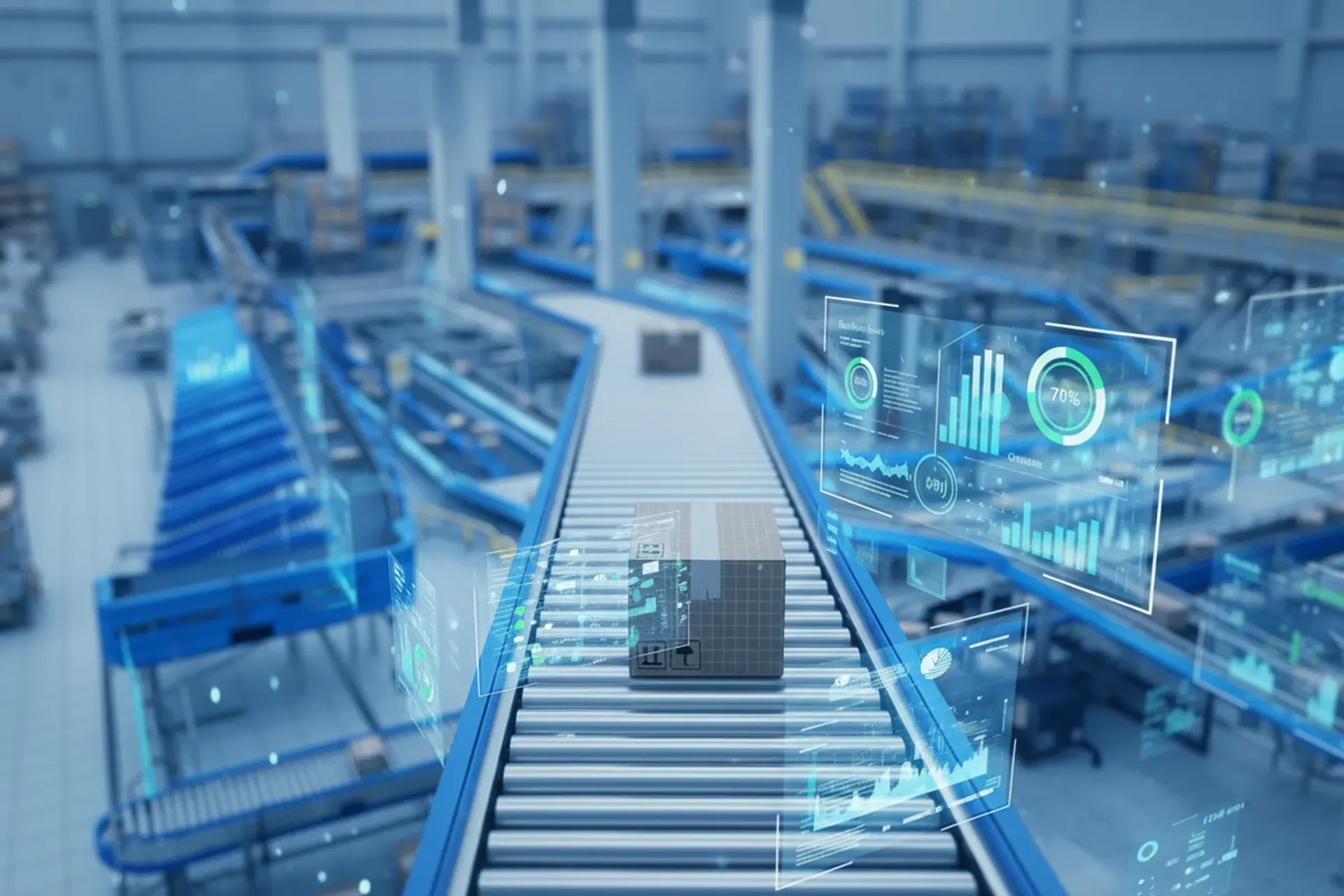
Digital twin warehouse software connects to live warehouse systems through data integration layers that pull real-time information from operational systems such as WMS, ERP, PLCs, and IoT sensors. The connection allows the digital twin to mirror what is actually happening on the warehouse floor at any given moment. Below, we answer the most common questions about how this connection works in practice.
What data does digital twin warehouse software actually receive from live systems?
Digital twin warehouse software receives operational data that describes the current state of physical processes: inventory levels, order statuses, equipment positions, conveyor speeds, pick rates, and worker locations. This data flows in from multiple source systems simultaneously, giving the digital twin an accurate, up-to-date picture of warehouse activity.
In practical terms, the incoming data typically covers:
- Inventory and stock data – current stock levels, locations, and movements across storage zones
- Order and fulfillment data – active orders, picking lists, dispatch schedules, and backlogs
- Equipment status data – conveyor states, sorter throughput, automated guided vehicle positions, and fault signals
- Workforce data – staffing levels, shift patterns, and task assignments
- Sensor and IoT data – temperature readings, weight measurements, and zone occupancy signals
The richness of this data is what separates a live-connected digital twin from a static model. The more granular and frequent the data feed, the more accurately the twin reflects real-world conditions and the more useful it becomes for operational decisions.
How does warehouse software connect to WMS, ERP, and PLC systems?
Warehouse digital twin software connects to WMS, ERP, and PLC systems through APIs, database connectors, middleware layers, and direct protocol integrations. Each system type uses a different communication method, so the integration architecture typically combines several approaches to cover the full operational picture.
Here is how each connection typically works:
- WMS integration – Most modern warehouse management systems expose REST or SOAP APIs that allow the digital twin to query order data, inventory records, and task statuses on a scheduled or event-driven basis.
- ERP integration – ERP systems such as SAP or Oracle connect via standard data exchange protocols or middleware platforms, feeding the twin with procurement data, production plans, and supply chain signals.
- PLC and SCADA integration – Programmable logic controllers on conveyors, sorters, and automated equipment communicate through industrial protocols such as OPC UA or MQTT, delivering real-time machine-level data at high frequency.
- IoT sensor integration – Sensors connect through IoT platforms or edge computing nodes, aggregating readings before passing them to the digital twin layer.
The integration layer sits between these source systems and the simulation model, translating data into the format the digital twin can process. This layer also handles data cleaning, timestamp alignment, and conflict resolution when systems report slightly different values.
Build your own simulation, your way
Enterprise Dynamics gives developers full control to model, scale, and integrate complex systems with C++, APIs, and real-time data.
Explore Enterprise DynamicsWhat’s the difference between a real-time digital twin and a simulation model?
A real-time digital twin is continuously synchronized with a live physical system, reflecting its current state at any moment. A simulation model, by contrast, is a standalone virtual representation built from historical data and assumptions, used to explore future scenarios without a live connection to operational systems.
The distinction matters because the two serve different purposes. A simulation model is ideal for planning, investment validation, and what-if analysis before a system is built or changed. A real-time digital twin is designed for operational monitoring and live decision support once a system is running.
That said, the two approaches are not mutually exclusive. Many organizations use an offline warehouse simulation model during the design and investment phase, then evolve it into a live-connected twin once the warehouse is operational. The simulation model effectively becomes the foundation that the digital twin is built upon, which is one reason why investing in a high-quality model from the start pays dividends over time. Platforms built on discrete event simulation software are particularly well suited to this progression, since the underlying discrete event simulation engine can support both offline scenario testing and live operational synchronization within the same environment.
How often does a digital twin sync with the physical warehouse?
The sync frequency of a digital twin with the physical warehouse depends on the data source and the operational need. PLC and sensor data can sync in near real time, often within seconds or milliseconds. WMS and ERP data typically sync on a scheduled basis, ranging from every few minutes to hourly, depending on system configuration and business requirements.
In practice, most warehouse digital twins operate with a layered sync approach. Machine-level data from conveyors and automated equipment updates continuously, while order management and inventory data refresh at longer intervals. This layered approach balances system performance with operational accuracy, avoiding unnecessary load on source systems while keeping the twin current enough to be useful.
For warehouses with highly dynamic operations such as e-commerce fulfillment or pharmaceutical distribution, faster sync cycles are generally worth the additional integration complexity. For slower-moving environments, less frequent updates are often sufficient.
What are the biggest challenges when connecting digital twin software to warehouse systems?
The biggest challenges when connecting digital twin warehouse software to live systems are data quality, system heterogeneity, and integration maintenance. These three factors account for the majority of delays and complications in real-world implementations.
Each challenge deserves attention:
- Data quality – Live warehouse data is often inconsistent, incomplete, or timestamped incorrectly. If the source data is unreliable, the digital twin will reflect those inaccuracies, undermining confidence in its outputs.
- System heterogeneity – Most warehouses run a mix of legacy and modern systems from different vendors, each using different data formats and communication protocols. Building a unified integration layer across these systems requires careful planning and often custom development.
- Integration maintenance – When source systems are updated or replaced, integrations can break. Maintaining a live-connected digital twin requires ongoing technical attention, not just a one-time setup.
- Latency and synchronization – Ensuring that data from multiple systems stays aligned in time is technically demanding, particularly when combining fast machine data with slower business system updates.
- Organizational readiness – IT teams, operations teams, and simulation specialists need to collaborate closely. Misalignment between these groups is a common source of project delays.
When should a warehouse use a live-connected digital twin versus offline simulation?
A warehouse should use a live-connected digital twin when it needs continuous operational visibility and real-time decision support for a system that is already running. Offline simulation is the right choice when the goal is to design, validate, or optimize a system before it is built or significantly changed.
A practical way to think about it is by stage. During the planning and investment phase, offline warehouse simulation software allows teams to test layouts, staffing models, and equipment configurations without any live data. This is where scenario testing, bottleneck identification, and throughput analysis deliver the most value at the lowest risk. Intralogistics simulation and material flow simulation are especially valuable at this stage, enabling teams to model conveyor simulation, AGV simulation, and automated storage and retrieval system simulation before any physical changes are made.
Once a warehouse is operational, a live-connected digital twin adds value by monitoring performance against the modeled baseline, flagging deviations, and supporting decisions about how to respond to disruptions or volume changes. Organizations with highly automated warehouses, complex material handling systems, or strict service-level requirements tend to benefit most from the live connection.
For smaller or less automated facilities, the cost and complexity of a live integration may outweigh the benefits, and periodic offline simulation reviews may be a more practical approach.
How Enterprise Dynamics supports digital twin warehouse integration
Enterprise Dynamics is our discrete event simulation platform built for exactly the kind of complex, data-rich environments described throughout this article. As a DES simulation software solution, it integrates directly with WMS and ERP systems to create a digital twin of your warehouse or supply chain, and supports both offline simulation and live-connected operational models. Its capabilities span warehouse simulation software, supply chain simulation, material handling simulation, and intralogistics simulation software, making it a versatile choice for logistics and operations teams across a wide range of industries.
With Enterprise Dynamics, you can:
- Model and test warehouse layouts, conveyor systems, and fulfillment processes in a risk-free virtual environment using a proven material flow simulation approach
- Connect to live operational data from WMS, ERP, and PLC systems to keep your digital twin synchronized with real-world activity
- Run what-if scenarios to validate investments, identify bottlenecks, and optimize throughput before making changes on the floor
- Use drag-and-drop atom libraries to build detailed models quickly, without starting from scratch
- Visualize operations in 2D and 3D to communicate findings clearly across technical and non-technical stakeholders
Whether you are in the planning phase of a new warehouse or looking to bring an existing facility under tighter operational control, Enterprise Dynamics gives your team the tools to make better decisions with confidence. Get in touch with us to discuss how we can support your warehouse simulation or digital twin project.
Frequently Asked Questions
How long does it typically take to implement a live-connected digital twin in an existing warehouse?
Implementation timelines vary significantly depending on the complexity of your existing systems and the quality of your data infrastructure, but most live-connected digital twin projects take anywhere from three to twelve months from initial scoping to full deployment. Simpler environments with modern, API-ready WMS and ERP systems tend to move faster, while facilities running legacy PLCs or heavily customized ERP configurations require more custom integration work. Starting with a high-quality offline simulation model before attempting live connection can meaningfully shorten this timeline, since the core model logic is already validated before integration work begins.
What data quality standards should our warehouse data meet before connecting it to a digital twin?
At a minimum, your source data should be consistently timestamped, free of significant gaps, and logically consistent across systems — for example, inventory figures in your WMS should not regularly contradict what your ERP reports. Before going live, it is worth running a data audit to identify fields with high null rates, duplicate records, or systematic timing mismatches between systems. Addressing these issues upstream, at the source system level, will always produce better results than trying to clean or reconcile poor data inside the integration layer itself.
Can a digital twin be built incrementally, starting with just one or two data sources before expanding?
Yes, and in most cases a phased approach is actually the recommended strategy. Starting with your highest-value data source — typically WMS order and inventory data — allows your team to validate the integration architecture, build confidence in the model outputs, and demonstrate early value before taking on the added complexity of PLC or IoT connections. Each new data source can then be layered in progressively, with the integration layer expanded to accommodate it. This approach also reduces project risk by limiting the scope of each implementation phase.
What happens to the digital twin if one of the connected source systems goes offline or sends corrupted data?
A well-designed digital twin integration layer should include fault tolerance mechanisms that handle source system outages gracefully — typically by continuing to operate on the last known good data state while flagging the affected data stream as stale or unavailable. Corrupted or anomalous data should be caught by validation rules at the integration layer before it reaches the simulation model, rather than being passed through unchecked. Defining these failure modes and fallback behaviors during the architecture phase, rather than after go-live, is one of the most important steps teams often underestimate.
Do we need a dedicated IT team to maintain the integrations once the digital twin is live?
You do not necessarily need a dedicated team, but you do need a clearly assigned owner — whether internal or through a managed service arrangement — who is responsible for monitoring integration health and responding when source systems change. The most common point of failure in live-connected digital twins is not the initial setup but the maintenance gap that occurs when a WMS upgrade or ERP patch silently breaks an API connection. Establishing a lightweight integration monitoring process and keeping documentation current are more important than headcount alone.
How do we know if our warehouse is complex enough to justify the investment in a live-connected digital twin?
A useful starting point is to assess whether real-time operational decisions in your facility are currently being made with incomplete or delayed information, and whether the cost of those suboptimal decisions — in missed SLAs, excess labor, or equipment downtime — is material. Highly automated facilities, multi-shift e-commerce operations, and warehouses with tight service-level agreements almost always clear this bar. For smaller or less automated facilities, beginning with periodic offline simulation reviews is often a more cost-effective entry point, with the option to evolve toward a live connection as operational complexity grows.
Can the same digital twin model be used for both future planning scenarios and live operational monitoring?
Yes, and this dual-use capability is one of the most compelling aspects of investing in a high-quality simulation model from the outset. In practice, teams typically maintain a live-synchronized instance of the model for day-to-day operational monitoring, while running separate scenario copies offline to test proposed changes — such as new equipment layouts or adjusted staffing plans — without disrupting the live model. This means the same underlying model that monitors today’s operations can also be used to validate tomorrow’s investments, compounding the return on the original modeling effort over time.
Related Articles
- Can warehouse simulation software model cross-docking operations?
- How does warehouse simulation software handle high object-count models?
- How to be a good supply chain planner?
- How do logistics companies use supply chain simulation software?
- What are the latest trends in supply chain simulation for 2026?