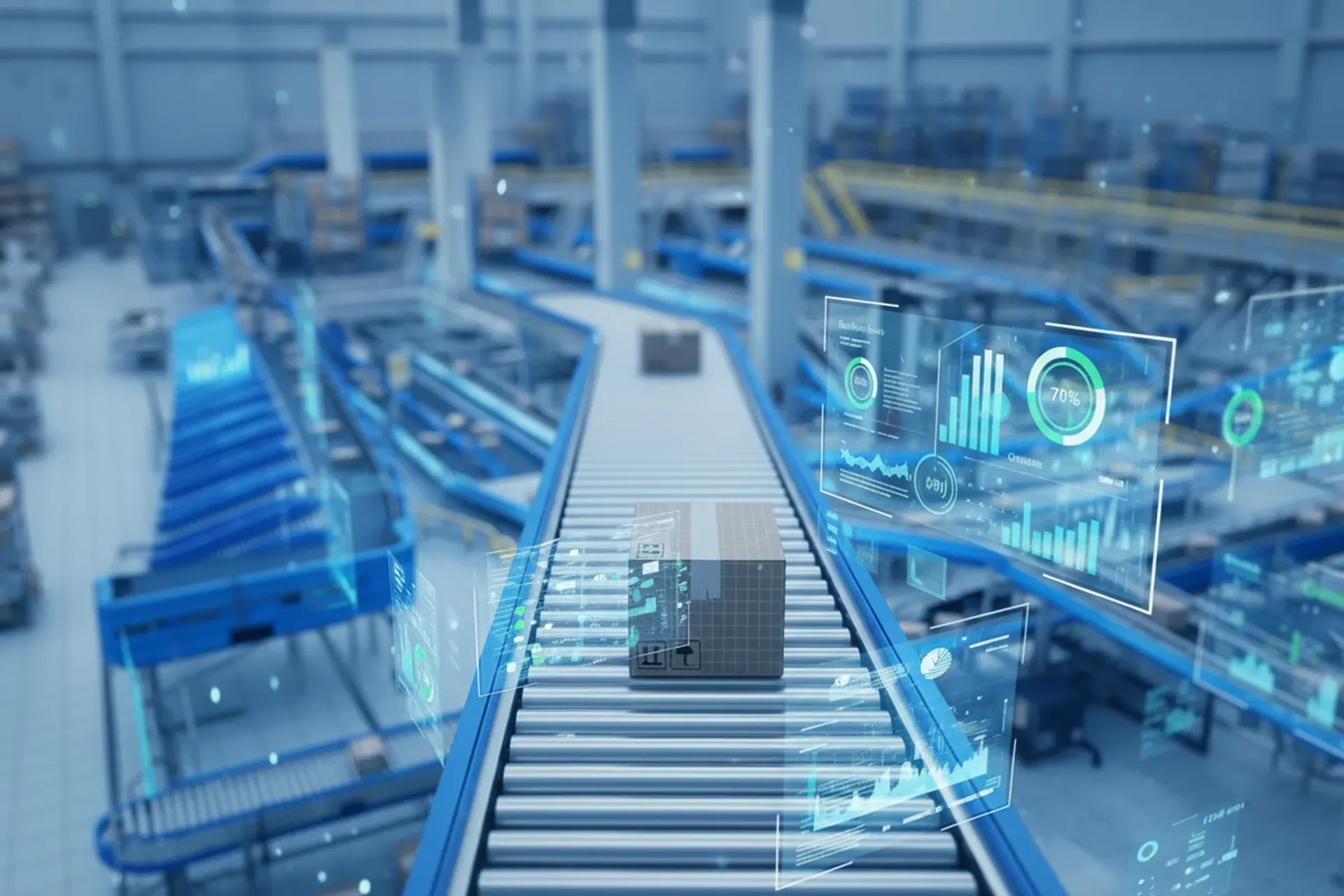
Warehouse automation simulation supports machine learning integration by generating rich, structured operational data and providing a risk-free environment where ML algorithms can be trained, tested, and validated before they ever touch a live system. Rather than waiting months for real-world data or risking costly errors in production, engineers can use simulation to accelerate the entire ML development cycle. The sections below explore exactly how this works across the most common warehouse engineering questions.
What data does warehouse simulation generate for machine learning models?
Warehouse simulation software generates granular, timestamped event data covering every movement, decision, and resource interaction within a modeled facility. This includes conveyor throughput rates, pick path sequences, dwell times, queue lengths, equipment utilization, and order completion timestamps, precisely the structured input that ML models need to identify patterns and make predictions.
Because simulation runs faster than real time, engineers can produce months or years of synthetic operational data in hours. This matters enormously for ML, where data volume directly influences model quality. Sparse real-world datasets, especially for rare events like equipment failures or peak demand spikes, can be supplemented or entirely replaced with simulation-generated scenarios.
The data produced is also clean and labeled by design. Every event in a discrete event simulation software environment carries context: which resource triggered it, under what conditions, and with what outcome. This removes much of the laborious preprocessing that typically consumes ML engineering time when working with raw operational logs.
How does simulation create a safe environment for training ML algorithms?
Simulation creates a safe environment for training ML algorithms by decoupling the learning process from live operations entirely. An ML algorithm trained inside a warehouse simulation model can make thousands of suboptimal decisions, explore edge cases, and fail repeatedly without disrupting a single real shipment or putting any worker at risk.
This is particularly valuable for reinforcement learning approaches, where an agent learns by trial and error. In a physical warehouse, allowing an algorithm to experiment freely with routing logic, picking sequences, or resource allocation would be operationally and financially unacceptable. Inside a simulation, the same experimentation is not only acceptable but encouraged.
Beyond reinforcement learning, simulation also allows engineers to stress-test ML models against conditions that rarely occur in normal operations:
- Sudden demand surges during peak periods
- Equipment failures and partial system outages
- Staffing shortages and shift pattern changes
- New product introductions that alter pick profiles
- Layout changes or the addition of new automation equipment
Exposing an ML model to these synthetic extremes before deployment significantly reduces the risk of unexpected behavior when real conditions deviate from the norm.
Build your own simulation, your way
Enterprise Dynamics gives developers full control to model, scale, and integrate complex systems with C++, APIs, and real-time data.
Explore Enterprise DynamicsWhat is the difference between simulation-driven ML and traditional ML in logistics?
The core difference is data origin and training environment. Traditional ML in logistics relies on historical operational data collected from live systems: WMS logs, sensor feeds, ERP records. Simulation-driven ML uses synthetic data generated by a virtual model of the warehouse, allowing engineers to control, expand, and manipulate the training dataset in ways that historical data simply cannot support.
Traditional ML approaches face several structural limitations in warehouse contexts:
- Data scarcity for rare events: Real operations rarely produce enough examples of failures, bottlenecks, or outlier conditions to train robust models.
- Lack of counterfactuals: Historical data only reflects decisions that were actually made, not the alternatives that were not tried.
- Delayed feedback loops: Collecting enough real-world data to retrain a model after a layout change or process update can take months.
- Risk of live experimentation: Testing an untrained or partially trained model in a live environment carries direct operational consequences.
Simulation-driven ML addresses each of these limitations directly. Engineers define the scenarios they want the model to learn from, generate as much data as needed, and validate the model in the same virtual environment before any deployment decision is made. Intralogistics simulation and supply chain simulation environments are particularly well suited to this workflow, because they can reproduce the full breadth of operational variability that real facilities experience.
How can ML models be validated using a warehouse digital twin?
ML models can be validated using a warehouse digital twin by running the trained model against a high-fidelity virtual replica of the real facility and comparing its decisions and predictions against known simulation outcomes. The digital twin acts as a controlled test bed where model performance can be measured without operational risk.
Validation through a digital twin warehouse model typically follows a structured process. Engineers first calibrate the digital twin against real operational data to ensure it accurately reflects the actual system. The trained ML model is then connected to the twin and allowed to make decisions, routing orders, allocating resources, adjusting throughput targets, while the simulation records the consequences of each decision.
This approach allows teams to answer specific validation questions: Does the model perform well only on the data it was trained on, or does it generalize to new scenarios? Does it degrade gracefully under conditions it has not seen before? Are its recommendations consistent with the physical constraints of the facility?
Because the digital twin can be run repeatedly and at speed, validation is not a one-time checkpoint but an ongoing process. As warehouse conditions evolve, new equipment, changed layouts, different order profiles, the model can be re-validated continuously against an updated twin.
Which warehouse processes benefit most from simulation-supported ML?
The warehouse processes that benefit most from simulation-supported ML are those characterized by high variability, complex interdependencies, and significant consequences for suboptimal decisions. These are exactly the conditions where both simulation and ML individually add value, and where their combination is most powerful.
The strongest candidates include:
- Dynamic order batching and wave planning: ML models trained on simulation data can predict optimal batch sizes and release timing based on real-time order profiles and resource availability.
- Predictive equipment maintenance: Simulation generates failure scenario data that is difficult to collect from real operations, giving ML models the examples they need to anticipate breakdowns before they occur. This is especially relevant for AS/RS simulation and automated storage and retrieval system simulation, where failure modes are highly specific and real-world failure data is scarce.
- Adaptive routing and sortation: In high-throughput conveyor simulation and sortation systems, ML models can optimize routing decisions dynamically, with simulation used to train and validate routing logic across thousands of scenario variations. AGV simulation adds another layer here, enabling ML agents to learn optimal path-planning and traffic management strategies before any physical deployment.
- Labor allocation and workforce scheduling: ML models supported by simulation can optimize shift patterns and task assignments by learning from synthetic data covering a wide range of demand conditions.
- Inbound and outbound flow balancing: Simulation-trained models can anticipate congestion points and proactively adjust receiving and dispatch schedules to maintain throughput. Material flow optimization is a natural output of this process, with the simulation environment serving as both the training ground and the validation benchmark.
When should engineers integrate ML with simulation versus using simulation alone?
Engineers should integrate ML with simulation when the operational decisions they need to optimize are too complex or dynamic for rule-based logic to handle effectively, and when the volume and variety of decision scenarios exceeds what manual analysis of simulation outputs can address. Simulation alone is sufficient when the goal is to evaluate a fixed set of design alternatives or validate a known operational strategy.
A practical way to think about this distinction: simulation answers “what happens if we do X?” ML integration adds the capability to ask “what is the best X to do, given continuously changing conditions?” If the answer to that second question changes frequently and at a granularity that human analysts cannot keep pace with, ML becomes a necessary layer.
Engineers should consider keeping simulation alone when:
- The design question is a one-time investment decision rather than an ongoing operational optimization
- The number of scenarios to evaluate is manageable through structured what-if analysis
- The operational rules governing the system are stable and well-understood
ML integration becomes the right choice when the warehouse needs to adapt decisions in near-real time, when the decision space is too large for exhaustive scenario testing, or when the system must learn from new data continuously as operations evolve. In these situations, a DES simulation environment provides the structured, repeatable foundation that makes continuous ML learning feasible at scale.
How Enterprise Dynamics supports ML-integrated warehouse simulation
Enterprise Dynamics is our DES simulation platform built specifically for the complexity of modern warehouse and intralogistics environments. For engineering teams exploring ML integration, it provides the foundational capabilities that make simulation-driven ML practical rather than theoretical:
- High-fidelity warehouse modeling using drag-and-drop atom libraries that represent conveyors, sorters, pick stations, AGVs, and workforce resources with operational accuracy
- WMS and ERP integration to calibrate digital twin models against real operational data and keep them synchronized as the facility evolves
- Scenario generation at scale to produce the volume and variety of synthetic training data that ML models require
- 2D and 3D visualization to validate model behavior and communicate simulation-supported ML recommendations to broader stakeholder groups
- Throughput analysis and bottleneck identification to pinpoint exactly where ML-driven optimization will deliver the greatest operational impact
If your team is evaluating how simulation can accelerate your ML development process or strengthen your digital twin strategy, we are ready to help. Get in touch with us to discuss your specific use case and see how Enterprise Dynamics fits into your roadmap.
Frequently Asked Questions
How much simulation data is typically needed before an ML model is ready for warehouse deployment?
The volume required depends heavily on model type and the complexity of the decisions being optimized. For supervised learning tasks like predictive maintenance, tens of thousands of labeled events are often sufficient, while reinforcement learning agents may require millions of simulation steps to converge on reliable policies. A practical starting point is to run simulation scenarios until model performance metrics — accuracy, loss, or reward curves — plateau across validation runs, then add targeted scenario coverage for any edge cases the model still handles poorly.
Can simulation-generated synthetic data fully replace real operational data for ML training?
Synthetic data can replace real data for many training tasks, but the simulation model itself must first be calibrated against real operational data to ensure its outputs reflect actual system behavior. Without that calibration step, a model trained purely on synthetic data risks learning patterns that do not transfer to the live environment — a problem known as the sim-to-real gap. The strongest approach combines simulation-generated data for volume and scenario coverage with real operational data to anchor the model to ground truth.
What are the most common mistakes engineers make when first integrating ML with warehouse simulation?
The most frequent mistake is treating simulation as a passive data source rather than an active validation environment — generating training data from simulation but then skipping the step of validating the trained model back inside the same simulation before deployment. A second common error is training ML models on overly idealized simulation scenarios that do not include enough variability, noise, or failure conditions, which produces models that perform well in testing but degrade quickly under real operational conditions.
How do we keep an ML model accurate as our warehouse layout or operations change over time?
The key is maintaining a synchronized digital twin that reflects the current state of the facility, including any layout changes, new equipment, or updated process flows. When operational changes occur, the updated twin is used to generate new training or fine-tuning data, and the ML model is re-validated against the revised environment before being pushed back to production. Establishing this as a repeatable workflow — rather than a one-time event — is what separates teams that sustain ML performance over time from those that see model drift erode their gains.
Is reinforcement learning practical for real warehouse environments, or is it still mostly theoretical?
Reinforcement learning is increasingly practical for warehouse applications, particularly for dynamic routing, resource allocation, and adaptive scheduling, but simulation is what makes it viable. Training an RL agent directly in a live warehouse is operationally infeasible due to the volume of trial-and-error decisions required, but simulation compresses that learning process into hours or days. Several logistics operators are already deploying RL-based policies for sortation and AGV routing that were trained and validated entirely within simulation environments before go-live.
How do we make the business case for investing in simulation infrastructure to support ML development?
The strongest business case centers on risk reduction and development speed: simulation eliminates the cost and operational disruption of testing ML models in live environments, and it accelerates the path from model concept to validated deployment. Quantify this by estimating the cost of a single ML-related operational failure — misrouted orders, throughput collapse during peak periods, or equipment damage — and compare that against the investment in simulation tooling. Teams that frame simulation as ML insurance rather than a standalone IT expense typically find the ROI case straightforward to build.
What technical skills does our engineering team need to get started with simulation-driven ML for warehouse optimization?
A functional starting team typically needs three overlapping skill sets: warehouse operations knowledge to build credible simulation models, simulation engineering experience to design scenarios and interpret outputs correctly, and ML engineering capability to select appropriate model architectures and manage the training pipeline. In practice, many teams begin by partnering with a simulation specialist — such as an Enterprise Dynamics implementation partner — to build and calibrate the foundational models, while their internal data science team focuses on the ML layer, which is a faster path to first results than trying to develop both capabilities simultaneously from scratch.
Related Articles
- Can warehouse layout simulation be used for retrofit automation projects?
- What is the difference between warehouse simulation software and a WMS?
- What software do warehouse managers use?
- What industries benefit most from supply chain simulation software?
- What are the limitations of AutoMod simulation software?