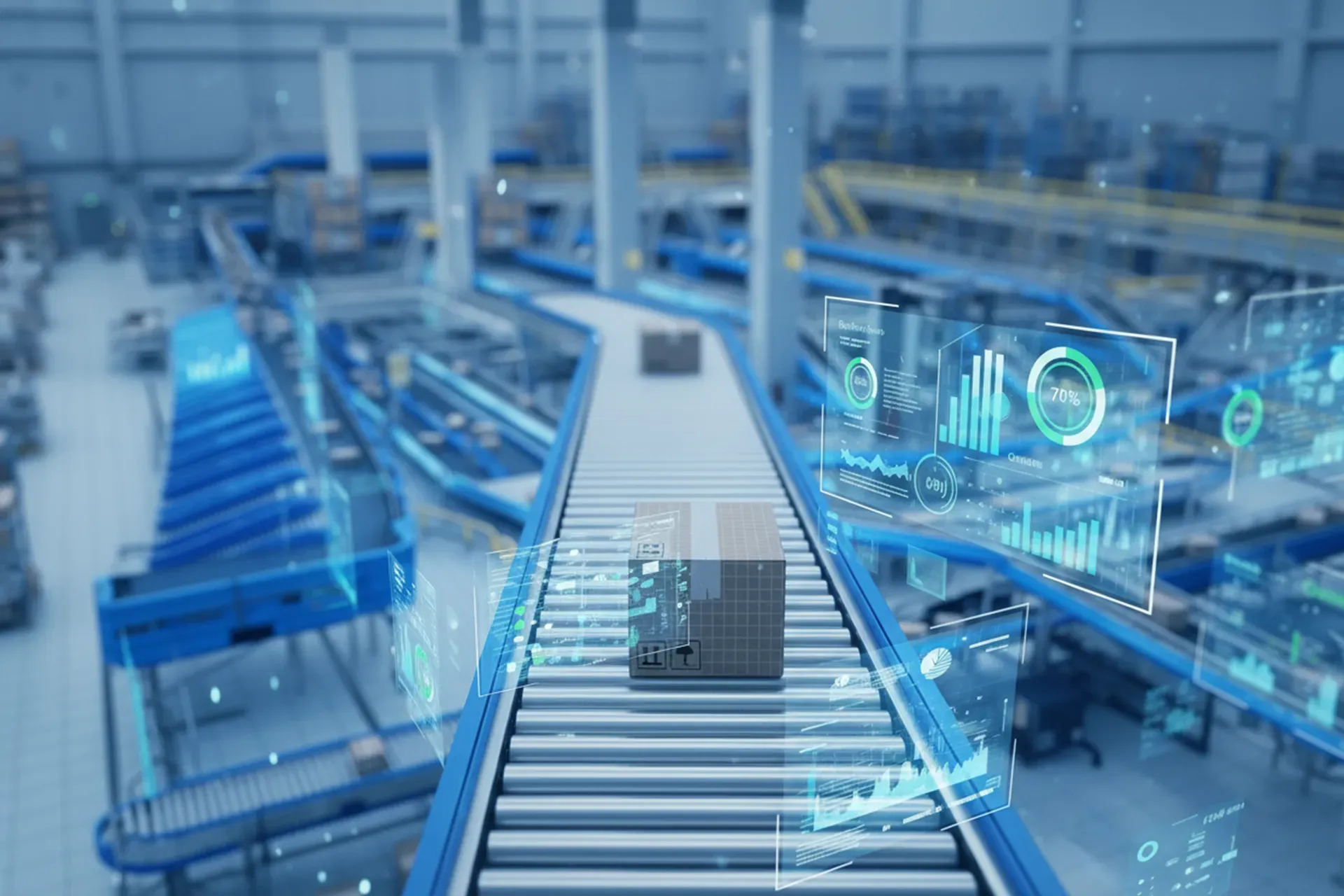
Material handling companies invest in digital twin warehouse simulation software to model, test, and optimize their operations in a risk-free virtual environment before committing to costly physical changes. By creating a live, data-connected replica of a warehouse, these companies can validate equipment investments, identify bottlenecks, and stress-test new workflows without disrupting daily operations. The questions below unpack exactly how and why this technology has become a strategic priority in 2026.
What business problems drive material handling companies toward digital twins?
The core business problems are operational inefficiency, costly investment risk, and the inability to test process changes without disrupting live operations. Material handling environments are complex systems where conveyors, sorters, pick stations, and workforces interact continuously. A single bottleneck or miscalculated capacity decision can cascade into missed throughput targets, increased labor costs, and failed service-level agreements.
Traditional planning tools like spreadsheets, WMS dashboards, and ERP reports capture historical data, but they cannot predict how a system will behave under new conditions. When a company plans to add automation, expand a facility, or reroute product flows, there is no safe way to test those changes in the real world without risk. That gap is precisely where material handling simulation software and digital twin warehouse tools deliver value.
- Bottleneck identification: pinpointing exactly where throughput breaks down under peak demand
- Capacity planning: understanding how much volume a system can realistically handle before adding equipment
- Investment validation: confirming that a planned sorter, conveyor line, or automated storage system will meet performance targets
- Workforce optimization: determining the right number of operators per shift without overstaffing or understaffing
- Risk reduction: testing operational changes virtually before any physical commitment is made
How does digital twin software actually model a warehouse?
Digital twin warehouse simulation software builds a dynamic, virtual replica of a warehouse by combining the physical layout, equipment logic, product flows, and operational rules into a single executable model. Unlike a static floor plan or a process map, the model runs over simulated time, so every conveyor, pick station, and routing decision behaves exactly as it would in the real facility.
In practice, the modeling process works in layers. Engineers start by importing or drawing the physical layout, then place pre-built components representing conveyors, sorters, buffers, workstations, and storage locations. Each component carries configurable logic: speeds, capacities, failure rates, and decision rules. Product orders are then fed into the model, either from historical data or from a connected WMS or ERP system, so the simulation runs against realistic demand patterns.
Once the model is live, it generates performance data in real time: throughput rates, queue lengths, equipment utilization, and resource consumption. Engineers can pause the simulation, adjust parameters, and rerun scenarios to compare outcomes. The result is a warehouse simulation environment where every what-if question gets a quantified answer before any physical change is made.
Build your own simulation, your way
Enterprise Dynamics gives developers full control to model, scale, and integrate complex systems with C++, APIs, and real-time data.
Explore Enterprise DynamicsWhat’s the difference between a digital twin and a warehouse simulation?
The key distinction is live data connectivity. A warehouse simulation is a model built to answer specific design or planning questions, using historical or estimated data as input. A digital twin is a simulation that connects to real operational data in near real time, so the virtual model continuously reflects the current state of the actual facility.
In practical terms, a simulation is typically used during the design or pre-investment phase. Engineers build the model, run scenarios, draw conclusions, and then the model may be set aside. A digital twin, by contrast, remains active and synchronized with the live operation. It can flag emerging problems, support ongoing decision-making, and be used to test operational adjustments as conditions evolve.
That said, the boundary between the two is not always sharp. Many material handling companies start with a discrete event simulation software project to validate a design decision, then evolve that model into a persistent digital twin as their data infrastructure matures. Both approaches use the same underlying modeling technology and deliver genuine operational insight.
Which material handling investments are validated with digital twin software?
Digital twin warehouse simulation software is most commonly used to validate investments in automation, facility expansion, and system redesign before capital is committed. These are decisions where the cost of being wrong is high and the opportunity to test in the real world is limited or nonexistent.
- Automated storage and retrieval systems (AS/RS): confirming that a planned AS/RS simulation meets throughput targets across peak and off-peak demand profiles
- Sorter and conveyor installations: validating routing logic, merge points, and capacity under realistic order mixes with conveyor simulation
- Goods-to-person picking systems: testing pick rates, buffer sizing, and workstation ergonomics before equipment is ordered
- Facility expansion or greenfield design: comparing layout alternatives to find the configuration with the best throughput-to-cost ratio using intralogistics simulation
- Warehouse management system changes: simulating the operational impact of new WMS logic or slotting strategies without touching the live system
- Multi-shift workforce planning: determining optimal staffing levels and shift structures to meet service-level targets without unnecessary labor cost
The common thread across all of these is that the investment is large enough that a virtual proof of concept is far cheaper than discovering a design flaw after implementation.
How does digital twin software reduce warehouse operating costs?
Digital twin software reduces warehouse operating costs by eliminating the trial and error that typically accompanies operational changes. When a company can test a new process, layout, or staffing model virtually and measure its impact before going live, it avoids the productivity losses, rework costs, and equipment downtime that come from discovering problems in the real operation.
The cost reductions show up in several concrete areas. Bottleneck analysis identifies where equipment is underperforming or where labor is being wasted waiting for upstream processes to catch up. Scenario testing reveals which operational changes deliver the greatest throughput improvement for the lowest additional cost. Material flow optimization through capacity modeling prevents over-investment in equipment that will not be fully utilized under realistic demand patterns.
Over time, companies that use digital twin technology also reduce the cost of planning itself. Rather than commissioning expensive physical pilots or relying on consultants to run manual analyses, internal engineering teams can answer complex operational questions quickly and independently using the virtual model.
When should a material handling company start using digital twin software?
A material handling company should start using digital twin warehouse software at the point where operational complexity outpaces what spreadsheets and standard reporting tools can reliably model. In practice, that moment often arrives when a company is planning a significant capital investment, experiencing recurring throughput problems it cannot diagnose, or preparing to scale operations significantly.
The earlier in a project the software is introduced, the greater the return. A digital twin built during the design phase of a new facility or automation project can influence fundamental layout and equipment decisions, delivering value that compounds across the entire operational lifetime of the system. Introducing the same technology after implementation still delivers value for ongoing optimization, but the highest-impact decisions have already been made.
Companies that are expanding into e-commerce fulfillment, adding warehouse automation simulation to an existing facility, or managing increasingly variable demand patterns are particularly strong candidates for digital twin adoption in 2026. The operational stakes in those environments are high enough that the cost of a modeling project is small relative to the risk it mitigates.
How Enterprise Dynamics supports material handling companies
Enterprise Dynamics is our DES simulation platform built specifically for the complexity that material handling and intralogistics environments demand. It gives engineering teams the tools to build accurate virtual models of warehouses, distribution centers, and automated systems, and to run those models against realistic demand data to answer the questions that matter most.
- Drag-and-drop modeling: pre-built atoms for conveyors, sorters, buffers, and workstations make it fast to build accurate facility models
- WMS and ERP integration: connect the model directly to live operational data for true digital twin capability
- 2D and 3D visualization: communicate results clearly to stakeholders who need to see the system in action, not just read a report
- What-if scenario testing: compare layout alternatives, staffing models, and automation configurations side by side before any physical decision is made
- Throughput and bottleneck analysis: identify exactly where performance breaks down and quantify the impact of proposed improvements
If your team is planning a warehouse investment, dealing with recurring throughput challenges, or preparing to scale operations, we would be glad to show you what Enterprise Dynamics can do for your specific situation. Get in touch with our team to start the conversation.
Frequently Asked Questions
How long does it typically take to build a working digital twin of an existing warehouse?
The timeline depends on facility complexity and data availability, but most material handling environments can produce a functional model within a few weeks. A straightforward distribution center with well-documented layouts and accessible WMS data can be modeled faster, while a highly automated, multi-zone facility may take longer to configure accurately. The biggest time factor is usually not the software itself but gathering clean, structured data on equipment specs, order profiles, and operational rules — so starting that data collection early shortens the overall project timeline significantly.
What data do we need to have ready before starting a digital twin project?
The essential inputs are your facility layout (CAD files or detailed floor plans), equipment specifications (conveyor speeds, sorter capacities, cycle times), historical order and SKU data, and your current operational rules such as routing logic and shift structures. WMS or ERP export files covering a representative demand period — ideally including a peak season — are particularly valuable because they allow the model to run against realistic volume patterns rather than estimates. You do not need perfect data to get started; experienced simulation engineers can work with what you have and flag where gaps in data introduce uncertainty into the model’s outputs.
Can digital twin software integrate with our existing WMS or ERP system, and how difficult is that integration?
Yes, modern digital twin platforms like Enterprise Dynamics are designed to connect with WMS and ERP systems to pull live or near-real-time operational data into the model. The integration complexity varies depending on your system’s API availability and data formats, but most major WMS platforms support data exports or direct connections that simulation software can consume. For companies not yet ready for live integration, the same software can run in offline mode using exported historical data files, which still delivers substantial planning and validation value while the data infrastructure is being developed.
What's the typical ROI on a digital twin warehouse software investment, and how is it measured?
ROI is most commonly measured by comparing the cost of the modeling project against the value of avoided mistakes, optimized investments, and throughput improvements it enables. A single avoided equipment miscalculation — such as discovering that a planned sorter cannot handle peak volume before it is purchased and installed — can easily exceed the entire cost of a simulation project. Additional ROI drivers include labor savings from optimized staffing models, reduced planning consultant fees, and faster decision-making cycles. While specific figures vary by project, material handling companies frequently report that a single validated capital decision pays back the software and modeling investment many times over.
Is digital twin software only useful for large warehouses, or can smaller operations benefit too?
Digital twin software scales to the complexity of the operation rather than its physical size. Smaller facilities with high automation density, complex routing logic, or significant throughput variability can benefit just as much as large distribution centers. The key threshold is not square footage but operational complexity — if your system has interdependent equipment, variable demand patterns, or recurring bottlenecks that are difficult to diagnose with standard reporting, a digital twin can provide clarity regardless of facility size. That said, the financial case is strongest when a capital decision or operational challenge is large enough that the cost of being wrong significantly exceeds the cost of the modeling project.
How do we know if the digital twin model is accurate enough to trust for real investment decisions?
Model validation is a critical step in any serious digital twin project, and it involves running the model against a known historical period and comparing its outputs — throughput rates, queue lengths, equipment utilization — against actual operational data from that same period. If the model closely replicates what really happened, it has earned the confidence needed to test future scenarios. Experienced simulation engineers will build validation checkpoints into the project from the start, and they will be transparent about where model assumptions introduce uncertainty so decision-makers can weigh outputs accordingly.
What happens to the digital twin model after the initial project is complete — can it be reused?
Absolutely, and reusability is one of the strongest long-term arguments for the investment. Once a model is built and validated, it becomes a living asset that can be updated and rerun as your operation evolves — new product lines, changed order profiles, additional automation, or facility expansions can all be incorporated into the existing model rather than starting from scratch. Companies that maintain their models over time find that answering new operational questions becomes progressively faster and cheaper, because the foundational work is already done. This is also the natural path from a one-time simulation project to a persistent digital twin that supports ongoing operational decision-making.
Related Articles
- What is the role of simulation in warehouse automation?
- How do distribution centers benefit from supply chain simulation software?
- What can you test with supply chain simulation software?
- What data is needed for supply chain simulation?
- How do you choose the right simulation software for your supply chain?