Warehouse simulation software helps avoid costly automation failures by letting you test, validate, and stress-test a proposed system in a virtual environment before a single conveyor belt is installed or a robot is commissioned. Instead of discovering that a sorter is undersized or a buffer zone creates a bottleneck on day one of live operations, you find those problems during the design phase, when changes cost time on a screen rather than money on the floor. The sections below unpack the most common questions operations teams, engineers, and project leads ask when evaluating simulation as part of their automation investment.
What causes warehouse automation projects to fail?
Warehouse automation projects most commonly fail because the system design is validated against ideal conditions rather than real-world variability. Vendors model peak throughput under perfect circumstances, but actual warehouses deal with order profile shifts, equipment downtime, staffing fluctuations, and seasonal demand spikes. When the live system meets those realities, performance gaps emerge that are expensive and disruptive to fix after installation.
The root causes tend to cluster around a few recurring patterns:
- Underestimated complexity: Multi-zone warehouses with mixed SKU profiles, returns flows, and cross-docking create interaction effects that simple spreadsheet models cannot capture.
- Siloed planning: Conveyor design, WMS logic, and labor planning are often specified by different teams or vendors without testing how they interact as a system.
- Static assumptions: Capacity calculations based on average throughput miss the variance that causes queues, jams, and missed SLAs during peak periods.
- Late-stage discovery: Problems surface during commissioning or go-live, when rework is at its most expensive and operational pressure is at its highest.
Simulation addresses these failure modes by treating the warehouse as a dynamic system rather than a collection of individual components, each modeled in isolation.
Build your own simulation, your way
Enterprise Dynamics gives developers full control to model, scale, and integrate complex systems with C++, APIs, and real-time data.
Explore Enterprise DynamicsHow does warehouse simulation software model a real system?
Warehouse simulation software builds a digital replica of a physical system by representing every element, conveyors, sorters, pick stations, AGVs, human operators, and control logic, as interacting components that evolve over simulated time. The model is driven by real or realistic input data, including order profiles, SKU mixes, and shift patterns, so the virtual system behaves the way the real one would.
In discrete event simulation, the approach used by Enterprise Dynamics, the model advances through events, a tote arrives, a pick is completed, a conveyor jams, rather than running in continuous time. This makes discrete event simulation software highly efficient for warehouse and intralogistics environments where activity is driven by discrete actions and decisions.
Practically, the modeling process works in stages:
- Data collection: Order history, SKU velocity, equipment specifications, and layout drawings are gathered and structured.
- Model construction: The physical layout and equipment are replicated in the simulation environment, with logic rules governing how items move and how decisions are made.
- Validation: The model is run against known historical data to confirm it reproduces real system behavior before being used for prediction.
- Scenario testing: Once validated, the model is used to test proposed changes, new equipment configurations, or demand scenarios without touching the live operation.
Integration with WMS and ERP data strengthens the model further, ensuring the simulation reflects actual operational logic rather than idealized assumptions.
What automation risks can simulation identify before implementation?
Simulation can identify a broad range of automation risks before implementation, including throughput bottlenecks, buffer sizing errors, equipment contention, and control logic failures. These are precisely the risks that only appear when the system is running under realistic, variable conditions, not under the steady-state assumptions used in most vendor proposals.
Specific risks that warehouse automation simulation regularly surfaces include:
- Throughput bottlenecks: A single sorter, merge point, or induction station operating near capacity that collapses performance under peak demand.
- Insufficient buffer capacity: Accumulation zones that are too short, causing upstream equipment to stop and creating cascading delays.
- Resource contention: AGVs, forklifts, or human operators competing for the same aisles or workstations at the same time.
- WMS and control logic gaps: Dispatch rules or routing logic that work in isolation but create conflicts when the full system runs concurrently.
- Sensitivity to variability: Systems that perform well at average throughput but degrade rapidly when order profiles shift or equipment availability drops.
Identifying these risks in simulation means design changes happen on screen, adjusting a buffer length, adding a divert, or revising a dispatch rule, rather than on the warehouse floor after commissioning.
How is warehouse simulation different from a vendor’s performance guarantee?
A vendor’s performance guarantee is a contractual commitment about what a system will achieve under defined conditions. Warehouse simulation software is an independent analytical tool that tests whether those conditions will actually be met given your specific operation, your order profile, and your real-world variability. The two serve entirely different purposes.
Performance guarantees are typically written around peak throughput at a specific SKU mix, under steady-state conditions, with all equipment operational. They are not designed to model what happens when order profiles shift mid-peak, a sorter goes offline for 20 minutes, or a batch of returns arrives unexpectedly.
Simulation, by contrast, is built to explore exactly those conditions. It lets you ask questions a vendor guarantee cannot answer: What happens to throughput if equipment availability drops to 95%? How does the system perform on the busiest day of the year, not the average day? What is the recovery time after a jam at the primary merge point?
This is why simulation and vendor guarantees are complementary rather than alternatives. The guarantee defines the target; simulation tests whether your specific system design will reliably hit it.
When in the automation project lifecycle should simulation be used?
Simulation delivers the most value when introduced early in the project lifecycle, ideally during concept design and detailed engineering, but it remains useful at every subsequent stage. The earlier simulation is applied, the cheaper and faster it is to act on what it reveals.
Across a typical automation project, simulation contributes differently at each phase:
- Concept design: Compare alternative layout configurations and automation strategies before committing to a direction. Simulation at this stage shapes the fundamental architecture of the system.
- Detailed engineering: Validate equipment sizing, buffer dimensions, and control logic against realistic demand scenarios. This is where most design risks are caught and corrected.
- Pre-commissioning: Stress-test the system design against edge cases and failure modes before physical installation begins.
- Commissioning and ramp-up: Use the validated model to plan the go-live sequence, identify the safest ramp-up path, and train operators on system behavior.
- Ongoing operations: Revisit the model when demand grows, new product lines are introduced, or operational changes are planned, avoiding the need to start from scratch.
Teams that bring simulation in only at commissioning still benefit, but they miss the highest-leverage window, which is the design phase when changes are inexpensive.
What does warehouse simulation software output look like in practice?
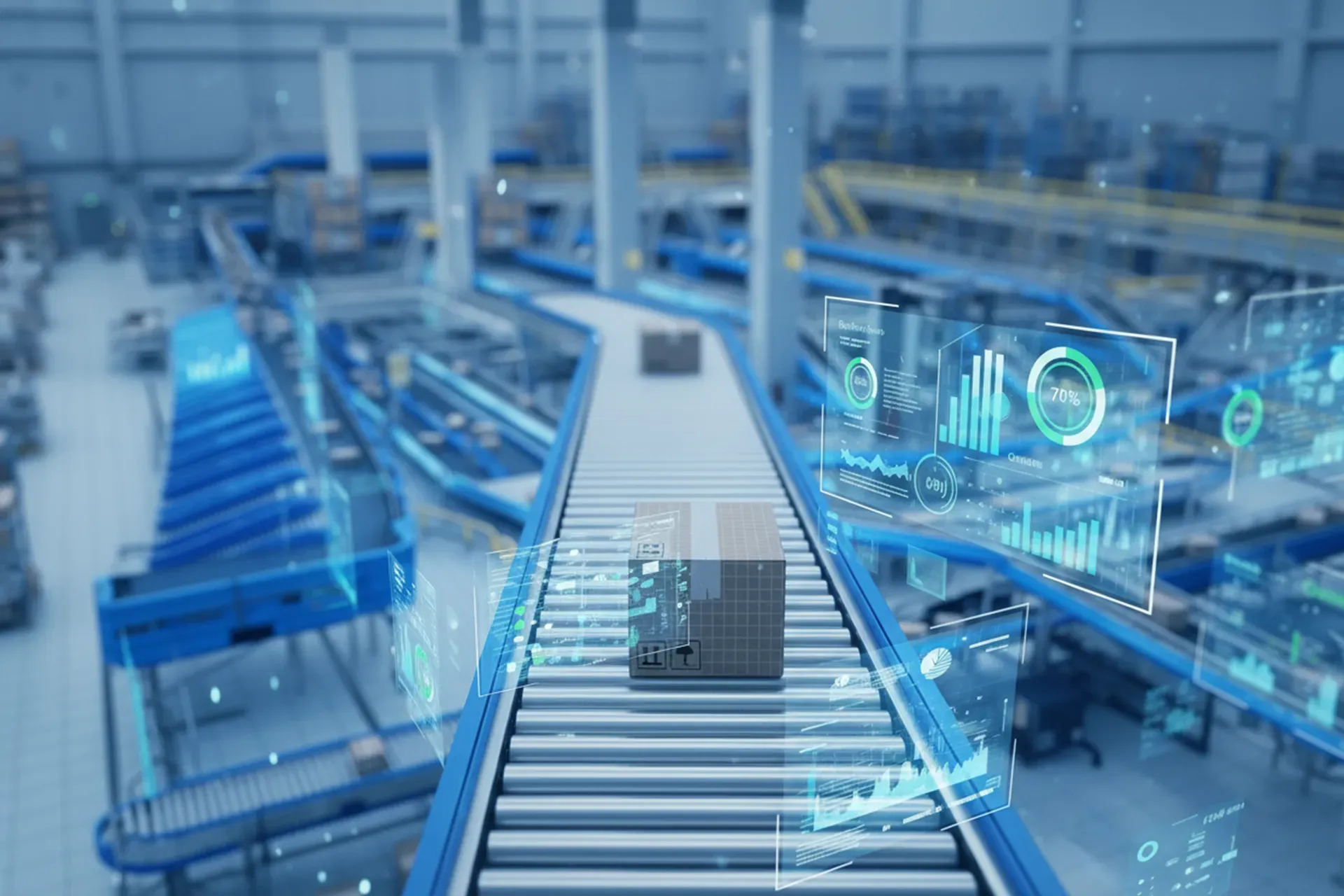
Warehouse simulation software produces a combination of visual outputs and quantitative performance data that together give engineering and operations teams a clear picture of how a system will behave. The visual component, a 2D or 3D animated model, makes it possible to see where queues form, where equipment sits idle, and where material flows interact in ways that create problems.
The quantitative outputs are where decisions get made. Typical outputs include throughput rates across the full shift, equipment utilization percentages, queue lengths at key points, cycle times, and labor productivity metrics. These numbers can be compared across scenarios, for example, the current design versus a modified buffer layout, or average demand versus peak demand, to make the trade-offs visible and quantifiable.
For stakeholders who need to present investment decisions to leadership, simulation outputs also provide a defensible evidence base. Rather than relying on vendor projections alone, teams can show modeled performance under a range of conditions, including stress scenarios that stress-test the business case rather than just confirming it.
How Enterprise Dynamics helps prevent automation failures
Enterprise Dynamics is our discrete event simulation platform built specifically for the complexity of modern warehouse and intralogistics environments. As a purpose-built DES simulation platform, it gives engineering teams the tools to model, test, and validate automation designs before implementation, reducing the risk of costly surprises during commissioning or go-live.
With Enterprise Dynamics, teams can:
- Build accurate digital twin warehouse models using a library of pre-built, drag-and-drop components representing conveyors, sorters, AGVs, pick stations, and more
- Run what-if scenarios to compare layout alternatives, equipment configurations, and control logic options under realistic demand conditions
- Identify throughput bottlenecks, buffer sizing issues, and resource contention before a single piece of equipment is installed
- Integrate with WMS and ERP data to ensure the model reflects actual operational logic, not idealized assumptions
- Visualize system behavior in 2D and 3D to communicate findings clearly to engineering teams, project sponsors, and executive stakeholders
If you are planning an automation investment and want to validate your design before committing, get in touch with our team to discuss how simulation can be applied to your specific project.
Frequently Asked Questions
How long does it typically take to build and validate a warehouse simulation model?
The timeline depends on the complexity of the operation, but most warehouse simulation projects range from a few weeks to a few months. A straightforward single-zone automated system might be modeled and validated in three to six weeks, while a multi-zone facility with complex WMS logic, AGVs, and mixed SKU flows can take two to four months. The validation phase — where the model is run against historical data to confirm it reproduces real behavior — is a critical step that should not be rushed, as it determines how much confidence you can place in the scenario results.
What data do I need to provide before a simulation project can begin?
The core inputs are order history (ideally 12 months to capture seasonal variation), SKU velocity profiles, equipment specifications, layout drawings, and shift patterns including staffing levels. WMS routing rules and control logic documentation are also highly valuable, especially for validating dispatch and sequencing behavior. If some data is incomplete or unavailable, experienced simulation engineers can work with representative assumptions and sensitivity analyses — but the more accurate the inputs, the more reliable the outputs.
Can simulation be used to evaluate an existing warehouse, not just a new automation project?
Absolutely. Simulation is equally valuable for existing operations facing capacity constraints, throughput problems, or planned changes such as new product lines, volume growth, or equipment upgrades. In these cases, the current system is modeled and validated against live operational data, then used to test proposed changes before they are implemented. This approach is often faster than a greenfield project because real operational data is already available to drive and validate the model.
What is the difference between a digital twin and a warehouse simulation model?
A warehouse simulation model is built to test and validate a design before it exists physically — it is predictive and used during the planning phase. A digital twin, in the strictest sense, is a live-connected model of an existing system that continuously receives real-time data from sensors and equipment to mirror current operational state. In practice, the two overlap significantly: a well-built simulation model often becomes the foundation for a digital twin once the physical system is operational, making the upfront simulation investment even more valuable over the long term.
How do I know if the simulation results are accurate enough to base major investment decisions on?
Accuracy is established through the validation process, where the model is run against known historical performance data and the outputs are compared to real-world results. A well-validated model should reproduce key metrics — throughput rates, queue behavior, cycle times — within an acceptable tolerance, typically within five to ten percent of observed values. If the model cannot reproduce past behavior reliably, it should not be trusted to predict future behavior. Working with experienced simulation engineers who follow a structured validation methodology is the most important factor in producing results that can defensibly support capital investment decisions.
What are the most common mistakes teams make when using warehouse simulation for the first time?
The most frequent mistake is treating simulation as a one-time validation exercise rather than an iterative design tool — running the model once, confirming the initial design looks acceptable, and moving on. Simulation delivers the most value when used to actively explore alternatives and stress-test assumptions across multiple scenarios. Other common pitfalls include using overly optimistic input data (such as vendor-rated equipment speeds rather than real-world availability rates), skipping the validation step, and involving simulation too late in the project when design flexibility has already been constrained by procurement or site decisions.
Can simulation help with the business case for automation, not just the technical design?
Yes, and this is an underused application. Simulation outputs — modeled throughput under a range of demand scenarios, equipment utilization rates, labor productivity metrics — provide an independent, evidence-based layer that strengthens the financial case for automation investment. Rather than presenting leadership with vendor projections alone, teams can show how the proposed system performs under best-case, expected, and stress-test conditions, making the risk profile of the investment visible and quantifiable. This kind of scenario-based evidence is particularly valuable when seeking approval for large capital expenditures or when the business case depends on achieving specific throughput or labor reduction targets.
Related Articles
- How does warehouse layout planning reduce costly redesign mistakes?
- What does warehouse simulation software do that spreadsheets cannot?
- How do you validate a warehouse control system using digital twin software?
- What is the benefit of combining simulation formalisms in one warehouse model?
- What is supply chain optimization?