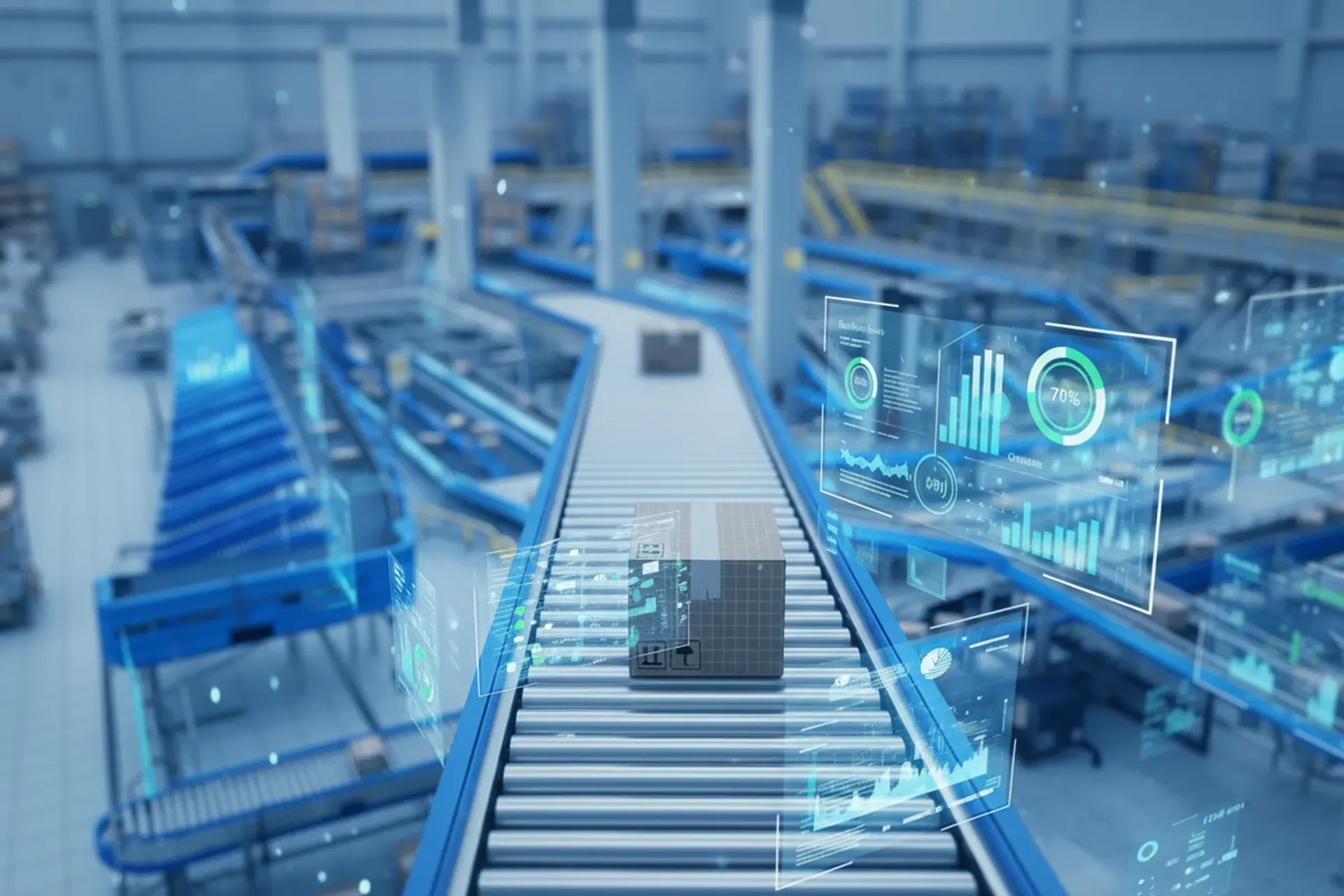
Yes, warehouse layout simulation can absolutely model conveyor and sortation systems. Modern discrete event simulation software represents these systems with high fidelity, capturing belt speeds, transfer points, merge and divert logic, accumulation zones, and sortation mechanisms. This makes simulation one of the most reliable tools for validating conveyor-based warehouse designs before a single piece of equipment is installed.
Whether you are planning a new distribution center, upgrading an existing line, or evaluating the impact of adding a new sortation unit, simulation gives you a virtual environment to test every assumption. The sections below answer the most common questions engineers and operations teams ask when considering warehouse simulation software for conveyor and sortation system design.
What types of conveyor systems can warehouse simulation model?
Warehouse simulation software can model virtually every conveyor type found in modern distribution centers. This includes belt conveyors, roller conveyors, chain conveyors, accumulation conveyors, incline and decline sections, cross-belt sorters, tilt-tray sorters, pop-up wheel sorters, and sliding shoe sorters. Each component can be configured with realistic physical parameters such as speed, capacity, and spacing rules.
Beyond individual conveyor segments, material handling simulation captures how these components interact as a system. Merge points, divert gates, buffer zones, and transfer units all behave according to the rules you define. This means you can model:
- Single-line and multi-line induction stations feeding a sorter
- Loop sorters with multiple chute destinations
- Accumulation zones that prevent product collisions
- Spiral conveyors connecting multiple mezzanine levels
- Automated storage and retrieval system interfaces with conveyor spurs
The depth of what can be modeled depends on the simulation platform. Platforms built specifically for intralogistics simulation and material handling environments, like Enterprise Dynamics, come with prebuilt conveyor and sortation components that replicate real-world behavior without requiring engineers to build logic from scratch.
How does simulation model sortation logic and routing decisions?
Simulation models sortation logic by encoding the decision rules that govern how items are routed to their destinations. These rules can mirror the exact logic used by a warehouse control system, including order-based routing, destination sequencing, exception handling for unreadable labels, and recirculation loops for items that miss their sort window.
This is where conveyor simulation moves beyond simple flow diagrams. A static layout drawing can show you where chutes are located, but it cannot tell you what happens when induction throughput spikes, a chute fills to capacity, or a scan tunnel misreads a barcode at 2,000 items per hour. Simulation plays out these scenarios dynamically, letting you observe how routing decisions cascade through the system under realistic operating conditions.
Engineers can test different sorting strategies side by side, such as comparing zone-based routing against wave-based routing, to identify which approach delivers better throughput and fewer recirculations. This kind of what-if testing is one of the most valuable capabilities a DES simulation platform brings to sortation system design.
Build your own simulation, your way
Enterprise Dynamics gives developers full control to model, scale, and integrate complex systems with C++, APIs, and real-time data.
Explore Enterprise DynamicsCan simulation predict bottlenecks in conveyor and sortation systems?
Yes, bottleneck prediction is one of the core strengths of warehouse simulation software. By running the model under realistic load conditions, material flow simulation surfaces the exact points in a conveyor or sortation system where throughput breaks down, queues build, or cycle times degrade. These findings appear before any physical equipment is ordered or installed.
Common bottlenecks that simulation reliably identifies include:
- Induction rate mismatches where manual or automated induction cannot keep pace with sorter capacity
- Merge point congestion where two product streams compete for the same conveyor section
- Chute overflow when downstream picking or packing cannot clear destinations fast enough
- Recirculation overload when a high percentage of items miss their sort window and loop back repeatedly
- Accumulation zone saturation that causes upstream lines to stop and start unpredictably
Because simulation runs at compressed time scales, you can observe the equivalent of an entire peak-season shift in minutes. This allows operations teams to validate not just average throughput but also system behavior under the stress conditions that matter most, such as Black Friday volumes or end-of-day order cutoffs.
What’s the difference between simulating a conveyor system and a digital twin?
A conveyor simulation is a model built to answer specific design or planning questions. It runs scenarios, produces results, and informs decisions. A digital twin is a continuously connected virtual replica of a live system, updated in real time with operational data from sensors, PLCs, and warehouse control systems. The key distinction is that simulation is primarily a planning tool, while a digital twin is an operational tool.
In practice, the line between the two is increasingly blurred. DES simulation software that integrates with WMS and ERP systems can be extended into a digital twin by connecting it to live data feeds. This means the same model used to validate a conveyor design during the planning phase can later be connected to the real system to monitor performance, test operational changes, and predict future states without disrupting live operations.
For most warehouse projects, simulation comes first. Teams build and validate the design virtually, then decide whether a persistent digital twin connection adds ongoing operational value. Both approaches use the same underlying modeling technology, which is why choosing a capable warehouse simulation platform from the start protects your investment either way.
When should a warehouse use simulation to validate conveyor system design?
Simulation adds the most value when the cost of getting a conveyor or sortation design wrong is high. This is true for any project where equipment lead times are long, installation is disruptive, or throughput requirements are complex. As a general rule, the more interdependent the components in a system, the more simulation validation is worth.
Specific moments where warehouse automation simulation is particularly well suited include:
- Greenfield distribution center design, where layout decisions are still reversible
- Capacity expansion projects that add new sortation lines to an existing facility
- Automation investment decisions where the business case needs quantified throughput evidence
- System integrator proposals that need independent validation before contract sign-off
- Peak season readiness assessments where operational risk is highest
Simulation is also valuable after a system is installed. If throughput targets are not being met, a calibrated model of the existing system can isolate the cause far faster than trial-and-error adjustments on the live line.
How Enterprise Dynamics helps you model conveyor and sortation systems
Enterprise Dynamics is our DES simulation platform built specifically for material handling, intralogistics, and warehouse environments. It is designed to handle exactly the kind of complex, interconnected systems that conveyor and sortation design demands.
With Enterprise Dynamics, your engineering team can:
- Build detailed conveyor and sortation models using a drag-and-drop library of prebuilt material handling simulation components
- Test sortation logic, routing rules, and exception scenarios before committing to a warehouse control system configuration
- Identify throughput bottlenecks and validate system capacity under peak load conditions
- Visualize the model in 2D and 3D to communicate design decisions to stakeholders across operations, engineering, and management
- Integrate with WMS and ERP data to move toward a digital twin of your distribution center
Whether you are validating a new sortation investment, stress-testing an existing design, or building the business case for automation, Enterprise Dynamics gives you the evidence you need to move forward with confidence. Get in touch with our team to discuss your project and see how simulation can support your next conveyor or sortation system decision.
Frequently Asked Questions
How long does it typically take to build a conveyor and sortation simulation model?
Build time depends on system complexity, but most conveyor and sortation models can be developed in two to six weeks when using a platform with prebuilt material handling components like Enterprise Dynamics. Simpler single-line systems may be ready for testing in days, while large multi-level distribution centers with complex sortation logic naturally require more configuration and validation time. Having accurate layout drawings, throughput targets, and routing rules ready before the project starts is the single biggest factor in accelerating model development.
What data do I need to provide to run a meaningful conveyor simulation?
At a minimum, you need your facility layout or CAD drawings, conveyor specifications (belt speeds, lengths, and capacities), product mix data (dimensions, weights, and volume by SKU), and your target throughput rates by time period. Sortation logic rules, order profiles, and downstream processing times at pack stations or chutes will significantly improve model accuracy. The more realistic your input data, the more reliable your simulation results will be when predicting real-world performance.
Can simulation model human operators working alongside conveyor systems, such as induction staff or pack station workers?
Yes, simulation can model human operators as active resources within the system, including their work rates, error rates, break schedules, and variability in task completion times. This is especially important for induction stations, where manual scan-and-induct rates directly govern sorter throughput, and for pack stations, where operator speed determines how quickly chutes are cleared. Modeling people alongside equipment gives you a much more accurate picture of true system capacity than modeling conveyors in isolation.
What happens if my actual throughput after installation doesn't match what the simulation predicted?
A gap between simulated and actual throughput is almost always traceable to input data that didn’t fully reflect real-world conditions, such as actual operator pace, unplanned downtime, or product mix variation. The right response is to calibrate the model using live operational data, then use it to diagnose the specific points where performance is falling short. A well-built simulation model becomes even more valuable post-installation as a diagnostic tool, allowing you to test operational adjustments virtually before applying them to the live system.
Is warehouse simulation only worth it for large-scale distribution centers, or can smaller operations benefit too?
Simulation scales to the size of the decision, not the size of the facility. Smaller operations with a single sortation line or a modest conveyor network can benefit significantly when they are evaluating a capital investment, planning a layout change, or troubleshooting a throughput problem. The cost of a simulation study is almost always a fraction of the cost of a poorly specified equipment purchase or a layout that requires rework after installation. For any project where getting the design wrong has real financial consequences, simulation is worth considering.
Can I use the same simulation model to evaluate multiple vendor proposals or equipment configurations?
Absolutely, and this is one of the most practical applications of simulation in the procurement process. Once a baseline model of your system requirements is built, you can swap in different equipment parameters, such as sorter speeds, chute counts, or induction configurations from competing vendors, and compare performance outcomes on equal footing. This gives your team objective, data-driven evidence to evaluate proposals rather than relying solely on vendor-supplied throughput claims, and it significantly strengthens your position during contract negotiations.
How do I know if a simulation platform is capable enough to handle my specific conveyor and sortation requirements?
Ask the vendor to demonstrate the platform modeling scenarios that are specific to your system, such as merge point behavior under surge conditions, recirculation loop handling, or multi-level spiral conveyor transfers. Platforms built specifically for material handling environments will have these components available as prebuilt, configurable objects rather than requiring custom code for each element. Requesting a proof-of-concept model using your actual layout data before committing to a platform is a reasonable and common practice for complex projects.
Related Articles
- How does warehouse simulation software handle multi-threaded computing?
- How do developers build custom warehouse simulation applications?
- How does simulation help warehouses adapt to changing order profiles?
- Which software is used in a warehouse?
- How can supply chain simulation software improve automated warehouses?