Simulation helps warehouses adapt to changing order profiles by creating a virtual model of the operation where managers can test how shifts in order mix, volume, or SKU complexity affect throughput, staffing, and layout, all without disrupting live operations. When order patterns change, the risks of getting the response wrong are significant: bottlenecks emerge, labor costs spike, and service levels drop. The sections below unpack the most common questions warehouses ask when facing this challenge.
What causes order profiles to change in warehouse operations?
Order profiles in a warehouse change when the mix, volume, frequency, or composition of customer orders shifts in ways that the existing operation was not designed to handle. The most common drivers are channel expansion (adding e-commerce to a retail distribution model), seasonal demand peaks, new product introductions, and changes in customer expectations around order size or delivery speed.
Each of these drivers creates a different operational challenge. A shift from pallet-level B2B orders to single-item B2C picks, for example, dramatically increases pick density and labor demand while reducing average order value per pick. Seasonal peaks compress the same volume into shorter windows, stressing conveyor capacity and sortation systems. New SKUs or product categories change slotting logic and may introduce new storage requirements.
- Channel mix shifts: Adding or scaling e-commerce alongside wholesale distribution creates competing pick strategies in the same facility
- Demand volatility: Promotional events, market growth, or economic shifts cause order volumes to spike or drop unpredictably
- Product range changes: New SKUs, product sizes, or categories alter storage requirements and pick paths
- Customer expectation changes: Shorter lead times and smaller, more frequent orders increase operational complexity per unit shipped
What makes these changes difficult to manage is that they rarely arrive in isolation. A warehouse adapting to e-commerce growth while also handling a seasonal peak is dealing with compounding pressures that traditional planning tools struggle to model accurately.
How does simulation model shifting order patterns in a warehouse?
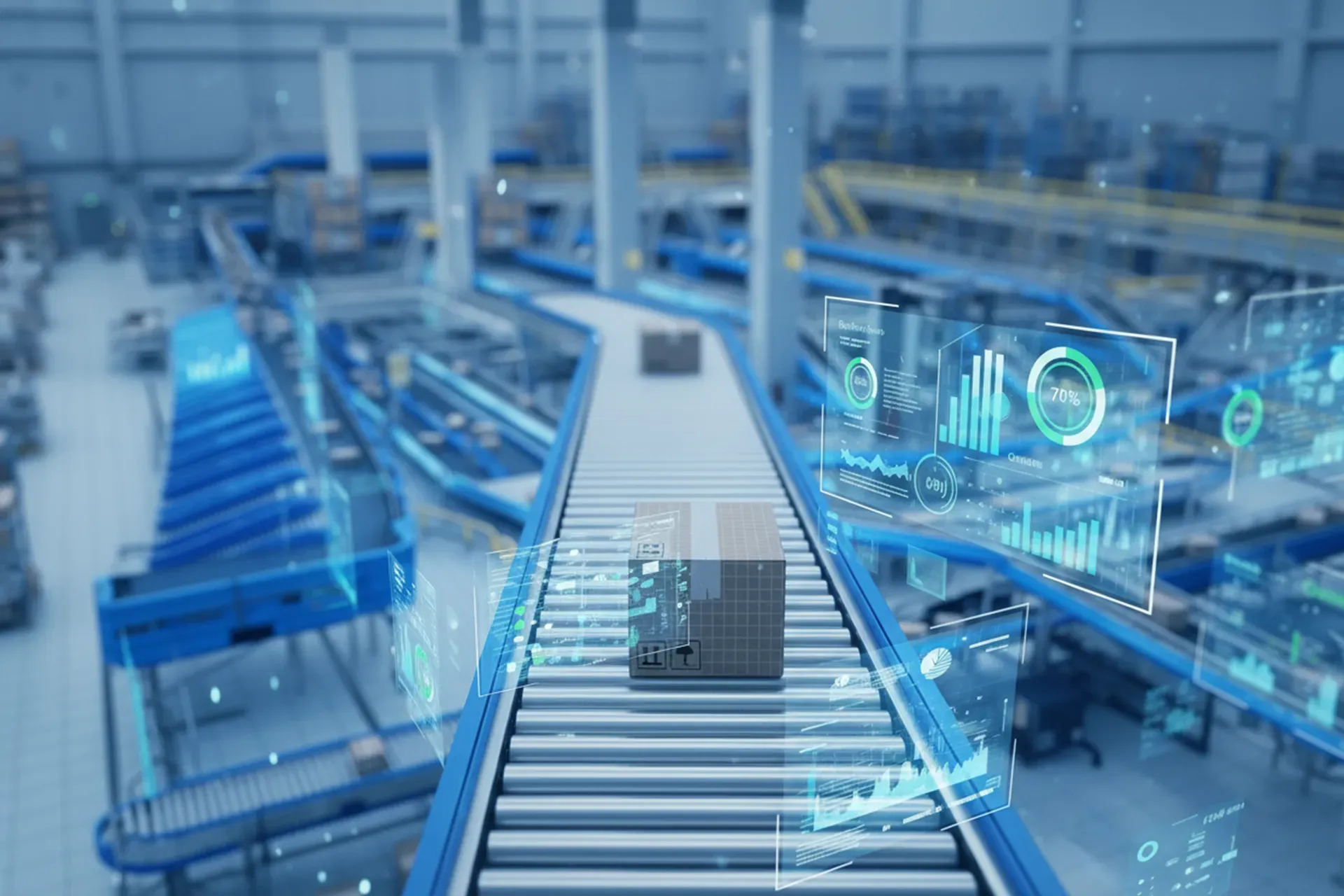
Warehouse simulation software models shifting order patterns by importing real or projected order data and running it through a virtual replica of the facility. The simulation replicates pick paths, conveyor flows, sortation logic, staffing levels, and equipment behavior, then measures how the system performs under the new demand profile before any physical change is made.
The key strength of discrete event simulation software in this context is its ability to capture time-dependent behavior. Orders do not arrive at a constant rate, and workers do not move at a fixed speed. A well-built simulation model accounts for variability in order arrival, pick times, equipment cycle times, and shift patterns. This means the output reflects realistic throughput ranges, not just theoretical averages.
Modern warehouse simulation platforms integrate directly with Warehouse Management Systems (WMS) and ERP systems, which means the model can be fed with live or historical order data rather than manual estimates. This integration makes it possible to run simulations that reflect the actual complexity of the operation, including multi-zone picking, batch strategies, and carrier cutoff windows. The same DES simulation environment that handles material flow simulation across a single facility can scale to support supply chain simulation across multiple nodes.
Once the base model is validated against current performance, planners can introduce the new order profile and observe exactly where the system begins to strain. The simulation produces measurable outputs: throughput per hour, queue lengths, resource utilization rates, and order cycle times. These outputs give decision-makers a clear, data-driven picture of what the operation can and cannot handle.
Build your own simulation, your way
Enterprise Dynamics gives developers full control to model, scale, and integrate complex systems with C++, APIs, and real-time data.
Explore Enterprise DynamicsWhat warehouse bottlenecks does simulation reveal when order profiles change?
When order profiles change, warehouse simulation reveals bottlenecks at the points where the new demand pattern exceeds the capacity or design intent of the existing system. The most common bottlenecks identified include pick face congestion, conveyor merge points, sortation capacity, packing stations, and dock scheduling conflicts.
Pick face congestion is particularly common when a warehouse transitions from case or pallet picking to unit-level picking. The same aisle layout that handled ten pickers efficiently may become a collision point when forty pickers are required to meet the new order volume. Simulation makes this visible by tracking individual picker movement and queue formation over time.
Conveyor and sortation systems are another frequent bottleneck. These systems are typically designed for a specific throughput ceiling. When order volume increases or order profiles shift toward smaller, more frequent shipments, the number of individual items moving through the system rises sharply. Intralogistics simulation identifies exactly which conveyor segments or sort destinations reach capacity first and under what conditions, giving operations teams a precise view of material flow constraints before they become live problems.
- Pick face congestion: Higher pick density creates aisle conflicts and increases travel time per order
- Conveyor merge points: Multiple induct points feeding a single conveyor create queue buildup during peak windows
- Sortation capacity: Increased item count per hour can exceed the rated throughput of sorters and divert equipment
- Packing station throughput: Smaller orders with more lines require more packing decisions per unit time
- Dock and staging area conflicts: More frequent, smaller shipments increase dock door demand and staging space pressure
By identifying these bottlenecks before they occur in the live operation, warehouse managers can prioritize which constraints to address first and evaluate whether the solution requires a layout change, a process change, additional equipment, or simply a scheduling adjustment.
How can simulation be used to test warehouse layout changes before implementation?
Simulation allows warehouse teams to test layout changes by building a virtual version of the proposed design and running realistic order scenarios through it before a single rack is moved or a conveyor section is installed. This approach eliminates the risk of committing capital to a layout that performs worse under real conditions than it appeared to on paper.
The process typically starts with the current layout as a validated baseline. Engineers then modify the virtual model to reflect the proposed change, whether that is relocating a pick zone, adding a mezzanine level, reconfiguring conveyor routing, or introducing new automation. Where facilities are evaluating automated storage and retrieval system simulation or AGV simulation alongside conventional picking, the DES simulation tool can model all of these elements together within the same environment. The simulation then runs the same order scenarios through both the current and proposed layouts, producing a direct performance comparison.
This kind of what-if testing is particularly valuable when multiple layout options are under consideration. Rather than debating the merits of each option in a meeting room, the team can run all three or four variants through the same demand scenarios and compare throughput, labor requirements, and equipment utilization side by side. The decision becomes evidence-based rather than opinion-based.
Layout testing through simulation also helps validate the business case for capital investment. When a warehouse manager needs to justify the cost of a new sortation system or an expanded pick area to finance or senior leadership, simulation output provides the quantitative evidence that supports the investment decision. Enterprise Dynamics simulation software is built specifically for this kind of operational modeling, combining drag-and-drop layout building with detailed performance analytics.
When should a warehouse invest in simulation software?
A warehouse should invest in simulation software when the cost of getting an operational decision wrong exceeds the cost of the software itself, which is typically the case whenever significant capital investment, major layout changes, or high-stakes operational transitions are involved. Simulation pays for itself most clearly when it prevents a costly mistake or accelerates a decision that would otherwise require months of physical trial and error.
There are several specific moments when the case for warehouse simulation becomes particularly strong:
- Before building or expanding a facility: Validating the design before construction locks in layout decisions that are expensive to reverse
- When automating or adding mechanized systems: Conveyor networks, sorters, and AS/RS systems represent large capital commitments that simulation can validate before procurement
- When order profiles are shifting significantly: As described throughout this article, changing demand patterns stress systems in ways that are difficult to predict without modeling
- When throughput targets are not being met: Simulation identifies the root cause of underperformance more precisely than manual observation
- When planning for peak seasons: Running simulated peak scenarios reveals whether the operation can absorb volume spikes before they happen
Warehouses that operate with thin margins, high throughput requirements, or complex multi-channel fulfillment tend to see the fastest return on a simulation investment. DES software for warehousing is also increasingly accessible: platforms like Enterprise Dynamics offer intuitive modeling environments that do not require a team of specialists to operate, making simulation practical for a wider range of operations than it once was.
How Enterprise Dynamics helps warehouses adapt to changing order profiles
We built Enterprise Dynamics to give warehouse planners and engineers the tools they need to stay ahead of operational change rather than react to it. When order profiles shift, the software lets you model the impact before it hits the floor.
- Digital twin integration: Connect directly to your WMS and ERP to build a simulation model that reflects your real operation, not a simplified approximation
- What-if scenario testing: Run multiple order profile scenarios side by side to compare throughput, labor demand, and equipment utilization across different demand futures
- Bottleneck identification: Pinpoint exactly where the system breaks down under new order patterns, from pick face congestion to sortation limits
- Layout validation: Test proposed layout changes virtually before committing to physical reconfiguration or capital expenditure
- 2D and 3D visualization: Communicate simulation results clearly to stakeholders across engineering, operations, and finance
Whether you are preparing for a channel expansion, evaluating automation investment, or trying to understand why throughput is falling short of targets, simulation gives you the evidence to make the right call. Get in touch with our team to discuss how Enterprise Dynamics can support your warehouse planning process.
Frequently Asked Questions
How accurate does the order data need to be to get reliable simulation results?
The simulation is only as reliable as the data fed into it, but it does not need to be perfect to be useful. Historical order data from your WMS covering at least 4–8 weeks of typical operations, plus any available peak period data, is usually sufficient to build a credible baseline model. If you are simulating a future order profile that does not yet exist, such as a new e-commerce channel, you can use projected order volumes and mix assumptions, then run sensitivity analyses to understand how results change if those assumptions are off by 10–20%.
How long does it typically take to build and validate a warehouse simulation model?
For a mid-sized single-facility operation, an initial simulation model can typically be built and validated within 4–8 weeks, depending on the complexity of the layout, the number of process flows involved, and the quality of available data. Validation, which involves comparing the model’s output against known real-world performance metrics, is the most critical step and should not be rushed. Once a validated baseline model exists, running additional what-if scenarios takes hours or days rather than weeks, which is where the ongoing value of the investment compounds.
Can simulation help if we are not planning a major layout change, just adjusting staffing or slotting?
Absolutely. Simulation is just as valuable for operational adjustments as it is for capital projects. Testing changes to shift schedules, labor allocation across zones, or SKU slotting logic through simulation can reveal meaningful throughput gains without any physical reconfiguration. In many cases, warehouses discover through simulation that a scheduling change or a re-slotting of fast-moving SKUs resolves a bottleneck they had assumed required equipment investment.
What is the difference between warehouse simulation and a simple spreadsheet capacity model?
A spreadsheet model calculates averages: average picks per hour, average throughput per shift, average labor required. Simulation captures variability and time-dependent behavior, which is where real operations actually break down. A spreadsheet will tell you that your conveyor has enough theoretical capacity; a simulation will show you that it hits a queue-forming bottleneck for 45 minutes every morning when two pick zones induct simultaneously. That distinction is precisely what makes simulation the more reliable planning tool when order profiles are changing and the stakes are high.
How do we know which bottleneck to fix first when simulation reveals multiple problem areas?
Simulation output typically includes utilization rates and queue metrics for every resource in the model, which makes prioritization straightforward. Start with the constraint that has the highest utilization rate or the longest sustained queue, as this is the system’s binding constraint, meaning fixing downstream issues first will deliver little improvement until the primary constraint is resolved. A useful rule of thumb is to address bottlenecks in flow order: if pick face congestion is starving the conveyor, resolving the pick-side constraint first will reveal the true capacity of the rest of the system.
What is the biggest mistake warehouses make when using simulation for the first time?
The most common mistake is skipping or shortcutting the model validation step. Teams eager to get to scenario testing sometimes build a model, assume it is correct, and make decisions based on output that has never been checked against real performance data. If the baseline model does not accurately replicate current throughput, queue behavior, and resource utilization, none of the what-if results can be trusted. Always validate the model against at least two or three known operational conditions before using it to evaluate changes.
Can the same simulation model be reused as our operation continues to evolve, or do we need to rebuild it each time?
A well-structured simulation model is a long-term operational asset, not a one-time project deliverable. As your operation changes, the model can be updated incrementally to reflect new layout elements, equipment additions, or revised process logic without rebuilding from scratch. Platforms like Enterprise Dynamics are designed specifically for this kind of ongoing use, allowing teams to maintain a living digital twin of the facility that stays current as the real operation evolves and can be re-run whenever a new planning question arises.
Related Articles
- What is the difference between warehouse simulation and a digital twin?
- Can digital twin warehouse software model third-party logistics operations?
- How do developers build custom warehouse simulation applications?
- What are the key performance indicators tracked by warehouse simulation software?
- How to measure resilience in supply chain?