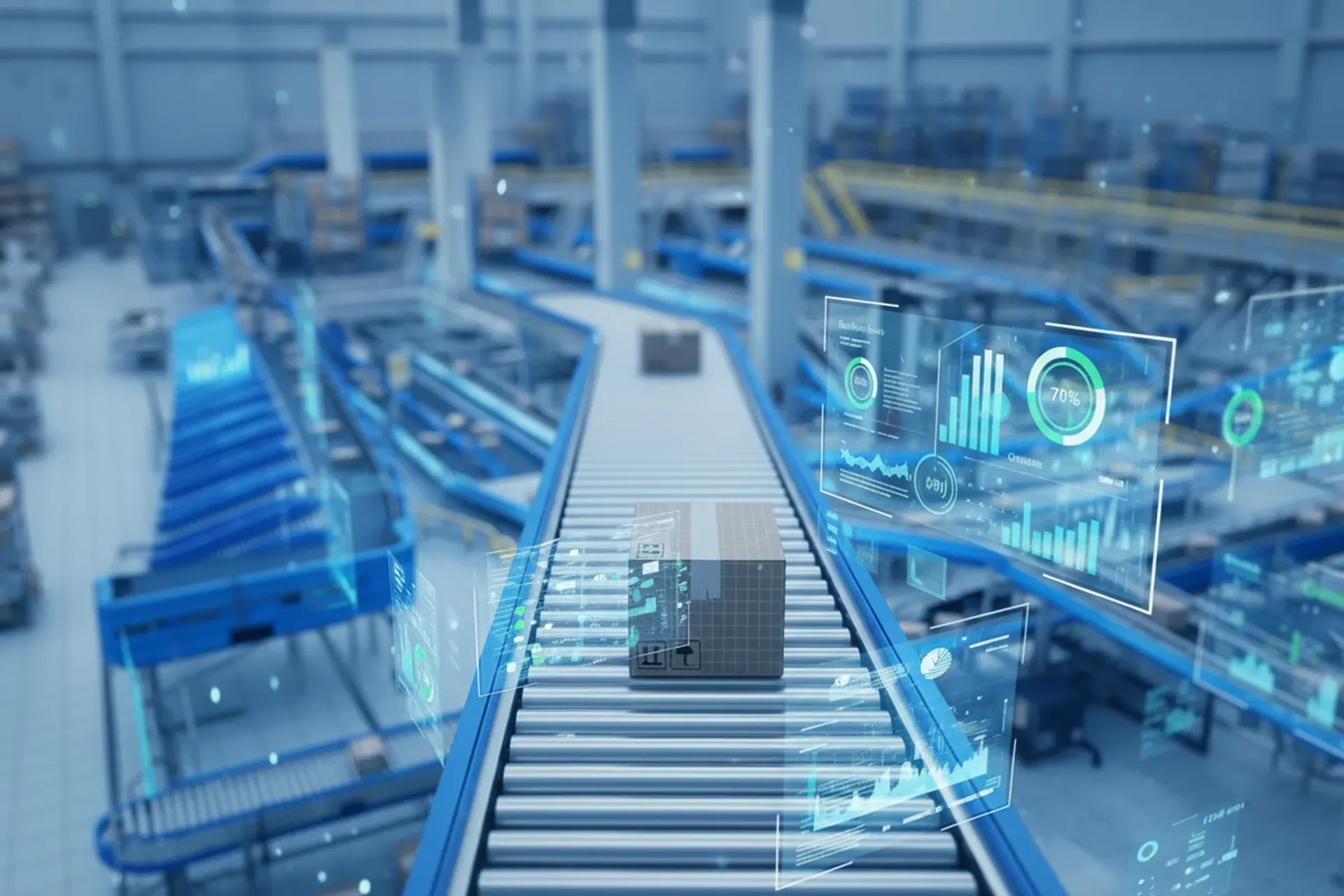
Warehouse simulation software benefits most industries that operate high-volume, complex distribution environments where downtime, errors, or inefficiencies carry significant cost. E-commerce fulfillment, pharmaceutical distribution, and retail and grocery logistics are the clearest fits, but any operation managing intricate material flows, tight service levels, or large capital investments can gain real value from simulation. Below, we walk through the key industries and the questions worth asking about your own operation.
Which types of operations is warehouse simulation built for?
Warehouse simulation software is built for operations where process complexity, volume variability, or investment scale makes it too risky to rely on guesswork. These are environments where a single bottleneck, miscalculated resource level, or poorly timed expansion can cascade into significant operational and financial damage. Simulation gives planners a risk-free space to test decisions before they are made in the real world.
At its core, discrete event simulation software models how goods, people, and equipment interact over time inside a warehouse or distribution center. It captures the dynamic nature of operations that static tools like spreadsheets simply cannot replicate. The types of operations that benefit most share a few common traits:
- High throughput with multiple simultaneous flows of goods
- Complex automation or conveyor systems with interdependencies
- Significant variability in demand, order profiles, or staffing
- Upcoming investments in equipment, layout changes, or new technology
- Strict service level requirements with little tolerance for failure
Industries like material handling, intralogistics, pharmaceutical distribution, e-commerce, and retail logistics consistently match this profile, which is why they have become the primary adopters of DES simulation software and digital twin warehouse tools.
What makes e-commerce fulfillment such a strong fit for simulation?
E-commerce fulfillment is one of the strongest fits for warehouse simulation software because of the extreme variability in order volumes, the diversity of SKUs, and the pressure to meet next-day or same-day delivery promises. No two days look the same in an e-commerce warehouse, and that unpredictability is exactly what simulation is designed to handle.
Fulfillment centers serving online retail face a unique combination of challenges. Peak events like promotional sales or seasonal surges can multiply order volumes several times over within hours. At the same time, automation investments in sorters, goods-to-person systems, and autonomous mobile robots are substantial and largely irreversible once deployed. Getting those decisions wrong is expensive.
Warehouse automation simulation allows e-commerce operators to model what happens when order volume spikes, when a sorter goes offline, or when a new picking strategy is introduced. Engineers can run hundreds of scenarios virtually to identify where throughput breaks down and what configuration of equipment and staffing best handles peak demand. This is far more reliable than rule-of-thumb capacity planning and far less risky than learning through live trial and error.
Build your own simulation, your way
Enterprise Dynamics gives developers full control to model, scale, and integrate complex systems with C++, APIs, and real-time data.
Explore Enterprise DynamicsHow does pharmaceutical distribution use warehouse simulation?
Pharmaceutical distribution uses warehouse simulation software to validate that complex, highly regulated picking and storage operations can meet throughput targets while maintaining compliance. In pharma, the cost of a process failure extends well beyond operational disruption, it can affect patient safety and regulatory standing, making risk-free testing essential.
Pharmaceutical distribution centers typically handle a wide range of product types with strict storage requirements, expiry tracking, and serialization demands. Order accuracy requirements are among the highest of any industry. At the same time, these facilities are increasingly automated, with sophisticated conveyor simulation models, automated storage and retrieval system simulation, and temperature-controlled zones all interacting simultaneously.
Intralogistics simulation enables pharma distribution planners to stress-test these systems before go-live. They can model how a new automated picking line performs under different order mixes, identify where queues build up during peak processing windows, and validate staffing levels for manual intervention points. For organizations like Boehringer Ingelheim, which operates in a sector where precision is non-negotiable, a robust DES simulation platform provides the confidence that a new or modified system will perform as designed from day one.
Why do retail and grocery distributors rely on simulation software?
Retail and grocery distributors rely on warehouse simulation software because their operations combine high volume, tight delivery windows, and significant seasonal variation, all within facilities that are often running at or near capacity. Simulation gives these distributors a way to optimize without disrupting live operations that cannot afford downtime.
Grocery distribution in particular operates under intense time pressure. Products have short shelf lives, store replenishment windows are fixed, and the margin for error in throughput planning is narrow. A distribution center that cannot handle a promotional week or a seasonal peak will cause stockouts at store level, with direct impact on revenue and customer satisfaction.
Retail distributors use logistics simulation software to answer questions that are otherwise very difficult to model accurately:
- Can the current dock and sortation setup handle a 30% volume increase during peak season?
- What happens to throughput if a key conveyor segment is taken offline for maintenance?
- How many pickers are needed to maintain order cycle times across different shift configurations?
- Which layout change would have the greatest impact on outbound throughput?
By running these scenarios virtually, retail and grocery operators make better-informed decisions about capacity, staffing, and automation investment without gambling on live operations.
Which other industries are increasingly adopting warehouse simulation?
Beyond the traditional strongholds of e-commerce, pharma, and retail distribution, several other industries are increasingly turning to warehouse simulation software as their operations grow in complexity and the cost of getting decisions wrong rises.
Automotive parts distribution is one growing area, where just-in-time delivery requirements and the diversity of parts create complex picking and sequencing challenges that material flow simulation handles particularly well. Third-party logistics providers are another, as they need to model how a new client’s volume and order profile will interact with existing operations before committing to a contract. Airport baggage handling and cargo operations also benefit significantly, as these are high-throughput environments with strict time constraints and costly automation infrastructure.
Defense and industrial manufacturing are also adopting DES simulation for warehouse and intralogistics planning, particularly where custom or high-value components move through complex internal supply chains. Supply chain simulation software is increasingly used in these sectors to validate end-to-end material flow before committing to infrastructure changes. The common thread across all of these sectors is the same: high stakes, complex interdependencies, and the need to validate decisions before they are implemented at scale.
How do you know if your operation needs warehouse simulation software?
Your operation likely needs warehouse simulation software if you are planning a significant investment, experiencing recurring bottlenecks you cannot diagnose with existing tools, or facing demand variability that makes static capacity planning unreliable. If any major operational decision carries meaningful financial or service-level risk, simulation is worth serious consideration.
A few practical indicators that simulation would add value to your operation:
- You are evaluating new automation, a facility expansion, or a layout redesign and need to validate the business case
- Your WMS or ERP data shows throughput shortfalls, but the root cause is unclear
- You regularly struggle to staff correctly for peak periods and are either over- or understaffed
- You have experienced unexpected failures or bottlenecks after implementing a change
- You need to demonstrate ROI on a capital investment to internal stakeholders before approval
The underlying question is whether your current planning tools can model the dynamic, time-dependent interactions inside your facility. If the honest answer is no, a dedicated DES simulation tool fills that gap directly.
How Enterprise Dynamics helps with warehouse simulation
Enterprise Dynamics is our discrete event simulation software platform built specifically for the kinds of complex material handling simulation and intralogistics simulation challenges described throughout this article. Whether you are planning a new fulfillment center, validating an automation investment, or diagnosing a persistent throughput problem, Enterprise Dynamics gives your engineering team the tools to model, test, and optimize in a risk-free virtual environment.
Here is what the platform brings to warehouse simulation projects:
- Drag-and-drop modeling using a library of pre-built atoms representing conveyors, sorters, storage systems, and workstations
- 2D and 3D visualization to communicate simulation results clearly to technical and non-technical stakeholders
- WMS and ERP integration to build models grounded in your actual operational data
- What-if scenario testing to compare layout options, staffing levels, and automation configurations before any physical change is made
- Bottleneck identification and throughput analysis to pinpoint exactly where performance breaks down under different demand conditions
If you are ready to explore what simulation can do for your warehouse or distribution operation, get in touch with our team and we will help you find the right starting point.
Frequently Asked Questions
How long does it typically take to build and run a warehouse simulation model?
The timeline depends on the complexity of your operation, but most warehouse simulation projects move from data collection to initial model results within a few weeks. A straightforward layout validation or staffing scenario can often be completed in two to four weeks, while a full-scale digital twin of a highly automated distribution center with multiple subsystems may take two to three months. Using a platform like Enterprise Dynamics, which includes pre-built atoms for common warehouse equipment, significantly reduces build time compared to coding a model from scratch.
What data do I need to provide to get started with a warehouse simulation project?
At a minimum, you need order volume data, SKU profiles, facility layout dimensions, equipment specifications, and staffing patterns across shifts. WMS or ERP exports covering at least a few months of operational history are ideal, as they capture the variability in order profiles and throughput that makes simulation valuable in the first place. You do not need perfectly clean data to begin — simulation teams are experienced at working with real-world data that has gaps or inconsistencies, and sensitivity testing can account for uncertainty in key inputs.
Can warehouse simulation software be used for an existing facility, or is it only useful when planning something new?
Simulation is equally valuable for existing operations and new builds. For existing facilities, it is particularly useful for diagnosing recurring bottlenecks, evaluating incremental automation investments, or stress-testing the current setup against projected volume growth before committing to a capital project. Many operators build a baseline model of their current operation first and then use it as a living reference to evaluate future changes, making it an ongoing planning tool rather than a one-time project deliverable.
What is the difference between warehouse simulation software and a WMS, and do I need both?
A Warehouse Management System (WMS) is an operational tool that directs and records real-time activity inside your facility — it tells workers what to pick, tracks inventory, and manages orders as they flow through. Warehouse simulation software is a planning and analysis tool that models how your operation would behave under different conditions before those conditions actually occur. They serve different purposes and are most powerful when used together: your WMS data feeds the simulation model, and the simulation results inform the operational and investment decisions that your WMS then executes.
How do I make the business case for warehouse simulation software internally?
The strongest business case ties simulation directly to a specific decision that carries financial risk — an automation investment, a facility expansion, or a recurring throughput problem with a measurable cost. Quantify what a wrong decision would cost in terms of capital write-downs, service level penalties, or lost revenue, and compare that to the cost of the simulation project. In most cases, a single avoided mistake or a validated layout change that improves throughput by even a few percentage points generates a return that far exceeds the investment in simulation.
What are the most common mistakes teams make when running their first warehouse simulation project?
The most common mistake is underinvesting in data quality and model validation — building a model quickly but not verifying that it accurately reflects real operational behavior before drawing conclusions from it. A close second is scoping the project too broadly at the start, trying to model every process in the facility simultaneously rather than focusing on the specific decision or bottleneck the simulation is meant to address. Starting with a clearly defined question, validating the model against known historical performance, and expanding scope incrementally leads to far more reliable and actionable results.
Can smaller distribution operations benefit from simulation, or is it only cost-effective at large scale?
Simulation is not exclusively a large-scale tool, though the ROI case is easiest to make when a significant capital decision is involved. Smaller operations can benefit when they are facing a specific, high-stakes question — such as whether a particular automation investment is justified, or how to reconfigure a layout to handle a new client — where the cost of getting it wrong outweighs the cost of the simulation project. Cloud-based and modular simulation platforms have also lowered the entry cost considerably, making it more accessible to mid-sized distributors than it was even five years ago.
Related Articles
- What are the five S's of warehouse management?
- What are the 4 pillars of supply chain resilience?
- What is the difference between supply chain planning and supply chain simulation software?
- What KPIs should you track with supply chain simulation software?
- What are the latest trends in supply chain simulation for 2026?