The key features to look for in warehouse simulation software are discrete event simulation, what-if scenario testing, real-time 3D visualization, WMS and ERP integration, and bottleneck identification tools. These capabilities allow logistics engineers and operations teams to model complex warehouse environments accurately, test changes safely, and make confident decisions before committing to costly infrastructure or process changes. The questions below unpack exactly what each of these features means in practice and how to evaluate them.
How does warehouse simulation software actually model real operations?
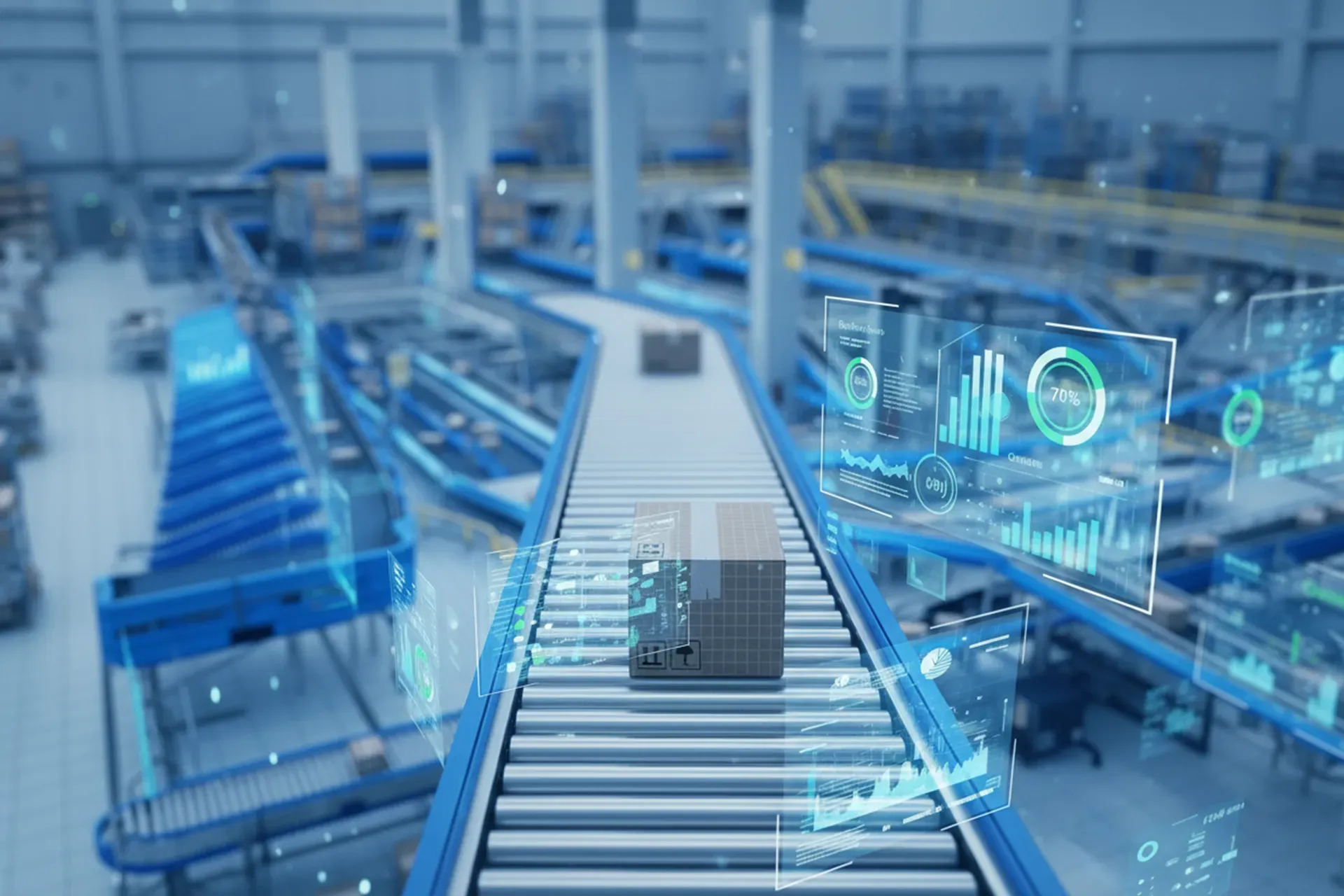
Warehouse simulation software models real operations by creating a virtual replica of your facility, including conveyors, sorters, storage systems, forklifts, and human workers, and then running time-based logic to replicate how those elements interact under real workload conditions. The model processes orders, routes products, assigns resources, and tracks throughput, all without touching your live operation.
The most effective platforms use a drag-and-drop approach to build these models quickly. Pre-built components, such as conveyor segments, pick stations, and loading docks, can be assembled into a working simulation of your warehouse layout. Once the model is configured with your actual order profiles, shift patterns, and equipment speeds, it runs thousands of simulated hours in minutes.
This approach gives engineers a reliable way to study system behavior over time. You can observe how the system responds during peak demand, what happens when a conveyor breaks down, or how a new SKU profile affects throughput. The simulation captures dynamic interactions that static spreadsheets simply cannot replicate.
What simulation capabilities matter most for intralogistics environments?
For intralogistics environments, the most critical simulation capabilities are throughput analysis, bottleneck detection, workforce planning, and multi-shift scenario modeling. These functions address the core challenges in distribution and fulfillment operations, where timing, resource allocation, and equipment performance directly affect service levels. Intralogistics simulation software built on discrete event simulation principles is particularly well suited to capturing these dynamics, because it models each event — every order pick, conveyor transfer, and resource assignment — as it unfolds in time.
- Throughput analysis: Measures how many orders, pallets, or items your system can process per hour under different conditions
- Bottleneck identification: Pinpoints exactly where queues build up and flow breaks down, so engineers can fix root causes rather than symptoms
- Workforce planning: Models how different staffing levels and shift structures affect output and idle time
- Equipment utilization: Tracks how hard conveyors, sorters, and automated systems are working and where capacity headroom exists
- Failure and reliability modeling: Simulates equipment downtime and maintenance events to assess their impact on overall performance
Intralogistics systems are particularly sensitive to cascading effects. A delay at one picking station can back up an entire sortation system within minutes. Material flow simulation captures these ripple effects in a way that no analytical model can, making it an essential tool for engineers designing or scaling fulfillment operations.
Build your own simulation, your way
Enterprise Dynamics gives developers full control to model, scale, and integrate complex systems with C++, APIs, and real-time data.
Explore Enterprise DynamicsHow does what-if scenario testing work in warehouse simulation?
What-if scenario testing in warehouse simulation works by creating multiple versions of your model, each with a different configuration, and running them side by side to compare outcomes. You can test changes to layout, staffing, equipment, order profiles, or operating rules without making any physical changes to your facility.
In practice, this means an engineer can answer questions like: What happens to throughput if we add a second pick-and-pass lane? How does our system perform if order volume increases by 30%? What is the impact of switching from two shifts to three? Each scenario runs as a separate simulation, producing comparable KPIs so decision-makers can evaluate trade-offs with real data.
This capability is especially valuable when evaluating capital investments. Rather than committing to a new automated storage and retrieval system based on vendor projections, you can validate performance claims inside your own model, using your own order data, before signing a contract. It removes a significant amount of financial risk from major operational decisions.
What’s the difference between warehouse simulation and a digital twin?
Warehouse simulation is a predictive modeling technique used to test future scenarios, while a digital twin is a continuously updated virtual replica of a real system that reflects its current state in real time. The key distinction is data connectivity: a simulation runs on configured assumptions, while a digital twin is fed live operational data from the physical facility.
In practice, the two concepts overlap and often build on each other. A high-quality discrete event simulation software platform can become the foundation of a digital twin when it is connected to live data streams from WMS, ERP, or sensor systems. At that point, the model no longer just predicts future states; it also mirrors what is happening right now.
For most warehouse planning and investment decisions, simulation is the right starting point. A digital twin adds value once operations are running and you want to monitor performance continuously, detect anomalies in real time, or test operational adjustments against a live baseline. Understanding where you are in that journey helps you choose the right tool for your current needs.
Should warehouse simulation software integrate with WMS and ERP systems?
Yes, warehouse simulation software should integrate with WMS and ERP systems, and this integration is one of the most important features to look for. Without it, your simulation model runs on manually entered assumptions rather than real operational data, which limits both its accuracy and its long-term usefulness.
When simulation software connects directly to your WMS and ERP, it can pull in actual order histories, SKU profiles, inventory levels, and throughput data. This makes the model significantly more realistic from the start, and it reduces the time engineers spend on data preparation. It also means the model can be updated as your operations evolve, rather than becoming outdated after the initial project.
Integration also enables the digital twin use case described above. A simulation model that stays connected to live data can be used for ongoing performance monitoring and continuous improvement, not just one-time design validation. For organizations running complex, high-volume distribution operations, this is where supply chain simulation software delivers its greatest long-term value.
How do you evaluate warehouse simulation software before buying?
Evaluating warehouse simulation software before buying comes down to five practical criteria: modeling accuracy, ease of use, integration capabilities, visualization quality, and vendor expertise. Checking all five gives you a complete picture of whether the platform will actually work in your environment.
- Modeling accuracy: Ask whether the software uses discrete event simulation (DES), which is the most reliable method for dynamic logistics systems. Request a demonstration using a scenario similar to your own operation.
- Ease of use: Look for a drag-and-drop interface with pre-built component libraries. The faster your team can build and modify models, the more value you get from the tool.
- Integration capabilities: Confirm whether the platform connects natively with your WMS and ERP systems, and ask about the data import and export process.
- Visualization quality: Strong 2D and 3D visualization make it easier to communicate findings to stakeholders who are not simulation engineers, which matters when you are presenting investment decisions to leadership.
- Vendor expertise and support: Evaluate whether the vendor has demonstrated experience in your specific industry, whether that is e-commerce fulfillment, pharma distribution, or retail logistics.
It is also worth asking for a pilot project or proof-of-concept engagement before committing to a full license. Running a real scenario through the software with your own data is the most reliable way to assess whether the platform delivers on its promises. When comparing options, pay particular attention to how each DES simulation tool handles material flow optimization and conveyor simulation, as these are often the most demanding aspects of any warehousing model.
How Enterprise Dynamics helps with warehouse simulation
Enterprise Dynamics is our DES simulation platform built specifically for material handling, intralogistics, and warehousing environments. It brings together all the capabilities described in this article in a single, proven platform used by organizations ranging from pharma distributors to large-scale e-commerce fulfillment operations.
Here is what Enterprise Dynamics delivers in practice:
- A drag-and-drop modeling environment with pre-built atoms for conveyors, sorters, pick stations, and more
- Powerful 2D and 3D visualization to communicate results clearly to both engineers and decision-makers
- Native integration with WMS and ERP systems to build accurate, data-driven models
- What-if scenario testing to validate investments and operational changes before they go live
- Throughput analysis and bottleneck identification to drive measurable performance improvements
Whether you are designing a new distribution center, scaling an existing operation, or validating a major warehouse automation simulation, Enterprise Dynamics simulation software gives your team the tools to make confident, evidence-based decisions. Ready to see what it can do for your operation? Get in touch with us and we will walk you through a demo tailored to your environment.
Frequently Asked Questions
How long does it typically take to build a working warehouse simulation model?
The time required depends on the complexity of your facility and the quality of your input data, but most initial models can be built in days to weeks rather than months, especially on platforms with drag-and-drop interfaces and pre-built component libraries. A straightforward distribution center with standard conveyor and pick station configurations might be modeled in two to five days, while a multi-zone automated facility with complex routing logic could take several weeks. Having clean, structured data from your WMS and ERP ready to import significantly accelerates the process and improves accuracy from day one.
What data do I need to provide to get started with warehouse simulation?
The core inputs you need are order profiles (volume, order lines, SKU mix), facility layout dimensions, equipment specifications (speeds, capacities, quantities), staffing levels and shift patterns, and historical throughput data. You do not need perfectly clean data to get started — simulation engineers regularly work with imperfect datasets and can make calibrated assumptions where gaps exist. The more representative your order data is of real peak and off-peak conditions, the more reliable your simulation results will be for planning and investment decisions.
Can warehouse simulation software handle automated and manual operations in the same model?
Yes, and this is one of its most important practical strengths. Modern warehouse simulation platforms are designed to model hybrid environments where automated systems like conveyors, sorters, and AS/RS operate alongside human pickers, forklift operators, and manual packing stations within the same facility. This matters because the interaction between automated and manual processes is often where bottlenecks emerge, and simulation captures those handoff points and dependencies far more accurately than any spreadsheet or analytical model can.
How accurate are warehouse simulation results compared to actual operational performance?
When built with representative data and validated against known operational benchmarks, discrete event simulation models typically achieve accuracy within 5–10% of real-world throughput figures. Accuracy depends heavily on the quality of input data, the realism of the logic rules applied, and whether the model has been calibrated against actual performance. Most simulation projects include a validation phase where the model is run against historical operational data to confirm it reproduces known results before it is used for predictive scenario testing.
What are the most common mistakes teams make when implementing warehouse simulation for the first time?
The most frequent mistakes are starting with overly complex models before validating simpler ones, using low-quality or unrepresentative order data, and skipping the model validation step entirely. Teams also sometimes underestimate the importance of stakeholder involvement — a simulation model is only as useful as the decisions it informs, so getting operations managers and engineers aligned on the scenarios being tested is critical. Starting with a focused, well-scoped pilot project rather than trying to simulate the entire facility at once is the most reliable path to early success.
Is warehouse simulation only useful for new facility design, or can it add value in existing operations?
Simulation adds substantial value in existing operations and is not limited to greenfield design projects. In running facilities, it is commonly used to evaluate the ROI of automation investments, diagnose persistent throughput problems, model the impact of peak season demand surges, optimize slotting and pick path strategies, and plan workforce levels for new contract wins. Because the model can be built from real operational data, existing facilities often produce the most accurate and immediately actionable simulation results.
How do I build a business case for investing in warehouse simulation software?
The strongest business cases for simulation software are built around the cost of decisions made without it — a misspecified automation investment, an underperforming new facility, or a peak season that exceeds system capacity. Quantify one or two high-stakes decisions your organization faces in the next 12–24 months, estimate the financial exposure if those decisions are made on flawed assumptions, and compare that figure against the cost of the simulation platform and implementation. Most organizations find that a single avoided design error or validated capital investment delivers a return that far exceeds the software cost.
Related Articles
- Why do material handling companies invest in digital twin warehouse software?
- How does warehouse simulation software help avoid costly automation failures?
- What is the difference between warehouse simulation software and flow analysis tools?
- Which ERP is best for supply chain management?
- How does supply chain simulation software integrate with WMS and ERP systems?