Discrete event simulation and a digital twin warehouse are related but distinct tools. Discrete event simulation models how a warehouse operates over time by processing events in sequence and is used primarily for design, planning, and what-if analysis before a system is built or changed. A digital twin warehouse is a live virtual replica of an existing facility, continuously fed by real-time data to mirror actual operations as they happen.
The key distinction comes down to timing and purpose: simulation is typically used to answer “what could happen,” while a digital twin answers “what is happening right now.” In practice, the two technologies overlap significantly, and the best warehouse systems often combine both approaches.
Below, we unpack the most common questions engineers and operations leaders ask when evaluating warehouse simulation software and digital twin warehouse software.
How does a warehouse digital twin actually work?
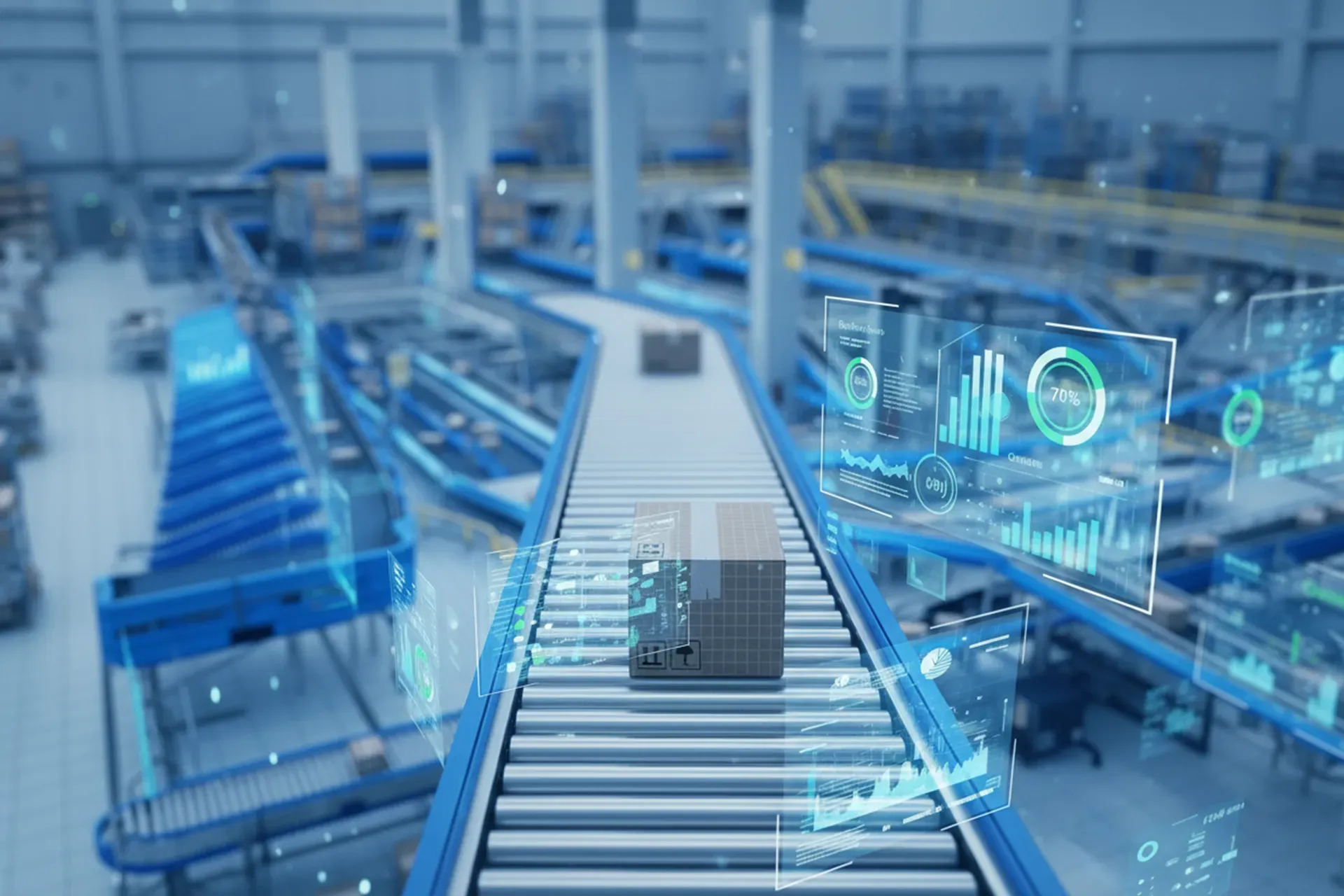
A warehouse digital twin is a continuously updated virtual model of a physical warehouse that receives live data from sensors, conveyors, WMS systems, and other operational sources. It mirrors the real facility in near real time, allowing operators to monitor performance, detect anomalies, and test changes without disrupting actual operations.
The architecture of a digital twin typically involves three layers working together:
- Data ingestion: Real-time feeds from IoT sensors, barcode scanners, conveyor systems, and warehouse management or ERP software continuously update the model.
- Virtual representation: A 2D or 3D model of the warehouse layout, equipment, and workflows reflects the current state of the facility at any given moment.
- Analytics and decision support: The twin surfaces KPIs, flags bottlenecks, and can run short-horizon forecasts to help operators make faster, better-informed decisions.
Because the twin is synchronized with live operations, it becomes increasingly valuable over time. It captures historical patterns, supports predictive maintenance, and provides a reliable baseline for comparing proposed changes against current performance.
What is discrete event simulation used for in warehouses?
Discrete event simulation in a warehouse context is used to model how goods, equipment, and people move through a facility by processing individual events in sequence. It answers planning and design questions such as how many pick stations are needed, where bottlenecks will form under peak load, and whether a proposed layout change will improve throughput before any physical work begins. As a category of DES simulation software, warehouse simulation tools are especially well suited to intralogistics simulation challenges — from conveyor simulation and AGV simulation to AS/RS simulation and broader material flow simulation across the facility.
Warehouse engineers rely on discrete event simulation for a range of decisions:
- Throughput analysis: Determining how many units a system can process per hour under different demand scenarios.
- Bottleneck identification: Pinpointing which conveyor, workstation, or process step limits overall system performance.
- Workforce planning: Testing how different staffing levels and shift patterns affect order cycle times.
- Investment validation: Proving the business case for automation, new equipment, or layout changes before committing capital.
- What-if scenario testing: Comparing multiple design options or operational strategies in a risk-free virtual environment.
Discrete event simulation is particularly powerful during the design and pre-implementation phases of a warehouse project, where decisions carry the highest financial risk and real-world testing is not yet possible. This is also where a capable DES simulation platform pays for itself many times over — giving engineers a reliable DES simulation environment in which to validate assumptions before a single piece of equipment is ordered.
Build your own simulation, your way
Enterprise Dynamics gives developers full control to model, scale, and integrate complex systems with C++, APIs, and real-time data.
Explore Enterprise DynamicsWhere do discrete event simulation and digital twins overlap?
Discrete event simulation and digital twin warehouse software overlap most significantly in their shared use of virtual models to understand and improve warehouse performance. Both represent physical systems mathematically, both can visualize operations in 2D or 3D, and both support scenario testing. The difference lies in how and when they are connected to real-world data.
A digital twin typically uses discrete event simulation as its underlying engine. The DES simulation engine that determines how events are processed, how queues form, and how resources are allocated is the same whether the model is running on historical data during the design phase or on live operational data in a deployed twin. This means that a well-built simulation model and a digital twin are not competing tools but complementary stages of the same analytical approach.
In practice, organizations often use simulation during planning and then transition the same model into a digital twin once the warehouse is operational, feeding it real data to keep it relevant and actionable over time.
When should you choose simulation over a digital twin?
Choose discrete event simulation over a digital twin when the warehouse does not yet exist, when you are evaluating design alternatives, or when real-time operational monitoring is not the primary goal. Simulation is the right tool for pre-construction analysis, capacity planning, and investment decisions where the question is about future performance rather than the current state.
Simulation is typically the better fit in these situations:
- You are designing a new warehouse or warehouse automation simulation from scratch.
- You need to compare multiple layout or process configurations before selecting one.
- You want to validate a business case for a capital investment without building anything first.
- You are stress-testing a system against peak demand scenarios that have not yet occurred.
- Real-time data infrastructure does not yet exist at the facility.
A digital twin adds the most value once a facility is operational and data connectivity is in place. If the goal is to monitor live performance, detect problems as they occur, or optimize ongoing operations day to day, a digital twin delivers capabilities that a standalone simulation model cannot match.
Can a discrete event simulation model become a digital twin?
Yes, a discrete event simulation model can become a digital twin when it is connected to live operational data from the real warehouse. The simulation model provides the logical structure and behavioral rules; the data connection transforms it from a planning tool into a living replica of the actual facility.
This transition is one of the most practical paths to a warehouse digital twin, because it avoids rebuilding the model from scratch. If the simulation was built with sufficient fidelity during the design phase, connecting it to WMS, ERP, or sensor data after go-live can activate it as a true digital twin.
For this evolution to work well, the original simulation model needs to be built with integration in mind. That means using a DES simulation platform that supports seamless data exchange with warehouse management and enterprise resource planning systems, and that can handle the continuous data flows a live twin requires without performance degradation.
How Enterprise Dynamics supports your warehouse simulation and digital twin goals
Enterprise Dynamics, our discrete event simulation platform, is built specifically for the kind of complex warehouse and intralogistics challenges described throughout this article. Whether you are in the design phase or looking to evolve an existing model into a digital twin, Enterprise Dynamics provides the tools to do both. As a full-featured DES simulation package, it covers everything from material handling simulation and material flow simulation to supply chain simulation and production logistics simulation — making it a versatile choice for both DES software for warehousing and DES software for logistics.
- Drag-and-drop modeling with pre-built atom libraries for conveyors, sorters, pick stations, and other warehouse components, so models can be built and tested quickly.
- 2D and 3D visualization that makes simulation results accessible to both engineers and non-technical stakeholders.
- Native WMS and ERP integration that enables the model to be fed with real operational data, forming the foundation of a warehouse digital twin.
- What-if scenario testing for throughput analysis, bottleneck identification, workforce planning, and investment validation.
- Scalability for large, complex systems including multi-site distribution networks and high-throughput automated facilities.
If you are evaluating warehouse simulation software or exploring how a digital twin could improve your facility’s performance, we are happy to walk you through what Enterprise Dynamics can do for your specific situation. Get in touch with our team to start the conversation.
Frequently Asked Questions
How long does it typically take to build a discrete event simulation model for a warehouse?
The timeline depends on the complexity of the facility and the level of fidelity required, but most warehouse simulation projects take anywhere from a few weeks to a few months. A straightforward single-site model with standard conveyor and pick station logic can often be built and validated in four to six weeks, while large, multi-zone automated distribution centers may require three to six months of modeling and calibration. Using a platform with pre-built component libraries, like drag-and-drop atom libraries for conveyors and sorters, can significantly compress build time compared to coding a model from scratch.
What data do I need to get started with a warehouse simulation or digital twin project?
For a discrete event simulation, you primarily need historical operational data: order profiles, SKU velocity, throughput rates, equipment specifications, and layout drawings. Even rough estimates can get a model started, with parameters refined as more accurate data becomes available. For a digital twin, you additionally need live data infrastructure — IoT sensors, barcode scanners, and API connectivity to your WMS or ERP — so the model can be continuously updated with real operational feeds. Starting with a simulation first is a practical approach when live data infrastructure is not yet in place.
What are the most common mistakes teams make when implementing warehouse simulation?
One of the most frequent mistakes is over-engineering the model by trying to replicate every operational detail, which increases build time without proportionally improving decision-making value. Another common pitfall is using unrealistic or overly optimistic input data — particularly for order volumes and equipment failure rates — which leads to simulation results that don’t hold up against real-world performance. Finally, many teams treat simulation as a one-time project rather than a reusable asset, missing the opportunity to evolve the model into a digital twin or use it for ongoing scenario planning as operations change.
How accurate does a simulation model need to be before it can be trusted for major investment decisions?
A simulation model is typically considered validated when its outputs match known historical performance data within an acceptable margin — commonly 5 to 10 percent for key KPIs like throughput and cycle time. Rather than chasing perfect accuracy, the goal is to ensure the model is directionally reliable enough that it correctly identifies which design option outperforms another. Sensitivity analysis, where you test how outputs change as inputs vary, is a practical way to understand where the model’s uncertainty lies and where to focus validation efforts before presenting results to decision-makers.
Can simulation and a digital twin be used simultaneously, or do you have to choose one?
They are not mutually exclusive and are often most powerful when used together. A common and effective approach is to run the digital twin in parallel with a separate simulation environment: the twin monitors live operations and flags anomalies, while the simulation environment is used to test proposed changes — new layouts, staffing adjustments, or equipment additions — before they are implemented in the real facility. This combination gives operations teams both real-time visibility and a safe space for forward-looking experimentation without any risk to live throughput.
What happens to the simulation model after a warehouse goes live — is it still useful?
Absolutely — a simulation model built during the design phase retains significant value after go-live, provided it is kept current. Once the facility is operational, the model can be connected to live WMS and ERP data to function as a digital twin, or it can be used in a standalone capacity to evaluate operational changes, test responses to demand spikes, or plan seasonal capacity adjustments. Organizations that treat their simulation model as a long-term operational asset rather than a one-time design deliverable consistently get more return from their initial investment.
How do I make the business case for investing in warehouse simulation or digital twin software?
The strongest business cases are built around avoided costs and measurable risk reduction. Quantify the cost of a poor design decision — an undersized sorter, a misplaced pick zone, or an incorrectly staffed shift — and compare it against the cost of the simulation project that would have prevented it. For digital twins, the ROI case typically centers on reduced downtime through predictive maintenance, improved throughput from continuous bottleneck detection, and faster response to disruptions. Requesting a vendor-led proof of concept or pilot model on your specific facility data is one of the most effective ways to generate concrete, credible numbers for internal stakeholders.
Related Articles
- What is the difference between warehouse simulation and operational analytics?
- What is meant by digital twin warehouse software?
- How to measure resilience in supply chain?
- How does supply chain simulation software support network design?
- How do you choose the right simulation software for your supply chain?