A warehouse simulation and a digital twin are related but distinct tools. A simulation is a model that replicates how a warehouse operates under defined conditions, letting you test scenarios before making changes. A digital twin goes further by connecting that model to live operational data, creating a continuously updated virtual replica of your real warehouse. The key difference is the live data connection. Below, we unpack each concept, explain when to use which, and show how the two can work together.
How does a warehouse simulation actually work?
A warehouse simulation builds a virtual model of your facility and runs it through time to predict how it will behave. You define the layout, equipment, workflows, and order volumes, then the software simulates operations to reveal throughput rates, bottlenecks, and resource utilization before anything changes in the real world.
The approach is called discrete-event simulation. Each event in the warehouse, such as a pallet arriving at a conveyor, a picker completing a task, or a sorter changing direction, is modeled as a distinct occurrence that triggers the next. By running thousands of these events in sequence, the discrete event simulation software produces reliable performance data across different scenarios — whether you are modeling a conveyor simulation, an AGV simulation, or a full warehouse automation simulation.
A typical warehouse simulation project follows a clear path:
- Define the scope and objectives, such as validating a new layout or testing a higher order volume
- Collect operational data, including cycle times, equipment speeds, and order profiles
- Build the virtual model using drag-and-drop components representing conveyors, storage locations, workstations, and workers
- Validate the model against known historical performance to confirm it behaves realistically
- Run what-if scenarios to compare configurations, staffing levels, or process changes
- Analyze results and use them to guide investment or operational decisions
The power of simulation lies in the ability to stress-test a system risk-free. You can simulate peak season demand, equipment failures, or a completely new automation concept without touching live operations or spending capital.
What makes a digital twin different from a simulation model?
A digital twin is a simulation model that is continuously fed real-time data from the physical system it represents. While a standard simulation runs on historical or assumed data, a digital twin stays synchronized with what is actually happening in the warehouse right now, making it a living, breathing replica rather than a static model.
The distinction comes down to three characteristics that a digital twin adds on top of simulation:
- Live data connectivity: sensors, WMS feeds, conveyor controllers, and other systems continuously update the twin with real operational data
- Bidirectional feedback: insights from the twin can flow back to inform or even automate decisions in the physical system
- Ongoing relevance: because the model updates automatically, it remains accurate over time without manual recalibration
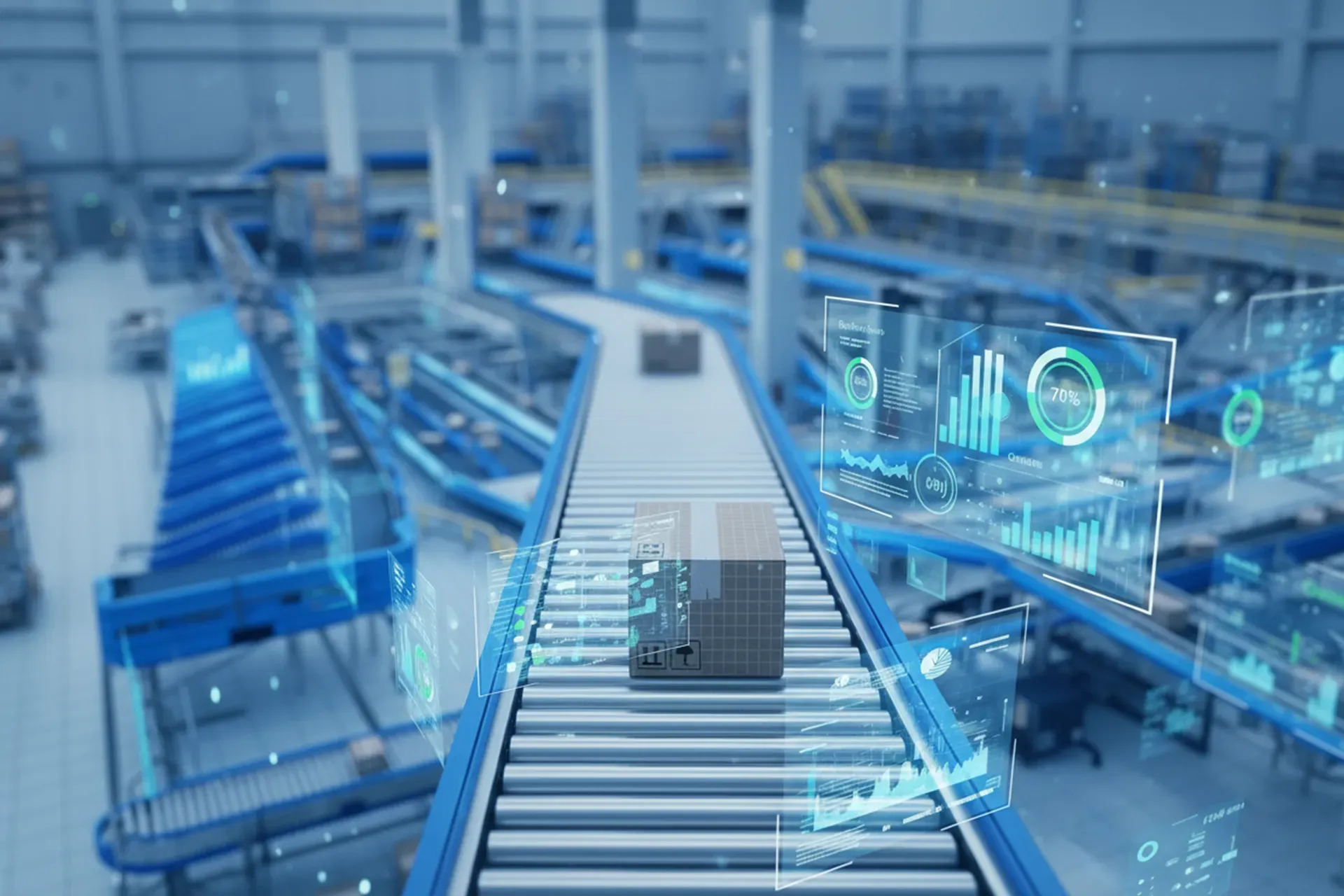
In practice, a digital twin of a warehouse might pull live data from barcode scanners, pick-to-light systems, and conveyor sensors, then surface real-time alerts about emerging bottlenecks or predict where a delay will occur within the next hour. This is fundamentally different from a simulation, which answers the question “what would happen if” rather than “what is happening now and what will happen next.”
Build your own simulation, your way
Enterprise Dynamics gives developers full control to model, scale, and integrate complex systems with C++, APIs, and real-time data.
Explore Enterprise DynamicsCan a warehouse simulation become a digital twin?
Yes, a warehouse simulation can evolve into a digital twin when it is connected to live operational data. The simulation model provides the foundation, and the data integration layer transforms it into a continuously updated replica. This is a common and practical path because building the simulation first ensures the model is validated before real-time data is layered on top.
The transition typically requires integration with systems already present in the warehouse, such as a Warehouse Management System (WMS) or an Enterprise Resource Planning (ERP) platform. Once those data streams feed into the simulation model, it begins reflecting current reality rather than modeled assumptions. The simulation logic remains intact, but the inputs become dynamic instead of static.
Not every simulation needs to become a digital twin. The upgrade makes most sense when ongoing operational monitoring, real-time optimization, or continuous performance tracking are part of the business need. For one-time design validation or investment decisions, a well-built warehouse simulation software model is often all that is required.
When should you use simulation instead of a digital twin?
Warehouse simulation software is the right choice when your goal is to answer a specific design or planning question rather than monitor ongoing operations. If you are evaluating a new warehouse layout, validating automation investments, or testing how your system handles peak demand, simulation gives you everything you need without the complexity of live data integration.
Simulation is particularly well suited to these situations:
- Designing a new facility or distribution center before construction begins
- Validating the business case for a conveyor system, automated storage and retrieval system simulation, or robotic picking solution
- Comparing multiple layout or process alternatives to identify the best-performing option
- Identifying bottlenecks in an existing operation using historical order data, including material flow simulation to understand how goods move through the facility
- Planning workforce requirements across different shift patterns or demand scenarios
Simulation is also the faster and more cost-effective starting point. It does not require sensor infrastructure or real-time data pipelines. For organizations making a major capital decision or redesigning operations, intralogistics simulation delivers clear, actionable answers at a fraction of the cost of a full digital twin implementation.
When does a digital twin add value that simulation cannot?
A digital twin adds unique value when you need continuous visibility into live operations, not just answers to a one-time planning question. If your warehouse runs complex, high-volume operations where conditions shift constantly, a digital twin allows you to detect problems in real time, predict disruptions before they escalate, and optimize dynamically rather than periodically.
The scenarios where a digital twin outperforms standalone simulation include operations where order profiles change daily, where equipment reliability directly affects throughput, or where small inefficiencies compound quickly at scale. A digital twin can flag that a specific conveyor zone is trending toward overload thirty minutes before it becomes a problem, giving operators time to intervene. This kind of real-time material flow optimization is simply not possible with a static simulation model alone.
Digital twin warehouse software also supports long-term continuous improvement. Because the model stays current, it can be used to evaluate operational changes against real baseline data rather than estimates. This makes it a strategic asset that grows in value over time, rather than a project deliverable that becomes outdated as the operation evolves.
Do warehouse simulation and digital twins work together?
Yes, and in most mature implementations they do. The simulation model and the digital twin serve complementary roles: simulation answers forward-looking design and planning questions, while the digital twin monitors and optimizes the operation as it runs. Together, they create a continuous improvement loop where insights from live operations inform future planning, and planning models are validated against real performance data.
A practical example: a distribution center uses supply chain simulation software to validate a new sorter configuration before installation. After go-live, the same model is connected to live sensor data and becomes the digital twin. When throughput dips below target, the twin identifies the cause. The team then uses the simulation layer to test corrective measures before applying them, closing the loop between planning and operations.
This combined approach is increasingly common in high-performance logistics environments, where the cost of downtime or suboptimal throughput justifies investment in both capabilities.
How Enterprise Dynamics supports warehouse simulation and digital twins
We built Enterprise Dynamics to support both warehouse simulation and digital twin use cases within a single platform. Whether you are validating a new facility design or building a continuously updated operational replica, Enterprise Dynamics gives your team the tools to model, test, and optimize complex warehouse systems with confidence. As a fully featured DES simulation platform, it is designed to handle everything from production logistics simulation to large-scale intralogistics simulation software projects.
Here is what Enterprise Dynamics brings to the table:
- Drag-and-drop modeling: build detailed warehouse models quickly using a library of pre-built components for conveyors, storage, picking stations, and more
- 2D and 3D visualization: communicate designs and results clearly to both technical teams and executive stakeholders
- WMS and ERP integration: connect your model to live operational data to evolve from simulation into a digital twin
- Scenario testing: run unlimited what-if analyses to compare layouts, staffing plans, and automation investments before committing
- Bottleneck identification: pinpoint where your operation loses throughput and test fixes in a risk-free environment
If you are ready to explore how simulation or digital twin technology can improve your warehouse operations, get in touch with our team and we will help you find the right starting point.
Frequently Asked Questions
How long does it typically take to build and validate a warehouse simulation model?
The timeline depends on the complexity of your operation, but most warehouse simulation projects take between four and twelve weeks from data collection to validated model. Simpler facilities with straightforward workflows can be modeled faster, while large multi-zone distribution centers with complex automation require more time to build and calibrate. The validation step — confirming the model matches known historical performance — is non-negotiable and should not be rushed, as it determines how much you can trust the scenario results.
What data do I need to get started with a warehouse simulation?
At a minimum, you need layout dimensions, equipment specifications (speeds, capacities, cycle times), order profiles (volume, SKU mix, peak periods), and staffing patterns. Most of this data already exists in your WMS, ERP, or operational records. You do not need perfect data to start — a well-built simulation can be validated and adjusted as better data becomes available, so the best approach is to begin with what you have and refine from there.
What is the biggest mistake companies make when implementing a warehouse digital twin?
The most common mistake is attempting to build a digital twin without first validating the underlying simulation model. Connecting live data to an unvalidated model means you are monitoring a replica that does not accurately reflect your real operation, which leads to misleading alerts and poor decisions. Always validate the simulation model against historical performance data before layering in real-time data feeds — the sequence matters.
Can warehouse simulation and digital twin tools be used for facilities that are not yet built?
Absolutely — in fact, this is one of the strongest use cases for simulation. You can model a greenfield facility entirely from design drawings and planned operational parameters, then run scenarios to optimize the layout, equipment selection, and workflow before a single dollar of construction capital is committed. Digital twins, by contrast, require a physical system to connect to, so they come into play after go-live, at which point the simulation model built during design can be repurposed as the twin’s foundation.
How do I know whether my operation needs a simulation, a digital twin, or both?
Start by asking what decision or outcome you are trying to support. If you are making a one-time capital or design decision — such as validating a new layout or justifying an automation investment — simulation alone is usually sufficient. If you need ongoing operational visibility, real-time bottleneck detection, or continuous performance optimization, a digital twin adds clear value on top of simulation. Many organizations begin with simulation for a specific project and later evolve to a digital twin as operational complexity grows and the ROI of continuous monitoring becomes evident.
What happens to the simulation model after a project is complete — does it have any ongoing value?
A completed simulation model retains significant value beyond the original project if it is maintained and updated as the operation evolves. It can be reused to evaluate future changes, test responses to disruptions, or onboard new team members by demonstrating how the warehouse behaves under different conditions. The most efficient path is to keep the model current so it can serve as the foundation for a future digital twin, rather than rebuilding from scratch when continuous monitoring becomes a priority.
Is warehouse simulation only practical for large distribution centers, or can smaller operations benefit too?
Simulation scales to fit the operation, not the other way around. Smaller warehouses with tighter margins and less room for trial-and-error often benefit just as much from simulation as large distribution centers — sometimes more, because the cost of a wrong layout or staffing decision hits proportionally harder. The investment in a simulation project is typically a fraction of the cost of a physical change that underperforms, making it practical and valuable for operations of almost any size.