The best factory simulation software combines discrete event simulation with powerful visualization, seamless integration with existing systems, and the flexibility to model complex logistics, warehouse, and production environments. For most industrial operations, the right choice depends on the scale of your processes, the depth of analysis you need, and how well the software fits into your existing technology stack. This article walks through the key questions to help you make a confident, informed decision.
What makes factory simulation software worth the investment?
Factory simulation software is worth the investment because it allows you to test operational decisions in a risk-free virtual environment before spending money on physical changes. Instead of discovering a bottleneck after installing new conveyor systems or hiring additional staff, simulation lets you identify and resolve those issues at the design stage, where fixes are fast and cheap.
The financial case becomes clearest when you consider what is at stake in a typical factory or distribution environment: capital equipment, workforce planning, throughput targets, and customer commitments. A single poor investment decision can cost far more than the simulation software itself. By running what-if scenarios digitally, operations teams can validate assumptions, compare alternatives, and build confidence in decisions that would otherwise carry significant financial risk.
Beyond cost avoidance, simulation accelerates decision-making. Stakeholders across engineering, logistics, and operations can align around shared model outputs rather than debating gut instincts. The result is faster project approvals, fewer costly surprises, and operations that perform closer to their designed potential from day one.
Build your own simulation, your way
Enterprise Dynamics gives developers full control to model, scale, and integrate complex systems with C++, APIs, and real-time data.
Explore Enterprise DynamicsWhat are the key features to look for in factory simulation software?
The key features to look for in factory simulation software are accurate modeling of material flow, flexible scenario testing, integration with WMS and ERP systems, strong 2D and 3D visualization, and the ability to handle both simple and highly complex process models. These capabilities determine whether the software can genuinely reflect your operation or only approximate it.
When evaluating options, prioritize the following:
- Drag-and-drop model building with pre-built components that speed up setup without sacrificing accuracy
- What-if scenario testing to compare operational strategies side by side
- Throughput analysis and bottleneck identification to pinpoint where your system loses capacity
- WMS and ERP integration so the model reflects real operational data rather than assumptions
- 2D and 3D visualization to communicate findings clearly to technical and non-technical stakeholders
- Workforce and resource planning tools to model staffing decisions alongside equipment
- Scalability so the software grows with your operation rather than limiting your model size
Ease of use matters too, especially if your team includes engineers who are new to simulation. Software that requires months of specialist training before delivering value slows down the return on investment. Look for platforms with intuitive interfaces backed by strong documentation and support.
What’s the difference between discrete event simulation and agent-based simulation for factories?
Discrete event simulation models a factory as a sequence of events, such as a pallet arriving, a conveyor moving, or a picking station processing an order, tracking how those events flow through the system over time. Agent-based simulation models individual entities with their own behaviors and decision rules, making it better suited to environments where human movement or autonomous decision-making is central to the process.
When choosing between a DES simulation tool and an agent-based approach, the nature of your operation is the deciding factor. Most factory and warehouse environments are process-driven rather than behavior-driven, which makes discrete event simulation software the more practical and widely adopted choice for production logistics and material handling simulation.
When discrete event simulation fits factories best
Most factory and warehouse environments are well served by discrete event simulation. Production lines, conveyor systems, sorting equipment, and order fulfillment processes all follow defined sequences that discrete event models capture accurately. DES simulation software excels at throughput analysis, capacity planning, and identifying where queues and delays build up under different load conditions. For teams looking at DES software for manufacturing or DES software for logistics, this approach covers the vast majority of real-world use cases.
When agent-based simulation adds value
Agent-based simulation becomes valuable when the behavior of individual people or autonomous systems significantly affects outcomes. In a factory context, this might include modeling how workers navigate a floor during a peak shift, or how autonomous mobile robots (AMRs) interact with each other and with human operators. For crowd safety, evacuation planning, or pedestrian flow at large facilities, agent-based approaches provide a level of behavioral realism that discrete event models cannot match.
In practice, the most demanding factory simulation scenarios benefit from combining both approaches within a single model, capturing process flow and individual behavior together.
How does factory simulation software handle complex logistics and warehouse systems?
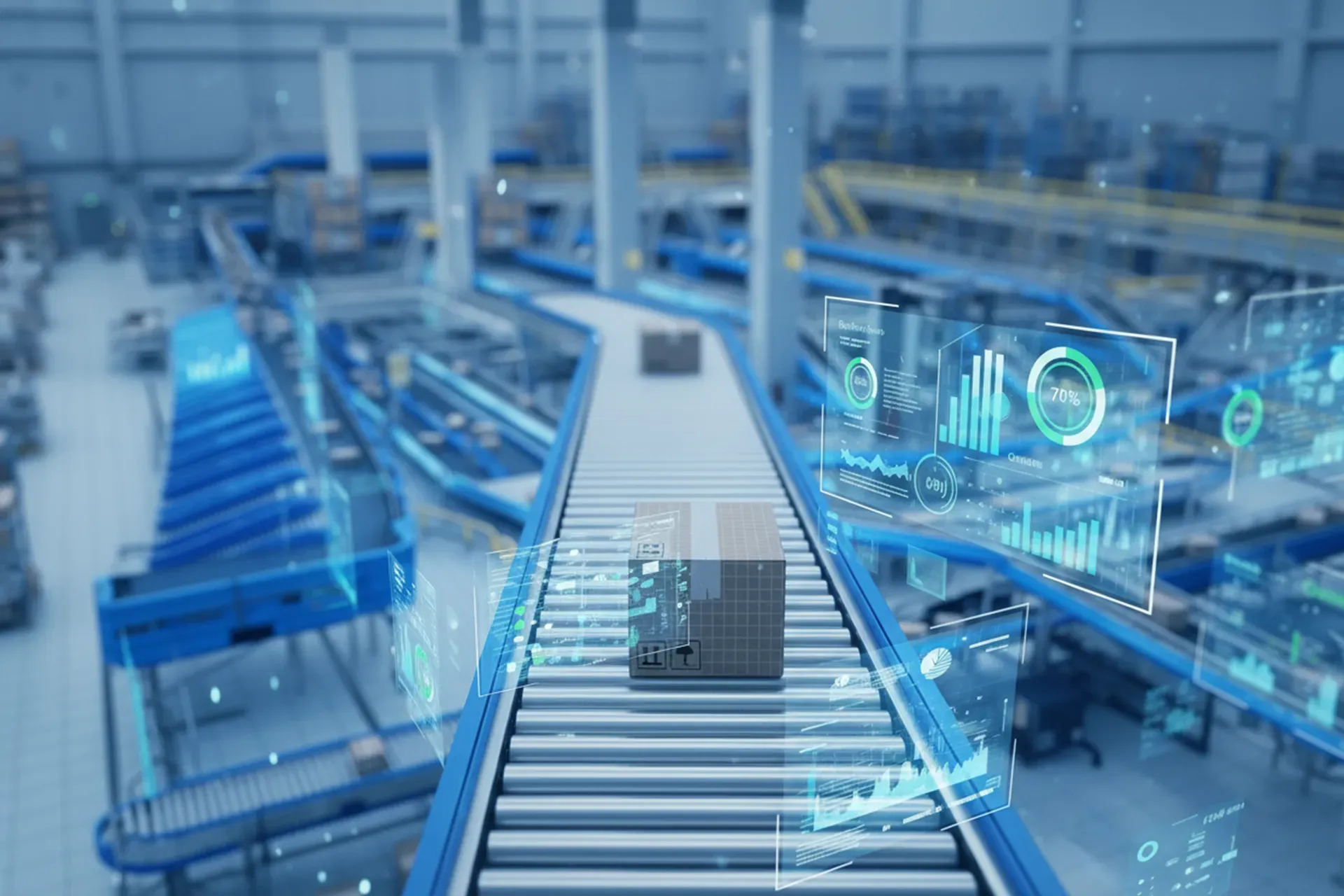
Factory simulation software handles complex logistics and warehouse systems by creating detailed virtual models of the physical environment and operational processes, then running those models under various conditions to reveal how the system performs. This includes baggage handling systems, automated storage and retrieval systems, conveyor simulation, sortation systems, and multi-zone picking operations.
The depth of what simulation can model in a warehouse or logistics setting is substantial. A well-built warehouse simulation model can account for equipment speeds and failure rates, order profiles and seasonal demand spikes, staffing levels and shift patterns, replenishment logic, and the interaction between multiple automated systems running simultaneously. Intralogistics simulation is particularly powerful when modeling AS/RS simulation scenarios, AGV simulation, and warehouse automation simulation — environments where the interaction between automated systems and material flow determines overall throughput. When integrated with real WMS and ERP data, the model becomes a digital twin of your warehouse, reflecting actual operational conditions rather than theoretical ones.
This level of fidelity makes it possible to answer questions that spreadsheets and ERP reports simply cannot: What happens to throughput if one sorter goes offline during peak hours? How many dock doors do we need to handle a 30% volume increase? Where will the picking system create congestion if we add a new product range? Simulation turns those questions into testable scenarios with quantifiable answers.
Which industries benefit most from factory simulation software?
The industries that benefit most from factory simulation software are those operating complex, high-volume processes where errors are costly, throughput is critical, and the consequences of a poor design decision are difficult to reverse. Material handling, intralogistics, pharmaceutical distribution, e-commerce fulfillment, and manufacturing are among the strongest use cases.
Here is a breakdown of where simulation delivers the most value:
- Material handling and intralogistics – Conveyor systems, automated warehouses, and sortation networks involve significant capital investment and tight throughput requirements. Material handling simulation software validates designs before construction begins, reducing the risk of costly redesigns after installation.
- Pharmaceutical distribution – Regulatory compliance, temperature-sensitive handling, and order accuracy requirements make this an environment where process errors carry serious consequences. Simulation helps optimize workflows while maintaining compliance.
- E-commerce fulfillment – Order volumes spike unpredictably, and fulfillment centers must handle that variability without service failures. Warehouse simulation software tests peak-day scenarios before they happen, including the performance of automated picking systems and conveyor networks under maximum load.
- Retail distribution – Multi-channel distribution with complex order profiles benefits from simulation to balance labor, equipment, and space across shifting demand patterns.
- Transportation infrastructure – Rail stations, airports, and container terminals use transportation simulation software to optimize passenger and cargo flow, reduce delays, and plan for disruption scenarios.
- Manufacturing and assembly – Production line simulation, machine utilization analysis, and shift planning all benefit from manufacturing simulation software to eliminate waste and maximize output.
How do you choose the right factory simulation software for your operation?
Choosing the right factory simulation software comes down to matching the software’s capabilities to the complexity of your processes, the technical skills of your team, and your integration requirements. Start by defining what decisions you need the software to support, then evaluate platforms against those specific needs rather than feature lists alone.
Consider these factors in your evaluation:
- Process complexity – Does the software handle the number of entities, rules, and interactions your operation involves without performance limitations?
- Integration capability – Can it connect to your WMS, ERP, or other data sources to build models grounded in real operational data?
- Ease of model building – How quickly can your engineers build and modify models? Drag-and-drop interfaces with pre-built components reduce time to insight.
- Visualization quality – Can the software produce 3D models that communicate findings clearly to decision-makers who are not simulation specialists?
- Vendor support and expertise – Does the vendor offer consultancy, training, and ongoing support, or does the relationship end at the software license?
- Scalability – Will the platform still meet your needs as your operation grows or as your simulation use cases expand?
It is also worth running a pilot or proof-of-concept project before committing. Build a model of a process you know well, validate it against real data, and assess whether the software delivers the accuracy and usability your team needs. That hands-on experience will tell you more than any feature comparison document.
How Enterprise Dynamics helps you simulate and optimize your factory
Enterprise Dynamics is our discrete event simulation platform built specifically for the complexity that material handling, intralogistics, and warehouse environments demand. As a DES simulation platform designed for industrial use, it gives engineering and operations teams the tools to build accurate virtual models, test decisions safely, and optimize performance before committing to changes in the real world.
Here is what Enterprise Dynamics brings to your factory simulation projects:
- Drag-and-drop model building using a library of pre-built atoms, so engineers can build detailed simulations without starting from scratch
- 2D and 3D visualization to present simulation results clearly to technical and executive stakeholders alike
- WMS and ERP integration to create a data-driven digital twin of your warehouse or production environment
- Throughput analysis and bottleneck identification to pinpoint exactly where your system loses capacity
- What-if scenario testing to compare operational strategies and investment options before any real-world commitment
- Scalability to handle large, complex logistics systems including conveyor networks, automated storage and retrieval system simulation, and multi-zone fulfillment operations
We also offer consultancy and training services, so your team gets the support it needs to build simulation capability in-house or to work alongside our specialists on high-stakes projects. If you want to see how simulation can work for your specific operation, get in touch with our team and we will help you find the right starting point.
Frequently Asked Questions
How long does it typically take to build and validate a factory simulation model?
The timeline depends on the complexity of your operation and the simulation platform you choose. A focused model of a single production line or warehouse zone can often be built and validated within a few days to a couple of weeks, especially with software that offers pre-built components and drag-and-drop interfaces. A full-facility digital twin integrating live WMS and ERP data may take several weeks to several months. Running a pilot on a well-understood process first is the fastest way to calibrate your expectations and build team confidence before tackling larger models.
What data do I need to get started with factory simulation?
At a minimum, you need layout dimensions, equipment specifications (speeds, capacities, failure rates), order or production volumes, and staffing patterns. Even rough data is enough to build an initial model and start identifying structural issues. As the model matures, integrating real operational data from your WMS or ERP system will significantly improve accuracy and allow the simulation to reflect actual demand profiles, shift patterns, and seasonal variability rather than averages or assumptions.
Can factory simulation software be used to justify capital investment to stakeholders?
Yes, and this is one of its most practical applications. Simulation outputs, particularly 3D visualizations, throughput comparisons, and side-by-side scenario results, are highly effective at communicating the business case for capital projects to executives and finance teams who are not engineering specialists. Rather than presenting spreadsheet projections, you can show exactly how a proposed conveyor layout or additional dock doors will perform under peak conditions, making it far easier to secure approval with confidence on both sides.
What are the most common mistakes teams make when implementing factory simulation for the first time?
The most common mistake is trying to model everything at once. First-time users often attempt to replicate their entire facility in full detail before they have developed the skills to validate individual components, which leads to complex models that are difficult to debug and slow to deliver insight. A better approach is to start with a focused scope, validate the model against real data, and expand incrementally. Another frequent pitfall is treating simulation as a one-time project rather than an ongoing decision-support tool, which limits the long-term return on the investment.
How does simulation handle variability and uncertainty, such as equipment breakdowns or demand spikes?
Factory simulation software models variability using statistical distributions rather than fixed values, which means equipment breakdown frequencies, repair times, processing speeds, and demand volumes can all be represented as ranges reflecting real-world unpredictability. By running multiple replications of the same scenario, the software generates a distribution of outcomes rather than a single result, giving you a realistic picture of best-case, worst-case, and average performance. This makes it possible to stress-test your operation against peak demand days, unplanned downtime events, or supply disruptions before they occur.
Is factory simulation software only useful for new facility designs, or can it help optimize existing operations?
Simulation is equally valuable for optimizing operations that are already running. Existing facilities often have untapped capacity, hidden bottlenecks, or staffing inefficiencies that are difficult to identify through observation alone. By building a model of your current operation and validating it against live data, you can test changes, such as revised picking sequences, adjusted shift patterns, or new equipment configurations, without disrupting production. Many operations teams find that simulation of an existing facility delivers faster ROI than greenfield projects because improvements can be implemented immediately.
What is the difference between a simulation model and a digital twin, and does it matter which one I use?
A simulation model is a virtual representation of a process built to answer specific what-if questions, while a digital twin is a continuously updated model that stays synchronized with the real operation through live data feeds. For planning and design decisions, a simulation model is typically sufficient and faster to build. A digital twin becomes valuable when you need ongoing operational monitoring, real-time decision support, or continuous performance benchmarking. Many organizations start with simulation for project-based analysis and evolve toward a digital twin as their data integration capabilities mature.