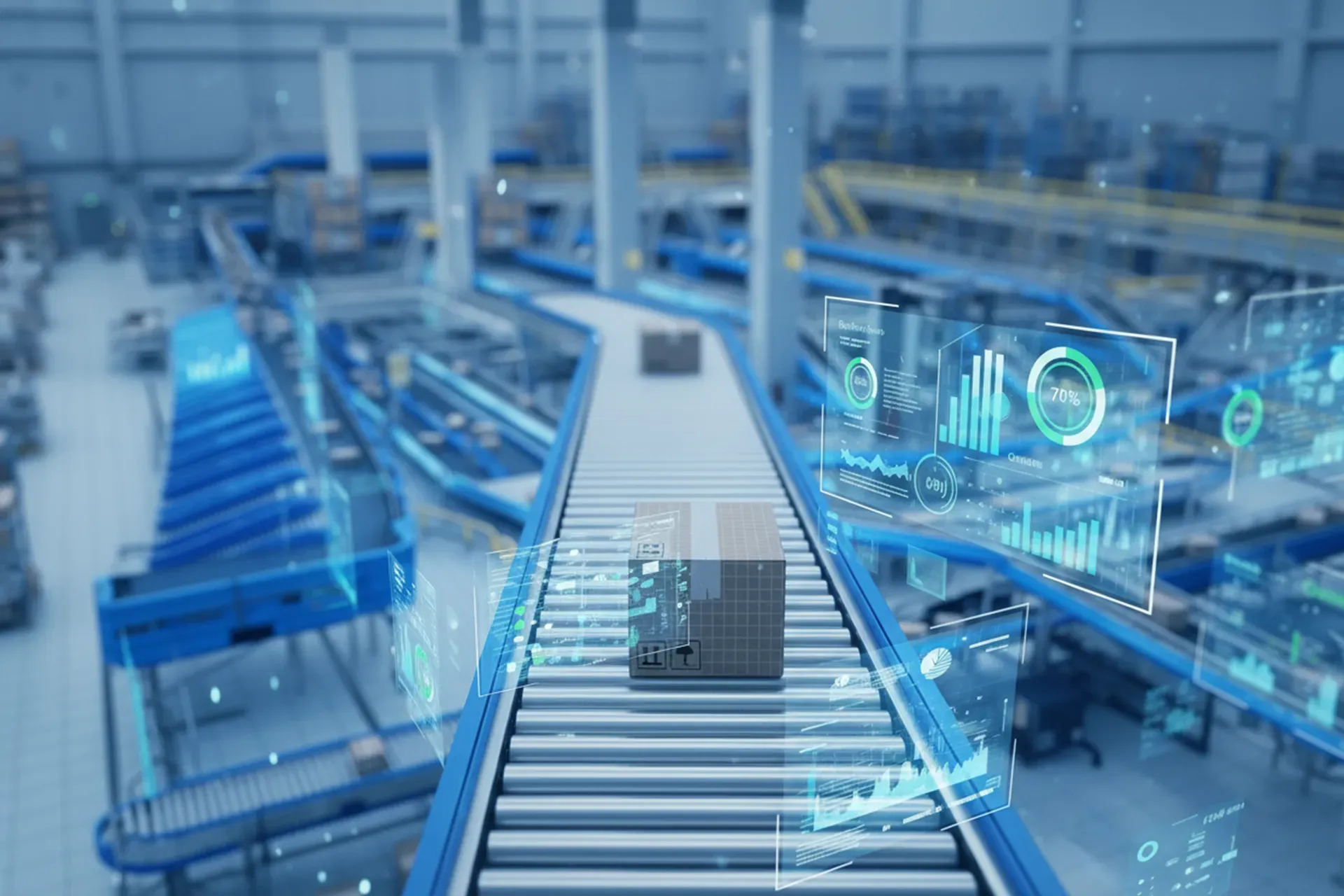
A workplace simulation is a virtual model of a real operational environment that allows organizations to test, analyze, and optimize processes before making changes in the real world. It recreates the logic, flow, and constraints of a workplace digitally, so teams can run scenarios, identify problems, and validate decisions without disrupting live operations or committing to costly investments upfront.
Workplace simulation is especially valuable in complex environments where variables interact in unpredictable ways, such as warehouses, distribution centers, production facilities, and transportation hubs. The sections below unpack how it works, where it applies, and when it makes sense to invest.
How does workplace simulation actually work?
Workplace simulation works by building a digital model of a physical environment, populating it with the rules, resources, and processes that govern real operations, and then running that model through time to observe how the system behaves. The model captures things like machine speeds, worker movements, order flows, conveyor layouts, and scheduling logic, and it plays these out dynamically rather than as static calculations.
Most simulation platforms use a method called discrete event simulation, where the model advances through a sequence of events (an order arrives, a picker starts a task, a conveyor becomes congested) rather than running in continuous real time. This makes it possible to simulate hours, days, or weeks of operations in minutes. As a category, discrete event simulation software is the standard approach for modeling process-driven operational environments, and a well-chosen DES simulation platform can handle everything from a single picking zone to a full multi-site distribution network.
Once the model is built, users can run what-if scenarios by adjusting inputs: adding a shift, changing a picking strategy, rerouting a conveyor, or scaling order volumes. The simulation shows how each change affects throughput, cycle times, resource utilization, and bottlenecks, giving decision-makers clear evidence before anything is touched in the real facility.
What types of workplaces use simulation software?
Simulation software is used across any environment where operations are complex, high-volume, or high-stakes enough that trial and error in real life would be too costly or too risky. The most common sectors include warehousing and distribution, manufacturing, transportation infrastructure, and large public venues.
- Warehouses and distribution centers use warehouse simulation software to model order fulfillment flows, conveyor systems, sortation equipment, and labor allocation across e-commerce, retail, and pharmaceutical operations. Material handling simulation and intralogistics simulation are particularly common applications, helping teams optimize material flow before committing to a layout or equipment investment.
- Manufacturing facilities use manufacturing simulation software to optimize assembly lines, identify production bottlenecks, and plan capacity for new product launches. Production line simulation and production logistics simulation are frequently used to validate new processes without halting live output.
- Airports and rail stations use transportation simulation software to model passenger flows, baggage handling systems, and platform capacity under peak and disruption conditions.
- Stadiums and large event venues use it for crowd management, evacuation planning, and visitor routing to improve both safety and experience.
- Supply chain networks use supply chain simulation software to test end-to-end logistics strategies across multiple nodes, carriers, and demand scenarios.
What these environments share is complexity: many moving parts, tight interdependencies, and consequences that are difficult to predict without modeling the full system.
Build your own simulation, your way
Enterprise Dynamics gives developers full control to model, scale, and integrate complex systems with C++, APIs, and real-time data.
Explore Enterprise DynamicsWhat’s the difference between workplace simulation and a digital twin?
The key difference is that a workplace simulation is a model used to test future scenarios, while a digital twin is a live, continuously updated virtual replica of a real system that reflects its current state in real time. Simulation explores possibilities; a digital twin mirrors reality as it happens.
In practice, the two concepts overlap significantly and are often used together. A digital twin of a warehouse, for example, is built using the same modeling logic as a simulation, but it stays synchronized with live data from sensors, WMS feeds, and operational systems. This means you can use the twin not just to analyze historical performance but to monitor live operations and run forward-looking simulations from the current state of the facility.
For organizations investing in warehouse simulation software, the distinction matters mostly at implementation: a standalone simulation project has a defined scope and timeline, while a digital twin is an ongoing operational asset that requires data integration and maintenance. Many organizations start with simulation and evolve toward a digital twin as their data infrastructure matures.
What problems can workplace simulation solve?
Workplace simulation is most powerful when used to solve problems that involve too many interacting variables for spreadsheets or intuition to handle reliably. It excels at identifying bottlenecks, validating capacity, reducing risk in investment decisions, and optimizing resource allocation before changes go live. This is true whether you are using a DES simulation tool to analyze a single conveyor loop or a full intralogistics simulation environment to model an entire distribution center.
Common problems simulation addresses include:
- Bottleneck identification: pinpointing exactly where throughput breaks down in a conveyor system, picking zone, or production line, and testing fixes without halting operations.
- Investment validation: proving whether a new automated system, expanded dock, or additional shift will deliver the expected return before capital is committed. This includes evaluating warehouse automation simulation scenarios for systems such as AGV simulation or AS/RS simulation before procurement decisions are made.
- Workforce planning: determining the right number of workers per shift, zone, or process step to meet throughput targets without overstaffing.
- System design verification: confirming that a new facility layout or material handling design will perform as intended under realistic demand conditions. Material flow simulation and material flow optimization are key techniques here, allowing engineers to validate designs before construction begins.
- Scenario planning: testing how operations hold up under peak demand, equipment failures, or supply disruptions before those events occur.
How is workplace simulation different from spreadsheets or ERP systems?
Spreadsheets and ERP systems handle static calculations and record transactions, but they cannot model how a system behaves dynamically over time. Workplace simulation captures the interactions, queues, randomness, and timing that determine real operational performance, which static tools are fundamentally unable to replicate.
A spreadsheet can calculate average throughput based on assumed cycle times, but it cannot show what happens when three machines are running at 95% capacity and a fourth fails unexpectedly. It cannot model how a queue builds, how workers respond, or how the ripple effect moves through the rest of the system. ERP systems are excellent at tracking inventory and orders, but they describe what happened, not what will happen under a different set of conditions.
Simulation fills this gap by modeling time-dependent behavior. It accounts for variability, resource contention, and the compound effects of small inefficiencies across a large system. A DES simulation engine is specifically designed to capture this kind of dynamic complexity, which is why organizations use simulation when they need to validate a decision that a spreadsheet cannot reliably answer.
When should an organization invest in workplace simulation?
An organization should invest in workplace simulation when the cost of a wrong decision outweighs the cost of building a model, or when the complexity of the system makes confident decision-making impossible with simpler tools. In practice, this threshold is reached most often when planning major capital investments, designing new facilities, or scaling operations significantly.
Strong signals that simulation is the right tool include:
- A new warehouse, distribution center, or production facility is being designed and needs to be validated before construction.
- An automation investment (conveyor systems, robotics, sorters) is being evaluated and the ROI depends on system-level performance, not just individual machine specs. Logistics simulation software and DES software for warehousing are commonly used at this stage to model the full system before any equipment is ordered.
- Operations are experiencing recurring bottlenecks or throughput shortfalls that cannot be diagnosed through observation or reporting alone.
- Order volumes are growing and it is unclear whether the current layout and staffing model will scale.
- A significant operational change (new process, new product line, new shift model) carries enough risk that testing it live would be unacceptable.
For smaller, well-understood problems, simpler tools may be sufficient. But when the stakes are high and the system is complex, simulation provides the evidence base that makes confident decisions possible.
How Enterprise Dynamics helps with workplace simulation
Enterprise Dynamics is our discrete event simulation software platform built specifically for the kinds of complex operational environments described throughout this article. It is designed for engineers and logistics professionals who need to model, test, and optimize warehouses, distribution centers, production facilities, and transportation systems with precision and speed. As a DES simulation platform, it covers the full range of use cases — from material handling simulation and conveyor simulation to AGV simulation, automated storage and retrieval system simulation, and supply chain simulation.
Here is what Enterprise Dynamics brings to a workplace simulation project:
- Drag-and-drop modeling using a rich library of prebuilt components (called atoms) that represent conveyors, sorters, workers, vehicles, storage systems, and more, so models can be built quickly without starting from scratch.
- 2D and 3D visualization that makes simulation results easy to communicate to stakeholders across engineering, operations, and leadership.
- WMS and ERP integration to feed real operational data into the model and create a digital twin of your supply chain environment.
- What-if scenario testing to compare layout options, staffing levels, equipment configurations, and process changes side by side before committing to any of them.
- KPI analysis and bottleneck identification to give teams the evidence they need to make confident, data-driven investment decisions.
If you are evaluating simulation for your facility or want to understand what a model of your operation could look like, get in touch with our team and we will help you find the right starting point.
Frequently Asked Questions
How long does it typically take to build a workplace simulation model?
The timeline depends on the complexity of the environment and the availability of operational data. A focused simulation of a single process or zone can often be built in a few days to a couple of weeks, while a full facility model with detailed logic, multiple process flows, and data integrations may take several weeks to a few months. Using a platform with prebuilt component libraries, like Enterprise Dynamics, significantly reduces build time compared to coding a model from scratch.
What data do I need to get started with a workplace simulation project?
At a minimum, you need layout or floor plan information, process flow descriptions, throughput targets or order volumes, and basic equipment or resource specifications such as machine cycle times, conveyor speeds, and staffing levels. Historical data from your WMS or ERP system is valuable but not always required to begin — many projects start with design assumptions and refine the model as better data becomes available. The more accurate the input data, the more reliable the simulation output, so it is worth investing time in data quality before building.
How accurate are workplace simulation results compared to real-world performance?
A well-built simulation model that is calibrated against real operational data can achieve a very high degree of accuracy, typically within 5–10% of observed real-world performance. Accuracy depends on how faithfully the model captures the actual rules, variability, and constraints of the operation, including factors like equipment downtime rates, worker pace variability, and order profile distributions. Most simulation projects include a validation phase where the model is run against known historical conditions and adjusted until results align with reality before any forward-looking scenarios are tested.
Can workplace simulation be used for an existing facility, or is it only useful when designing something new?
Simulation is highly valuable for both new and existing facilities. For existing operations, it is commonly used to diagnose recurring bottlenecks, evaluate the impact of adding automation or changing layouts, plan for volume growth, and test new shift or staffing models — all without disrupting live operations. In fact, some of the highest-ROI simulation projects happen in facilities that are already running, because the operational data available makes it easier to build an accurate model and the problems being solved are immediate and concrete.
What is the difference between discrete event simulation and agent-based simulation, and which is better for warehouses?
Discrete event simulation (DES) models a system as a sequence of events — orders arriving, conveyors moving, workers completing tasks — and is best suited for process-driven environments with defined flows and resources, making it the standard approach for warehouses, distribution centers, and manufacturing facilities. Agent-based simulation models individual entities (agents) that make autonomous decisions based on rules and their environment, and is more commonly used for crowd behavior, pedestrian flow, or supply chain network modeling where decentralized decision-making matters. For most warehouse and fulfillment center applications, discrete event simulation provides the right level of detail and runs efficiently enough to model complex systems at full operational scale.
What are the most common mistakes organizations make when running a workplace simulation project?
The most common mistake is treating simulation as a one-time validation exercise rather than an iterative tool — building a model for a single decision and then shelving it rather than maintaining it for future scenarios. Other frequent pitfalls include using overly optimistic input data (such as assuming machines always run at peak speed with no downtime), skipping the model validation step, and failing to involve operations and engineering teams in the modeling process, which leads to models that miss important real-world constraints. The most successful simulation projects treat the model as a living asset and keep it updated as the operation evolves.
How do I build a business case for investing in workplace simulation software?
The strongest business case for simulation is built by quantifying the cost of a wrong decision in the context of a specific upcoming investment or operational challenge. If your organization is evaluating a multi-million dollar automation system, for example, the cost of a simulation project is typically a small fraction of the risk it mitigates. You can also frame the ROI in terms of avoided redesign costs, faster time-to-decision, and the ability to optimize a system before go-live rather than after. Requesting a scoping conversation with a simulation vendor is a practical first step — most can help you identify a concrete use case and estimate the cost-to-value ratio for your specific situation.