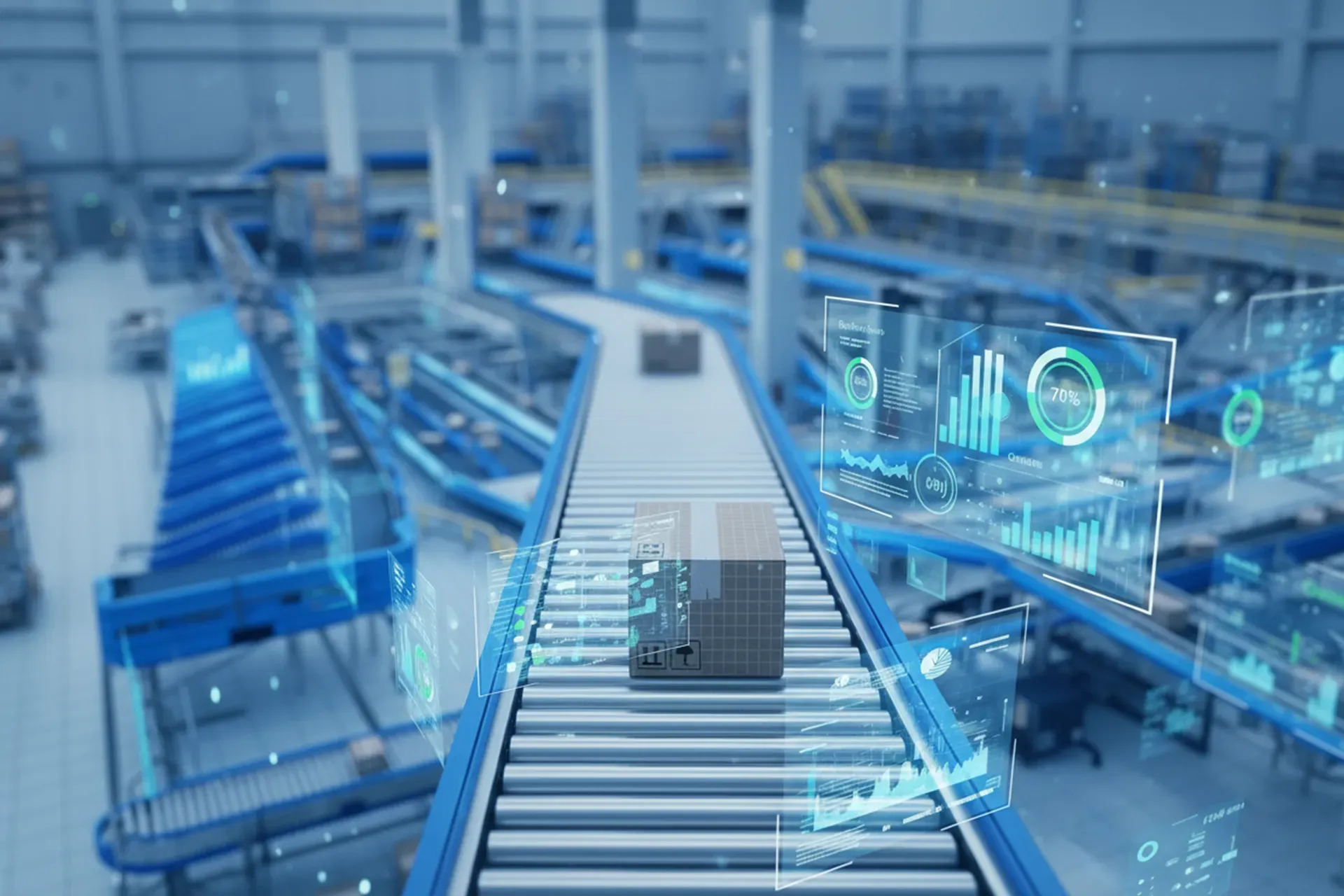
Warehouse simulation is a digital modeling technique that creates a virtual replica of a warehouse environment, allowing operations teams to test layouts, workflows, and equipment configurations before making any physical changes. It works by recreating the dynamic behavior of a real warehouse, including order flows, conveyor systems, picking strategies, and staffing levels, so you can observe how the system performs under different conditions. At its core, most modern warehouse simulation software relies on discrete event simulation — a method that models operations as a sequence of events unfolding over time, making it well suited to the stop-start, queue-driven nature of logistics environments. The sections below unpack how simulation works in practice, what it can model, and when it delivers the most value.
How does warehouse simulation actually work?
Warehouse simulation works by building a virtual model of your warehouse that replicates the movement of goods, the behavior of equipment, and the decisions made by staff, then running that model through time to observe how the system performs. The result is a dynamic, animated representation of your operation that responds to real-world variables like order volume, machine speeds, and shift patterns.
The modeling process typically starts with data: floor plans, throughput figures, equipment specifications, and historical order profiles. These inputs are used to construct a digital environment where every conveyor belt, sorter, pick station, and worker role is represented. Once the model is built, you can run it at accelerated speed across thousands of simulated hours to generate performance data that would take months to collect in the real world.
What makes simulation particularly powerful is the ability to introduce variability. Real warehouses do not operate under perfectly controlled conditions. Equipment breaks down, demand spikes unexpectedly, and staff absences create gaps. A well-built simulation accounts for all of this, producing results that reflect the messy reality of live operations rather than idealized assumptions. This is precisely where discrete event simulation software excels — it captures the timing and sequencing of individual events, such as a pallet arriving at a pick station or a conveyor segment becoming blocked, in a way that static models simply cannot.
Build your own simulation, your way
Enterprise Dynamics gives developers full control to model, scale, and integrate complex systems with C++, APIs, and real-time data.
Explore Enterprise DynamicsWhat can warehouse simulation model?
Warehouse simulation can model virtually every element of a distribution or fulfillment operation, from the physical infrastructure to the human decisions that drive it. This includes conveyor and sortation systems, automated storage and retrieval systems (AS/RS), picking strategies, docking operations, inventory positioning, and workforce scheduling. Modern intralogistics simulation platforms are capable of representing entire material handling ecosystems — not just individual machines, but the way those machines interact under real operating conditions.
More specifically, a warehouse simulation model can represent:
- Inbound and outbound material flows, including receiving, putaway, and dispatch
- Automated equipment such as conveyors, sorters, robotic picking arms, and shuttle systems, including AGV simulation for sites using autonomous mobile robots or guided vehicles
- Manual processes including zone picking, batch picking, and goods-to-person workflows
- Staffing levels across shifts, including the impact of absences or redeployment
- System integrations such as WMS-driven order release logic and slotting strategies
- Peak demand scenarios, seasonal surges, and promotional order spikes
- AS/RS simulation, covering automated storage and retrieval system behavior including crane movements, shuttle cycles, and throughput constraints
This breadth means simulation is not limited to greenfield design projects. Existing warehouses benefit just as much, because the model can be calibrated against live operational data to reflect the current state before any changes are tested.
What’s the difference between warehouse simulation and a warehouse digital twin?
Warehouse simulation and a warehouse digital twin are closely related but serve different purposes. Simulation is primarily a planning and analysis tool used to test scenarios and predict future performance. A digital twin is a continuously synchronized virtual replica of a live operation, updated in real time with sensor data and operational feeds so it always reflects the current state of the physical warehouse.
Think of it this way: simulation answers “what would happen if,” while a digital twin answers “what is happening now.” In practice, the two often work together. A digital twin provides the accurate baseline data that makes a simulation model more reliable, and simulation capabilities embedded within a digital twin allow operators to run forward-looking scenarios against real-time conditions.
For organizations planning a new facility or evaluating a major system upgrade, simulation is typically the starting point. For organizations managing a complex live operation who want ongoing visibility and continuous optimization, a digital twin warehouse approach becomes the natural evolution.
When should a warehouse use simulation instead of spreadsheets or WMS data?
A warehouse should use simulation when the system is too dynamic and interconnected for spreadsheets or WMS reports to capture accurately. Spreadsheets model averages and static relationships. WMS data tells you what happened in the past. Neither tool can show you how a change in one part of the operation ripples through the rest of the system over time.
Simulation becomes the right tool in situations such as:
- Evaluating a major capital investment such as a new sorter, an AS/RS system, or an expanded pick area, where the cost of getting the decision wrong is high
- Designing a new facility or reconfiguring an existing one, where layout decisions have long-term consequences that are difficult to reverse
- Preparing for peak trading periods such as peak season, where you need to stress-test your operation against demand volumes you have not yet experienced
- Identifying bottlenecks that are not visible from throughput reports alone, because the constraint shifts depending on order mix and timing
- Comparing automation vendors or system configurations on equal terms before committing to a supplier
If a decision is reversible and low-cost, a spreadsheet may be sufficient. When the stakes are high and the system is complex, simulation provides the depth of analysis that static tools simply cannot match.
What types of problems does warehouse simulation solve?
Warehouse simulation solves problems that involve complexity, uncertainty, and interdependence. These are situations where a change in one variable, such as order release timing or conveyor speed, produces non-obvious effects elsewhere in the operation.
Common problems that warehouse simulation addresses include throughput bottlenecks that are difficult to isolate through observation alone, workforce sizing questions where the right staffing level depends on order mix and equipment behavior simultaneously, and investment validation challenges where a business case needs to be tested before capital is committed. Material flow simulation is particularly useful here — by tracing how individual units or pallets move through the facility, teams can identify where congestion builds, where equipment is underutilized, and where small process changes would have an outsized effect on overall performance. Simulation also helps resolve disputes between system integrators and operators about whether a proposed design will meet its performance targets by providing an independent, data-driven answer.
Beyond problem-solving, simulation is increasingly used proactively, to explore opportunities for efficiency improvement, test the impact of process changes before rollout, and build organizational confidence in decisions that would otherwise rely on intuition or incomplete data.
How accurate is warehouse simulation?
Warehouse simulation accuracy depends directly on the quality of the input data and the skill with which the model is built and validated. A well-constructed simulation model, calibrated against real operational data, can achieve very high predictive accuracy for throughput, cycle times, and resource utilization. The model is only as good as the assumptions and data that go into it.
Validation is the critical step that separates reliable simulations from unreliable ones. This involves running the model against historical data and comparing its outputs to known results. When the simulated performance closely matches what actually happened in the warehouse, confidence in the model’s predictive capability increases significantly.
It is also worth noting that simulation does not need to be perfect to be valuable. Even a model with acknowledged simplifications provides far more insight than a spreadsheet when it comes to understanding dynamic system behavior. The goal is not to predict the future with certainty, but to make better-informed decisions by understanding the range of likely outcomes before committing to a course of action.
How Enterprise Dynamics helps with warehouse simulation
Enterprise Dynamics is our flagship warehouse simulation software, built specifically for engineers and operations professionals who need to model, test, and optimize complex logistics environments. As a fully featured DES simulation platform, it uses discrete event simulation to capture the time-dependent, event-driven behavior that defines real warehouse operations. It combines an intuitive drag-and-drop modeling interface with powerful 2D and 3D visualization, making it practical to build detailed warehouse models without starting from scratch every time.
Here is what Enterprise Dynamics brings to warehouse simulation projects:
- Pre-built component libraries with specialized atoms for conveyors, sorters, pick stations, and automated equipment, so models can be assembled quickly and accurately
- WMS and ERP integration, enabling the simulation to reflect real order data and operational logic rather than theoretical assumptions
- What-if scenario testing across layout configurations, staffing levels, equipment speeds, and demand profiles
- Bottleneck identification and throughput analysis to pinpoint where performance constraints occur and quantify the impact of resolving them
- Material flow optimization tools that allow teams to evaluate alternative routing, sequencing, and storage strategies within the same model
- Digital twin capability, allowing the model to evolve from a planning tool into a continuously updated operational asset
Whether you are validating a capital investment, preparing for peak season, or designing a new facility from the ground up, Enterprise Dynamics gives your team the analytical depth to make decisions with confidence. Get in touch with us to discuss how we can support your next warehouse simulation project.
Frequently Asked Questions
How long does it take to build a warehouse simulation model?
The time required depends on the complexity of the operation and the quality of data available. A straightforward model for a single-zone pick-and-pack operation might take a few days to a week to build and validate, while a multi-level automated facility with complex conveyor networks and WMS integration could take several weeks. Having clean, well-organized data on hand — floor plans, equipment specs, and historical order profiles — significantly shortens the build time.
What data do I need to get started with warehouse simulation?
At a minimum, you need floor plans or layout drawings, equipment specifications (speeds, capacities, cycle times), order volume and profile data (ideally 12 months to capture seasonal variation), and staffing information by shift. The more detailed and accurate this data is, the more reliable your model will be. If some data is unavailable, experienced simulation engineers can work with estimates and clearly flag where assumptions have been made, so you understand the model’s confidence boundaries.
Can warehouse simulation be used for an existing operation, or is it only useful for new facility design?
Simulation is equally valuable for existing operations and is often where the return on investment is most immediate. An existing warehouse provides real operational data that can be used to calibrate and validate the model quickly, giving you a highly accurate baseline to test changes against. Common use cases include reconfiguring pick zones, evaluating automation upgrades, optimizing workforce scheduling, and stress-testing the operation ahead of peak season — all without disrupting live operations.
What are the most common mistakes teams make when running a warehouse simulation project?
The most frequent mistake is using poor or incomplete input data and then treating the model’s outputs as ground truth. Simulation results are only as reliable as the data and assumptions behind them, which is why validation against historical performance is non-negotiable. Another common pitfall is building a model that is too detailed too early — over-engineering the initial model adds time and cost without necessarily improving decision-making. Starting with the key questions you need answered and building to that level of detail is a more effective approach.
How do I know if the results from a warehouse simulation are trustworthy?
Trust in a simulation model is established through a formal validation process, where the model is run against a known historical period and its outputs — throughput rates, cycle times, queue lengths, resource utilization — are compared to what actually occurred in the warehouse. A well-validated model should reproduce real-world results within an acceptable margin, typically within 5–10% for key performance indicators. Any significant deviations should be investigated and resolved before the model is used for forward-looking scenario testing.
Can warehouse simulation integrate with our existing WMS or ERP system?
Yes, modern warehouse simulation platforms like Enterprise Dynamics support integration with WMS and ERP systems, allowing the model to consume real order data, slotting logic, and operational rules rather than relying on synthetic inputs. This integration makes scenario testing far more realistic, because the simulation responds to actual order profiles and system behaviors rather than theoretical averages. It also enables the model to evolve into a digital twin over time, continuously updated with live operational data.
At what point in a capital investment decision should we commission a warehouse simulation?
Ideally, simulation should be commissioned early in the decision-making process — before vendor selection, not after. Running simulation during the evaluation phase allows you to test competing system configurations on equal terms, identify potential design flaws before they are locked in, and build a business case grounded in data rather than vendor projections. Commissioning simulation after a procurement decision has already been made limits its value to implementation planning rather than strategic validation, which is where the highest-impact decisions are made.
Related Articles
- How does warehouse automation simulation help optimize conveyor throughput?
- How does warehouse simulation software help avoid costly automation failures?
- How to avoid supply chain risks?
- What happens to my AutoMod models when support ends?
- What industries benefit most from supply chain simulation software?