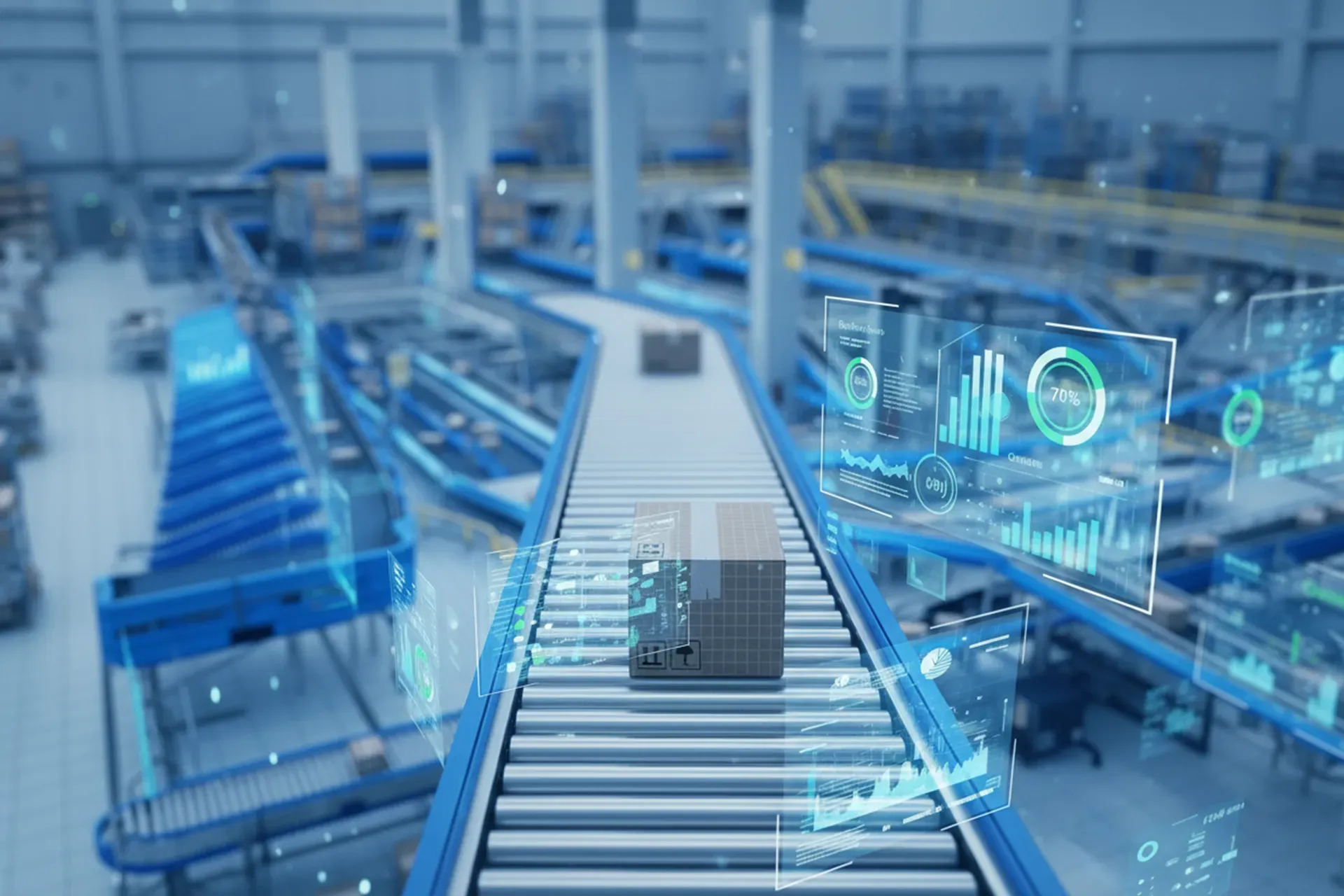
A simulation is a dynamic, computerized model of a real-world system or process that mimics how that system behaves over time. Rather than guessing how a warehouse, production line, or logistics network will perform, a simulation lets you run thousands of virtual scenarios and observe the outcomes before anything changes in the real world. Below, we answer the most common follow-up questions about how simulations work, what types exist, and when they make sense for your organization.
How does a simulation actually work?
A simulation works by representing a real system as a set of components, rules, and events inside a computer model. The software tracks how entities, such as orders, pallets, vehicles, or people, move through the system, interact with resources, and respond to changing conditions. By running the model forward in virtual time, you can observe performance metrics like throughput, wait times, and resource utilization without touching the live operation.
In practice, building a simulation model involves three broad steps:
- Model the system: Define the physical layout, resources, and logic, for example, the conveyor belts, picking stations, and routing rules in a warehouse.
- Feed in realistic data: Input actual or estimated demand patterns, processing times, shift schedules, and failure rates so the model reflects real-world variability.
- Run experiments: Execute the model repeatedly under different conditions, peak season volumes, equipment failures, staffing changes, and collect the results for comparison.
The power of simulation lies in that third step. Because the model runs in virtual time, you can compress months of operation into minutes, test dozens of scenarios side by side, and identify the best course of action with confidence.
What are the main types of simulation?
The three main types of simulation are discrete event simulation, agent-based simulation, and continuous simulation. Each is suited to different kinds of systems and questions, and modern platforms can combine all three in a single model.
- Discrete event simulation (DES): Models systems where events happen at distinct points in time, a pallet arriving at a sorting station, a truck docking at a bay. DES simulation is the dominant approach for warehouse simulation software, logistics simulation software, and manufacturing simulation software because most operational processes are naturally event-driven.
- Agent-based simulation: Models individual actors, people, vehicles, robots, each following their own behavioral rules. It is especially useful for crowd movement, pedestrian flow, and any scenario where emergent group behavior matters.
- Continuous simulation: Tracks quantities that change smoothly over time, such as fluid levels in a tank or energy consumption across a facility. It is common in process industries and engineering applications.
For most logistics and intralogistics challenges, discrete event simulation software is the starting point. Agent-based and continuous methods add depth when human behavior or physical flows are part of the picture.
Build your own simulation, your way
Enterprise Dynamics gives developers full control to model, scale, and integrate complex systems with C++, APIs, and real-time data.
Explore Enterprise DynamicsWhat is the difference between a simulation and a digital twin?
A simulation is a model you build to answer specific what-if questions, while a digital twin is a continuously updated virtual replica of a real asset or system that stays synchronized with live operational data. Think of a simulation as a powerful experiment and a digital twin as a living mirror of your operation.
In practice, the boundary between the two is often blurry, and many organizations use both together. A simulation model of a distribution center might be built and validated during a design project. Once the facility goes live, that same model can be connected to real-time data feeds from the WMS and ERP systems, at which point it becomes a digital twin warehouse simulation environment. The twin reflects current inventory levels, equipment status, and order volumes at all times, enabling ongoing monitoring and rapid scenario testing without disrupting the live operation.
The key distinction is the data connection. A simulation can run entirely on historical or assumed data. A digital twin requires a live, persistent link to the real system it represents.
What kinds of problems can simulation solve?
Simulation is most valuable for complex, dynamic problems where many variables interact and the consequences of a wrong decision are costly or irreversible. Common applications include capacity planning, bottleneck identification, investment validation, safety analysis, and workforce optimization.
In warehousing and intralogistics specifically, intralogistics simulation software is used to:
- Determine whether a proposed automation system can handle peak volumes before purchasing equipment
- Identify which workstation, conveyor segment, or process step is limiting overall throughput
- Test the impact of adding a shift, changing routing logic, or reconfiguring a sortation system
- Validate that a new facility layout meets service-level targets under realistic demand variability
- Assess the risk of equipment failures and evaluate buffer strategies, including scenarios involving AGV simulation or automated storage and retrieval system simulation
Beyond warehousing, simulation is used to model baggage handling at airports, passenger flow at train stations, evacuation scenarios at stadiums, and production line simulation in manufacturing. Wherever a system is too complex, too fast, or too risky to experiment on directly, simulation provides a safe environment for learning and decision-making.
When should an organization use simulation instead of spreadsheets?
An organization should move from spreadsheets to simulation when the system involves significant variability, interdependent processes, or time-dependent behavior that static calculations cannot capture. Spreadsheets assume average conditions and fixed relationships, they cannot model queues building up, equipment competing for shared resources, or demand arriving in unpredictable bursts.
Specifically, a DES simulation tool becomes the better choice when:
- Processes are sequential and resources are shared, a delay in one step ripples through the entire system in ways averages do not reveal
- Variability matters, processing times, order volumes, and failure rates fluctuate, and the worst-case behavior is as important as the average
- The investment is large enough that a wrong decision is expensive, a new automated warehouse, a fleet expansion, or a facility redesign
- Multiple scenarios need to be compared systematically, not just one baseline calculation
- Stakeholders need a visual, communicable model rather than a column of numbers
Spreadsheets remain useful for simple, stable calculations. But as soon as a system has queues, randomness, or multiple interacting components, discrete event simulation software provides answers that spreadsheets structurally cannot.
How Enterprise Dynamics helps you simulate with confidence
For organizations ready to move beyond spreadsheets and static models, Enterprise Dynamics is our DES simulation platform built specifically for material handling simulation, warehousing, logistics, and production environments. It gives engineers and decision-makers the tools to build accurate virtual models quickly and test scenarios before committing to real-world changes.
With Enterprise Dynamics, you can:
- Build 2D and 3D models using a drag-and-drop library of pre-built components tailored to logistics systems, including conveyor simulation and material flow simulation
- Connect directly to your WMS and ERP systems to create a warehouse simulation environment fed by real operational data
- Run throughput analyses, identify bottlenecks, and compare investment scenarios in a risk-free virtual setting
- Visualize results in a way that communicates clearly to both engineers and senior decision-makers
Whether you are validating a new automation investment, redesigning a distribution center, or preparing for peak season demand, Enterprise Dynamics gives your team the confidence to make the right call. Get in touch with us to discuss your simulation challenge and see what the platform can do for your operation.
Frequently Asked Questions
How long does it typically take to build a simulation model for a warehouse or logistics operation?
The timeline depends on the complexity of the system and the quality of data available, but most operational simulation projects range from a few weeks to a few months. A focused study, such as validating a single conveyor line or a picking zone, can be completed in two to four weeks, while a full distribution center model with multiple processes and shift patterns may take two to three months. Platforms like Enterprise Dynamics accelerate this significantly through pre-built component libraries tailored to logistics environments, reducing the time spent on model construction and allowing teams to focus on running experiments and interpreting results.
What data do I need to have ready before starting a simulation project?
The most critical inputs are order or throughput volumes (including peak and off-peak patterns), processing times for each operation step, resource counts (staff, equipment, docks), shift schedules, and failure or downtime rates for automated equipment. You do not need perfect data to get started — simulation models can be built with estimated ranges and then refined as better data becomes available. In fact, one of the early benefits of building a model is that it reveals exactly which data gaps have the biggest impact on results, helping you prioritize where to invest in better measurement.
How do I know if my simulation model is accurate enough to trust its results?
Model validation is the process of confirming that the simulation reproduces known, real-world behavior before you use it to test new scenarios. The standard approach is to run the model using historical input data and compare its outputs — throughput, queue lengths, cycle times — against actual recorded performance from the same period. A well-validated model should match real-world KPIs within an acceptable margin, typically around 5–10%, depending on the application. If discrepancies appear, they usually point to missing logic, incorrect data, or overlooked process steps, all of which are valuable findings in themselves.
Can simulation be used after a system is already live, or is it only useful during the design phase?
Simulation is valuable at every stage of a system’s lifecycle, not just during design. Post-launch, a validated model can be used to test operational changes — new routing rules, staffing adjustments, or process reconfigurations — before rolling them out on the live floor. When connected to real-time data from a WMS or ERP, the model transitions into a digital twin that supports ongoing monitoring, rapid scenario testing, and proactive decision-making. Many organizations find that the return on their simulation investment actually increases over time as the model is reused across multiple projects and operational questions.
What is the most common mistake organizations make when running a simulation project?
The most common mistake is underestimating the importance of variability in the input data. Teams often feed the model with average processing times and average demand figures, which produces results that look clean but miss the real-world behavior that causes problems — the bursts, the breakdowns, and the knock-on delays. Simulation’s core advantage over spreadsheets is its ability to model randomness and interdependency, so if you strip that out by using only averages, you lose much of the analytical power. Always define realistic distributions for processing times, arrival rates, and failure intervals, even if that means working with estimated ranges rather than precise figures.
How many scenarios should I test in a simulation study to get meaningful results?
There is no fixed number, but a well-structured simulation study typically includes a validated baseline scenario, two to four alternative configurations, and a set of stress-test conditions such as peak volumes or equipment failures. The baseline establishes that the model is accurate; the alternatives answer your specific what-if questions; and the stress tests reveal how robust each option is under adverse conditions. Running multiple replications of each scenario — using different random seeds — is equally important, as it accounts for statistical variability and ensures that your conclusions reflect consistent trends rather than a single lucky or unlucky run.
Is simulation software difficult to learn, and do I need a programming background to use it?
Modern simulation platforms like Enterprise Dynamics are designed for engineers and operations professionals, not software developers, and most users become productive without writing a single line of code. Drag-and-drop component libraries, visual model building, and pre-configured logic for common logistics processes significantly flatten the learning curve. That said, more advanced customizations — such as complex routing algorithms or integration with live data systems — may benefit from scripting knowledge. Most organizations start with out-of-the-box functionality, build confidence through early projects, and gradually explore more advanced capabilities as their needs evolve.