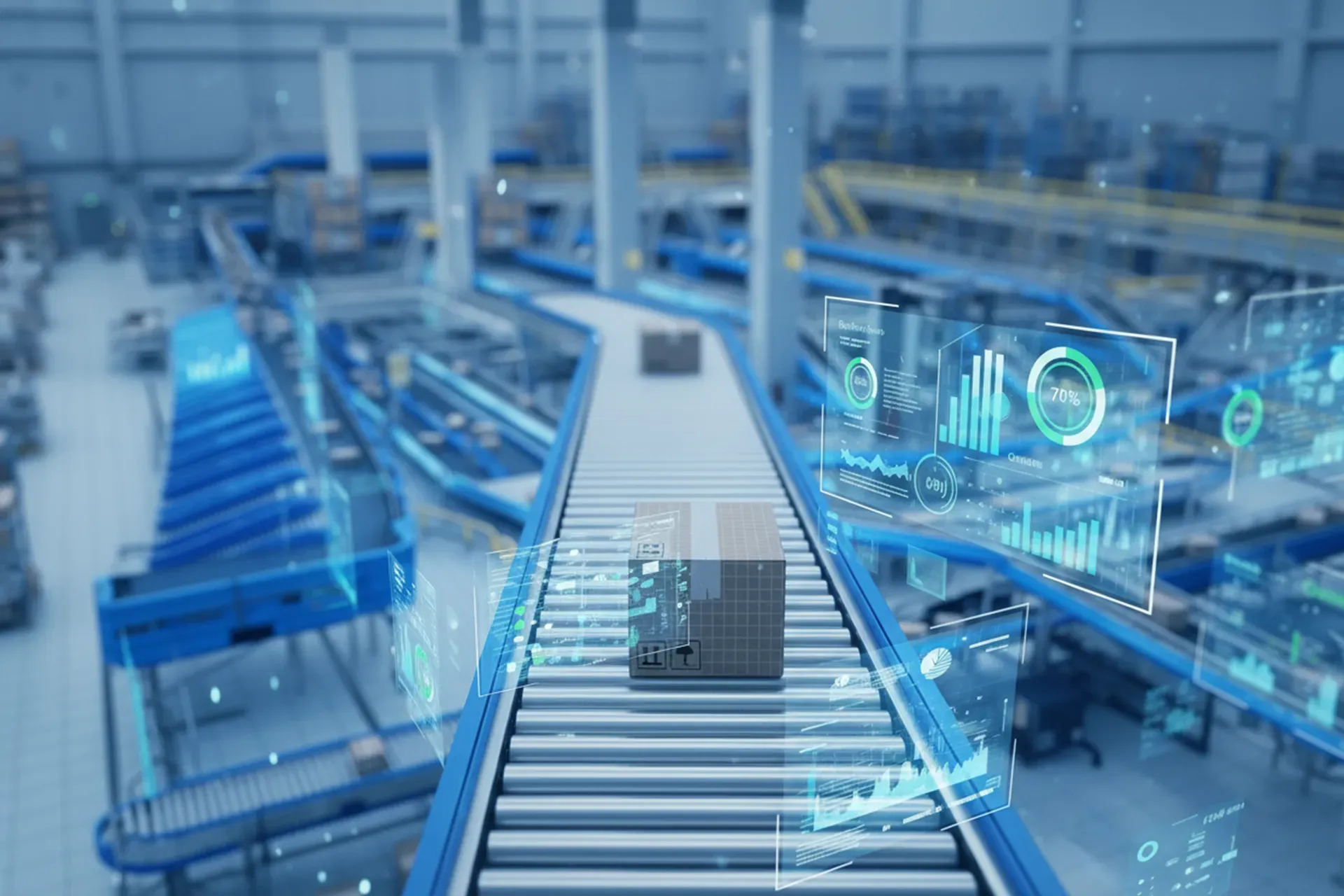
Warehouse automation simulation is the use of software to build a virtual model of a warehouse or distribution center and test how automated systems, processes, and layouts perform before anything is physically built or changed. It lets operations teams run thousands of scenarios in a risk-free environment, identifying bottlenecks, validating equipment choices, and fine-tuning workflows without disrupting live operations. The sections below answer the most common questions about how simulation works, what it can model, and when it delivers the most value.
How does warehouse automation simulation actually work?
Warehouse automation simulation works by creating a dynamic virtual replica of a warehouse environment where automated systems, goods flows, and human interactions are modeled as discrete events unfolding over time. The software processes millions of individual actions, such as a conveyor moving a tote or a robot picking an item, to reveal how the whole system behaves under real operating conditions.
In practice, engineers build the model by placing pre-configured components into a virtual space. In discrete event simulation software tools like Enterprise Dynamics, these components are called atoms and represent physical objects such as conveyors, sorters, workstations, and vehicles. Once the layout is assembled, the model is fed with real or representative data, including order volumes, SKU profiles, shift patterns, and equipment speeds.
The simulation then runs forward in time, compressing hours, days, or weeks of warehouse activity into minutes. Engineers observe how the system responds, measure throughput, track resource utilization, and pinpoint exactly where slowdowns occur. They can then adjust parameters and re-run the model instantly, comparing outcomes across dozens of configurations without touching the physical warehouse.
What warehouse processes and systems can be simulated?
Virtually every process inside a modern warehouse or distribution center can be simulated, from inbound receiving and put-away through picking, sorting, packing, and outbound dispatch. The scope includes both manual workflows and fully automated systems, making warehouse simulation relevant whether a facility is planning its first conveyor or designing a lights-out fulfillment center.
Common systems and processes that simulation covers include:
- Conveyor and sortation systems – belt conveyors, cross-belt sorters, sliding shoe sorters, and merge or divert points. Conveyor simulation allows teams to identify flow restrictions and optimize throughput before any physical installation takes place.
- Automated Storage and Retrieval Systems (AS/RS) – unit-load cranes, mini-loads, shuttle systems, and vertical lift modules. AS/RS simulation and automated storage and retrieval system simulation make it possible to validate cycle times and storage density under realistic demand conditions.
- Autonomous Mobile Robots (AMRs) and AGVs – routing logic, charging cycles, traffic management, and interaction with human workers. AGV simulation is particularly useful for testing fleet sizing and path conflict resolution before deployment.
- Picking operations – goods-to-person stations, pick-and-place robotics, and zone-based picking strategies
- Workforce planning – staffing levels across shifts, break schedules, and seasonal demand peaks
- Order batching and wave release – how different release strategies affect throughput and labor efficiency
The ability to combine all of these elements in a single model is particularly powerful. Real warehouses do not operate in isolated subsystems, and neither does a well-built intralogistics simulation. A change to sortation speed, for example, will ripple through the picking area and affect outbound staging, and a good simulation captures that interdependency accurately. Material flow simulation plays a key role here, making it possible to trace how goods move through every stage of the operation and where material flow optimization opportunities exist.
Build your own simulation, your way
Enterprise Dynamics gives developers full control to model, scale, and integrate complex systems with C++, APIs, and real-time data.
Explore Enterprise DynamicsWhat’s the difference between warehouse simulation and a digital twin?
Warehouse simulation and a digital twin are closely related but serve different purposes. A simulation is a model used to test future scenarios before they exist in the real world. A digital twin is a live, continuously updated virtual replica of an existing facility that mirrors real-time operational data. The key distinction is time: simulation looks forward, while a digital twin reflects the present.
In practice, the two concepts often overlap and complement each other. A simulation model built during the design phase of a new warehouse can evolve into a digital twin once the facility goes live, with data from WMS, ERP, and sensor systems feeding into the model to keep it current. This means teams can use the same underlying model for both predictive planning and day-to-day operational monitoring.
For organizations evaluating digital twin warehouse software, it is worth understanding that the simulation model is typically the foundation. A digital twin without a validated simulation behind it lacks the predictive capability that makes it genuinely useful. Building the simulation first, validating it against real data, and then connecting it to live feeds is the most reliable path to a functional digital twin.
When should a business use warehouse automation simulation?
A business should use warehouse automation simulation whenever the cost or risk of getting a decision wrong is high enough to justify the investment in modeling. In practice, this covers several distinct moments in the lifecycle of a warehouse or distribution operation.
The most common trigger points are:
- Before a major capital investment – validating that a proposed AS/RS, conveyor system, or robot fleet will actually deliver the expected throughput before signing contracts worth millions.
- During facility design or expansion – testing layout options, flow paths, and equipment configurations when changes are still inexpensive to make on paper.
- When capacity is being outgrown – understanding exactly where the current system will break under higher volumes and what changes will extend its useful life.
- Before going live with a new system – running stress tests and edge cases in the simulation to reduce the risk of costly surprises during commissioning.
- When operational performance is declining – using simulation to diagnose bottlenecks that are difficult to isolate through observation or spreadsheet analysis alone.
- For workforce and shift planning – modeling how different staffing strategies affect throughput and service levels without experimenting on real operations.
Simulation is also valuable as an ongoing planning tool rather than a one-time exercise. Facilities that maintain a live model can respond to changes in demand, SKU mix, or operating constraints much faster than those starting from scratch each time a question arises.
What results can warehouse automation simulation deliver?
Warehouse automation simulation delivers measurable improvements in throughput, resource efficiency, and investment confidence. The results are specific and quantifiable because the simulation produces data, not opinions. Teams walk away knowing the exact throughput capacity of a proposed layout, the utilization rate of each piece of equipment, and the precise conditions under which the system will hit its limits.
Across logistics and intralogistics projects, simulation consistently produces value in several areas. Bottlenecks that would have gone undetected until commissioning are identified and resolved during the design phase, when fixes cost a fraction of what they would in a live environment. Equipment sizing is optimized, which often means avoiding over-investment in capacity that will never be needed. Workforce planning becomes more precise, reducing both idle time and understaffing during peak periods.
Simulation also accelerates decision-making. When a buying committee is evaluating competing automation proposals, a validated simulation model gives everyone a shared, objective reference point rather than relying on vendor claims or gut instinct. This is particularly relevant for complex procurement decisions involving multiple departments and significant capital. Logistics simulation software and warehouse simulation software both play an important role here, giving teams the analytical depth to compare options with confidence.
How Enterprise Dynamics helps with warehouse automation simulation
Enterprise Dynamics is our DES simulation platform built specifically for the challenges that warehouse and intralogistics teams face. As a purpose-built DES simulation environment for logistics and material handling, it gives engineers a practical, flexible environment to model, test, and optimize complex automated systems before a single piece of equipment is ordered or installed. For teams evaluating DES software for warehousing or DES software for logistics, it offers a comprehensive and proven foundation.
Here is what Enterprise Dynamics brings to warehouse automation simulation projects:
- Drag-and-drop model building – pre-built atoms for conveyors, sorters, AS/RS, AMRs, workstations, and more, so engineers can assemble realistic models quickly without writing code from scratch
- 2D and 3D visualization – clear visual output that makes it easy to communicate findings to technical teams and non-technical stakeholders alike
- WMS and ERP integration – real operational data feeds directly into the model, so scenarios reflect actual order profiles, SKU behavior, and shift patterns
- What-if scenario testing – run hundreds of configurations in the time it would take to manually evaluate a handful, with direct comparison of KPIs across scenarios
- Bottleneck identification and throughput analysis – pinpoint exactly where and when constraints occur, and model the impact of resolving them
Whether you are validating a greenfield DC design, stress-testing an existing system ahead of a peak season, or building a business case for automation investment, Enterprise Dynamics gives your team the evidence to move forward with confidence. Get in touch with us to discuss your project and see what simulation can do for your warehouse operation.
Frequently Asked Questions
How long does it typically take to build a warehouse simulation model?
The time required depends on the complexity of the facility and the availability of input data. A focused model covering a single subsystem, such as a sortation line or a goods-to-person picking area, can often be built and validated within a few weeks. A full-facility model for a large distribution center with multiple automated systems may take two to three months, though platforms like Enterprise Dynamics significantly reduce build time through pre-configured components that don’t require custom coding.
What data do I need to provide to run a warehouse automation simulation?
The core inputs are order volume and profile data (daily or hourly throughput targets), SKU characteristics (dimensions, weight, velocity), equipment specifications (speeds, capacities, cycle times), and operational parameters such as shift patterns and break schedules. The more representative your data, the more accurate the simulation output will be. If you’re in early planning stages and don’t yet have all real data available, simulation engineers can work with industry benchmarks or assumptions, clearly flagging where sensitivity analysis should be applied.
Can simulation be used to evaluate competing vendor proposals objectively?
Yes, and this is one of the most practical applications. When multiple automation vendors are pitching different system designs, a simulation model lets you test each proposal against the same set of real operational demands rather than relying on vendor-supplied performance claims. This gives procurement and operations teams a shared, data-driven reference point and often reveals performance gaps or hidden constraints that wouldn’t surface until after installation.
What are the most common mistakes teams make when running warehouse simulations?
The most frequent mistake is using overly optimistic input data, such as equipment running at theoretical maximum speeds with no downtime, which produces results that look great on paper but don’t reflect real-world performance. Another common error is modeling subsystems in isolation rather than as an integrated whole, which misses the interdependencies that cause real bottlenecks. Finally, teams sometimes skip the model validation step, where simulation output is compared against known historical data, which is essential for building confidence in the results before using them to make major decisions.
Is warehouse automation simulation only worthwhile for large distribution centers?
Not at all. While simulation is most commonly associated with large, capital-intensive automation projects, it delivers value at a much smaller scale too. A mid-sized facility evaluating its first conveyor system, planning a mezzanine expansion, or trying to squeeze more throughput from an existing layout can benefit significantly. The relevant question isn’t facility size, but whether the cost of a wrong decision outweighs the investment in modeling, and in most automation or expansion scenarios, it does.
How do I know if the simulation results I'm seeing are accurate enough to trust?
Model validation is the process that answers this question. Before using a simulation to make forward-looking decisions, engineers run the model against a period of known historical data and compare the simulated outputs, such as throughput rates and equipment utilization, against what actually happened. If the model reproduces real-world behavior within an acceptable margin, typically within 5-10%, it is considered validated and reliable for scenario testing. Any reputable simulation project should include a formal validation step, and the results of that validation should be documented and shared with decision-makers.
Can an existing simulation model be updated as our warehouse operations evolve?
Yes, and maintaining a living model is one of the most cost-effective ways to use simulation long-term. Rather than rebuilding from scratch each time a new question arises, an updated model lets your team quickly test the impact of changes such as new product lines, volume growth, equipment additions, or layout modifications. When the model is also connected to live WMS or ERP data feeds, it can evolve into a digital twin that supports both ongoing operational decisions and future planning, making the initial investment in simulation pay dividends well beyond the original project.
Related Articles
- Can warehouse simulation software model autonomous mobile robots?
- How does warehouse simulation software support pharma distribution planning?
- How do developers build custom warehouse simulation applications?
- What are the limitations of AutoMod simulation software?
- How is supply chain simulation software used in manufacturing?