Empowering Rail Networks With Intelligent Predictive Simulation
For the coming years, public transport by train is expected to grow steadily worldwide. Railway companies, especially in high-populated areas, face multiple challenges regarding this growth. The main challenge is to optimize rail infrastructure, maximize rail utilization and satisfy both passengers and freight operators. Solutions to this challenge are constraint by safety regulations and the wish for energy efficiency.
Simulation has been proven to be an indispensable decision support tool for solving these challenges. Railway simulation software is a key tool for rail network managers when performing for example punctuality and robustness analysis of train schedules. Simulation is also used by rail network managers for safety, capacity and energy analysis of (future) infrastructure.
InControl develops advanced, customizable railway-traffic simulation software used by rail infrastructure managers, operators, and planners. Our platform enables the creation of detailed models of rail networks, supporting decisions about future performance, safety, capacity, and innovation. The software helps organizations optimize infrastructure, improve punctuality, and assess energy-efficient operations within regulatory constraints. It also supports evaluation of new technologies such as TMS, ATO and ERTMS before real-world deployment. Beyond analysis, the system enables large-scale serious-gaming sessions to train staff and test procedures in realistic, distributed simulation environments. Overall, InControl’s decades of expertise provide rail organizations with a powerful tool for planning, innovation, and operational readiness.
Applications
InControl is an expert in railway simulation software, understanding the concepts and systems that are relevant to railway operation. By uniting our simulation platform with customer applications, tooling and datasets, InControl creates large scale microscopic multi-purpose railway simulation software, which can be used for:
-
Simulation studies
Use simulation to support the design/construction and optimization of train schedules, track occupation and energy efficiency -
Innovation support
Evaluate the effect of innovative measures and systems before putting them into practice -
Serious gaming
Train employees and evaluate workload, procedures and processes during large-scale multi-application gaming sessions, using a distributed simulation environment -
Stakeholder Communication
Informing stakeholders about the effects of changes and innovations
Applications:
InControl has become an expert in railway simulation software, understanding the concepts and systems that are relevant to railway operation. By uniting our simulation platform with customer applications, tooling and datasets, InControl creates large scale microscopic multi-purpose railway simulation software, which can be used for
-
Simulation studies
Use simulation to support the design/construction and optimization of train schedules, track occupation and energy efficiency -
Innovation support
Evaluate the effect of innovative measures and systems before putting them into practice -
Serious gaming
Train employees and evaluate workload, procedures and processes during large-scale multi-application gaming sessions, using a distributed simulation environment -
Stakeholder Communication
Informing stakeholders about the effects of changes and innovations
Simulation Studies:
Railway optimization
InControl’s Railway Simulator developed for ProRail, the Dutch infrastructure manager, allows users to simulate and visualize large networks on microscopic level. The Flexible Rail Infra Simulation of Operations (FRISO) supports users by automatic generation of a complete simulation model from company data sources containing:
- Infrastructure data (e.g. tracks, signals, switches, routes and slopes),
- Rolling stock data (acceleration and braking, “circulation”),
- Train schedules (arrivals, departures and connections).
- Traffic control configuration data
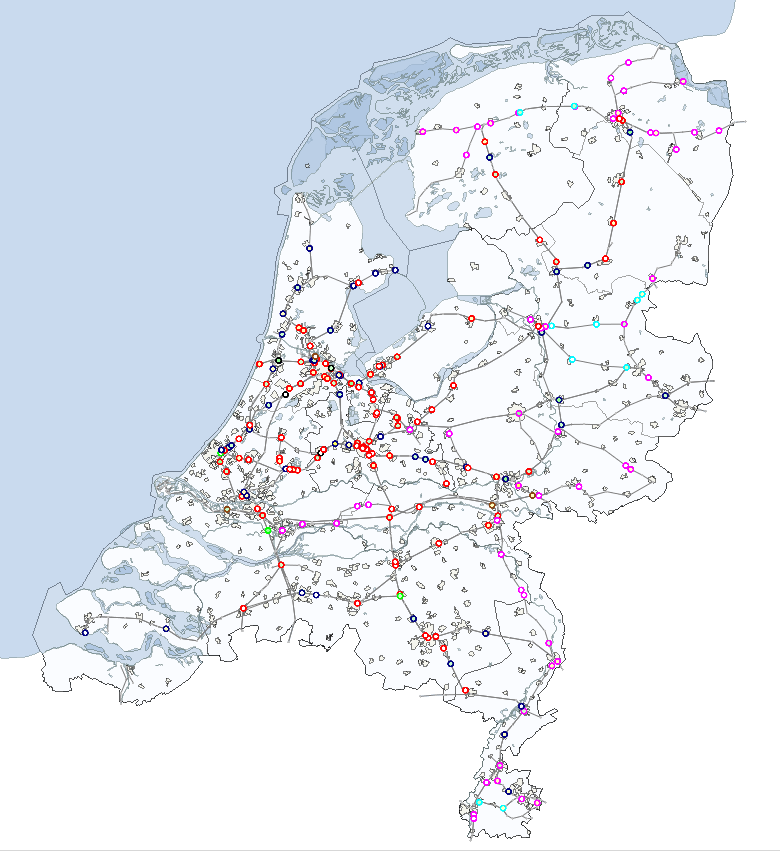
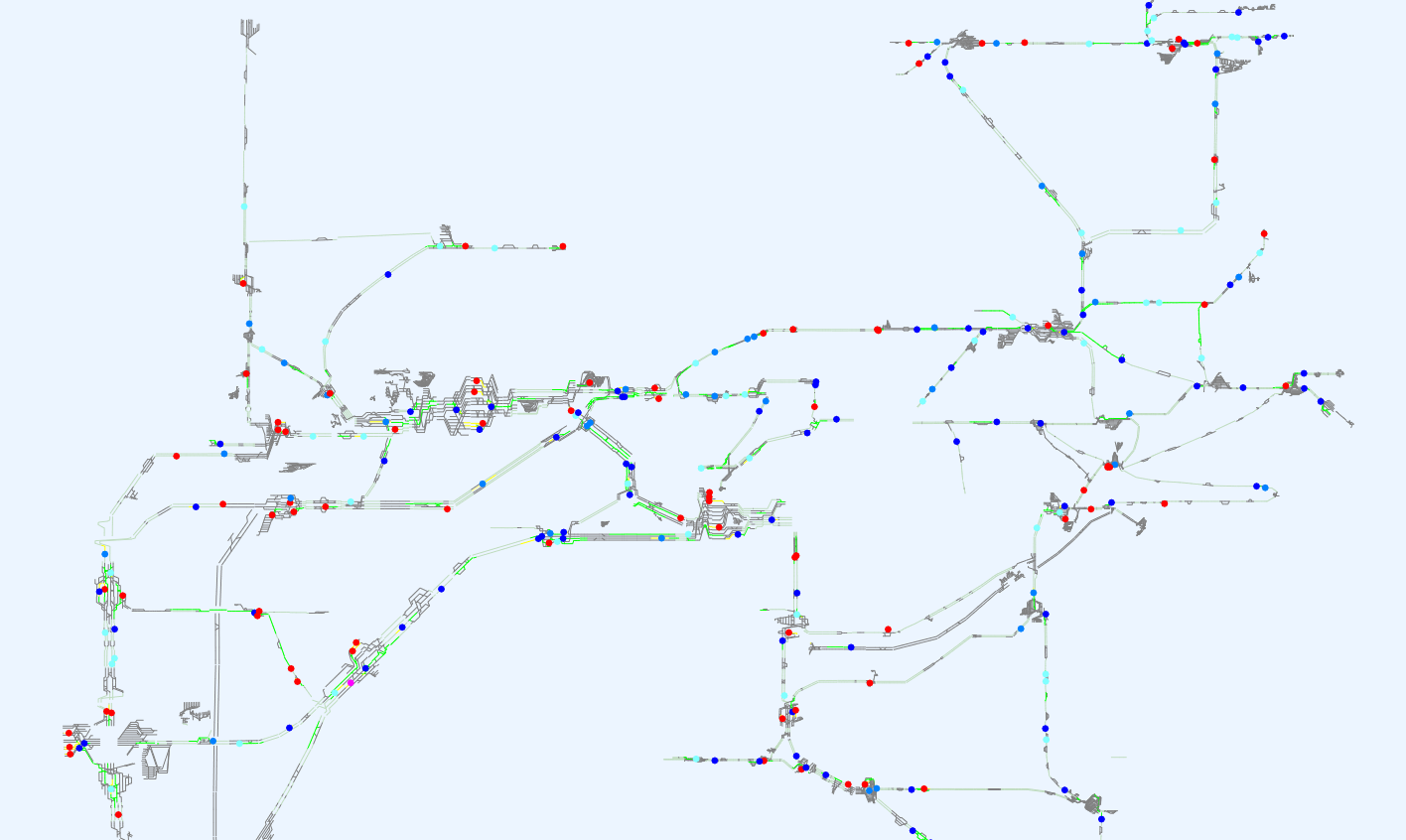
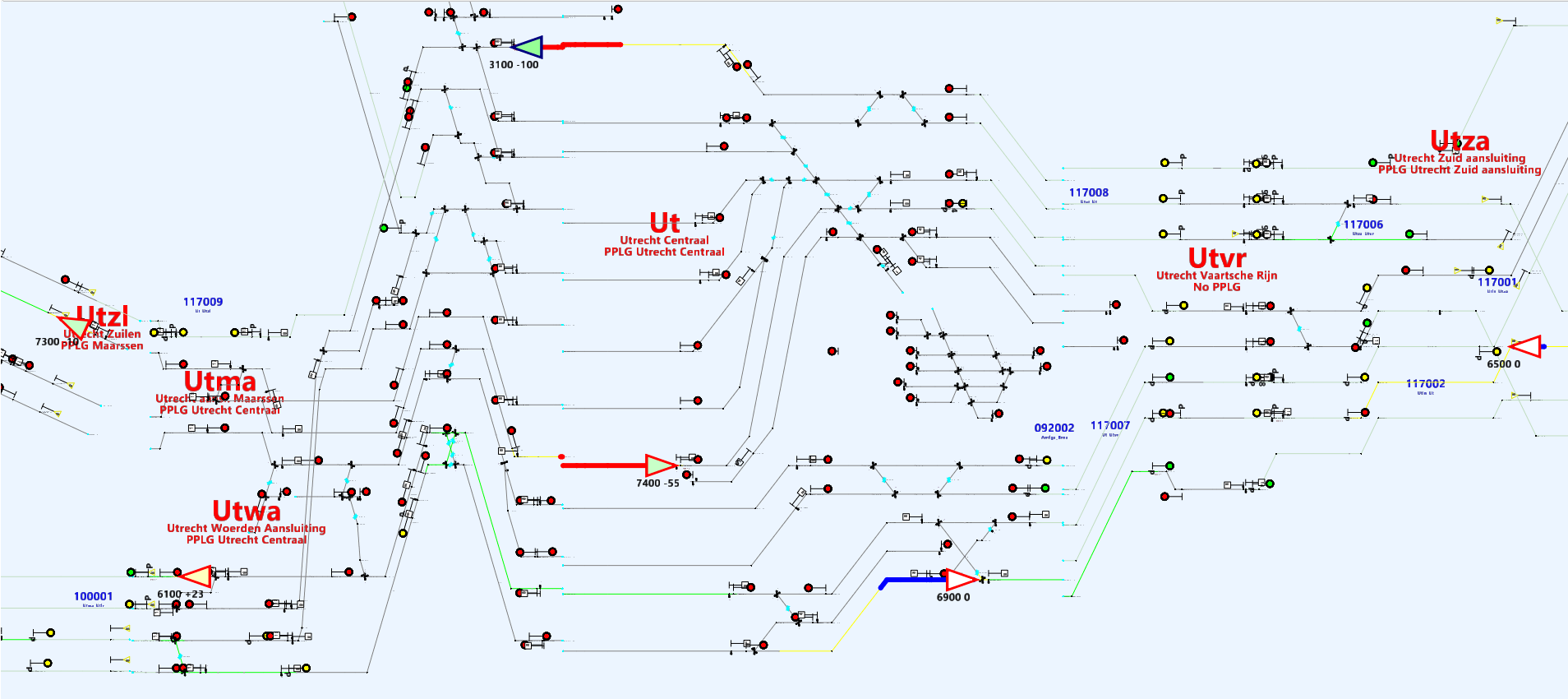

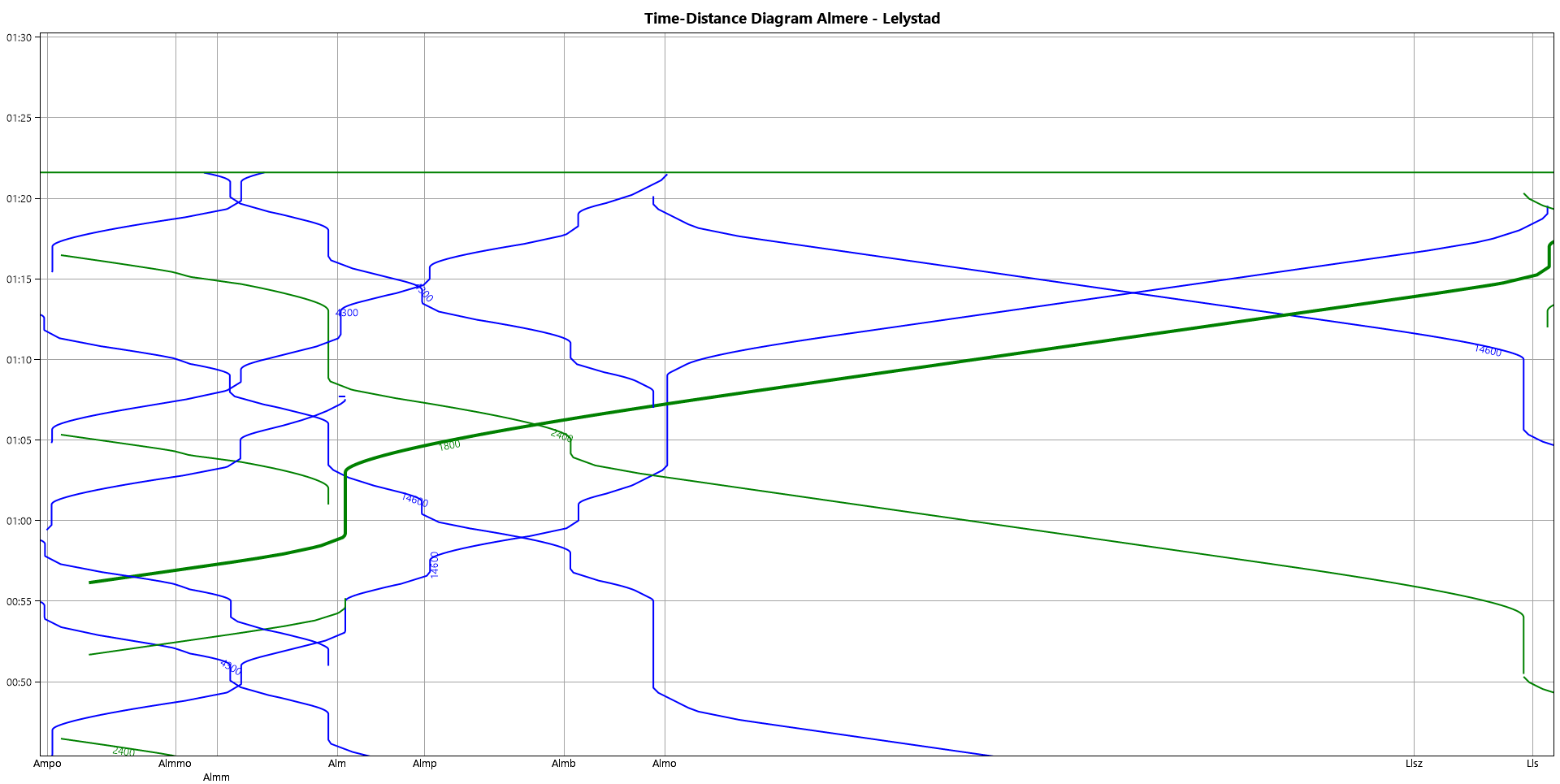
FRISO models nearly all aspects of a railway network. Signals, interlocking, switches, and intersections behave according to real-world rules. FRISO supports both the Dutch NS’54 and European ERTMS safety systems and implements ATB and ETCS train protection. Train movement is modelled using physical characteristics and external factors such as slopes, resistance, and power supply. Human factors are represented through various train-operator and dispatcher agents. Together, these elements create a realistic railway simulator.
FRISO supports both stochastic and non-stochastic disturbances, which can be fitted to realisation data from previous years. Parallel stochastic runs reduce total simulation time. Output includes train graphs (distance/time, speed/distance, height/distance, energy/distance) and track-occupation diagrams for assessing schedules and infrastructure. Additional outputs cover safety, delays, energy use, and level-crossing statistics. Extensive logging also allows users to build custom visualisations and perform statistical analysis on simulated data.
FRISO in a Simulation Environment
FRISO can transmit and receive train and infrastructure state data during simulation. This enables external applications to take over train-operation tasks (driver and guard) as well as dispatching functions. These external controllers may be automated systems (e.g., ATO – Automatic Train Operation) or human-operated, allowing full Human-in-the-Loop simulation.
Within a single simulation, control can be flexibly shared. Different parts of the network can be managed simultaneously by FRISO or by human dispatchers. Likewise, individual trains may be operated by FRISO, by human drivers, or by a real ATO-OB computer—all at the same time. FRISO supports multiple communication protocols, including DDS, CERTI’s HLA implementation, DLLs, and other APIs.
Development and Evaluation of TMS, ATO and ERTMS
Several train-driver models are implemented in FRISO to study differences between drivers, including an energy-efficient model based on NS’s TimTimPro DAS and a plan-based model. The most accurate model is an agent-based driver created using realisation data.
FRISO also supports studying the introduction of ATO. It includes an ATO module that calculates the speed profile needed to meet scheduled goals. Through the EU-Rail R2DATO project, a real ATO component has been connected to FRISO for pre-deployment evaluation. This connection follows the ERA ERTMS ATO SUBSET-125 standard, allowing any compliant ATO system to operate trains in FRISO.
FRISO can also connect to external Traffic Management Systems (TMS). A TMS optimises punctuality, safety, and energy use through advisory speeds, reordering, and rerouting. It monitors traffic, detects conflicts, reschedules, and optimises speed profiles. FRISO enables comparison, optimisation, and academic research on TMS and TPE algorithms.
For a small-scale ERTMS pilot between Amsterdam and Utrecht, FRISO was used to model ERTMS and Dual Signalling to gather insights on transitioning safely from legacy systems. Independent experts have validated FRISO’s dual-signalling ERTMS implementation. FRISO has proven valuable for ERTMS capacity and energy-efficiency studies.
Serious Gaming: Simulation based training
FRISO is deployed in the TRINITY distributed simulation environment, where operational and simulated railway applications interact with FRISO as if they were communicating with the real world. Applications for train rescheduling (ProRail), crew planning, and rolling stock planning (NS) can run simultaneously during gaming sessions. This setup supports large-scale sessions with up to 40 participants across four roles.
TRINITY has been used successfully in the SiGMaT 1 and SiGMaT 2 projects to evaluate ERTMS user processes. Results from SiGMaT 2 were presented at the 2025 SpoorPro ERTMS Congress: “By introducing them [train dispatchers and drivers] to driving under ERTMS using simulation programs especially, everyone becomes more and more enthusiastic.”
TRINITY has been used to prepare train dispatchers for infrastructure changes at Utrecht Central Station, the Netherlands’ busiest station with over 50 million passengers per year. Simulation supported a smooth transition to operating a layout with only one-third of the original switches.
TRINITY was also used in a pilot for a new timetable with six intercity trains per hour between Amsterdam and Eindhoven. During gaming sessions, multiple scenarios were tested, including track intrusions and defective trains.
Real World Impact
See how our Railway Simulator supports decision-making in real-world cases:
Ready to modernize your rail operations?
Contact us to learn how InControl’s simulation platform improves planning, boosts capacity, validates new technologies, and prepares staff for real-world operational challenges.