A digital twin in logistics is a virtual replica of a physical logistics operation, such as a warehouse, distribution center, or supply chain network, that mirrors real-world processes in a live or simulated environment. It connects to real operational data and allows teams to monitor, analyze, and test changes without touching the actual system. The sections below unpack how digital twins work in practice, what they need to run, and when investing in one makes sense.
How does a digital twin actually work in a logistics setting?
A logistics digital twin works by building a virtual model of your physical operation, feeding it with real or representative data, and then running that model to reflect, predict, or test operational behavior. The twin mirrors the layout, equipment, workflows, and resource constraints of your actual facility or network, allowing you to observe performance and experiment with changes in a risk-free environment.
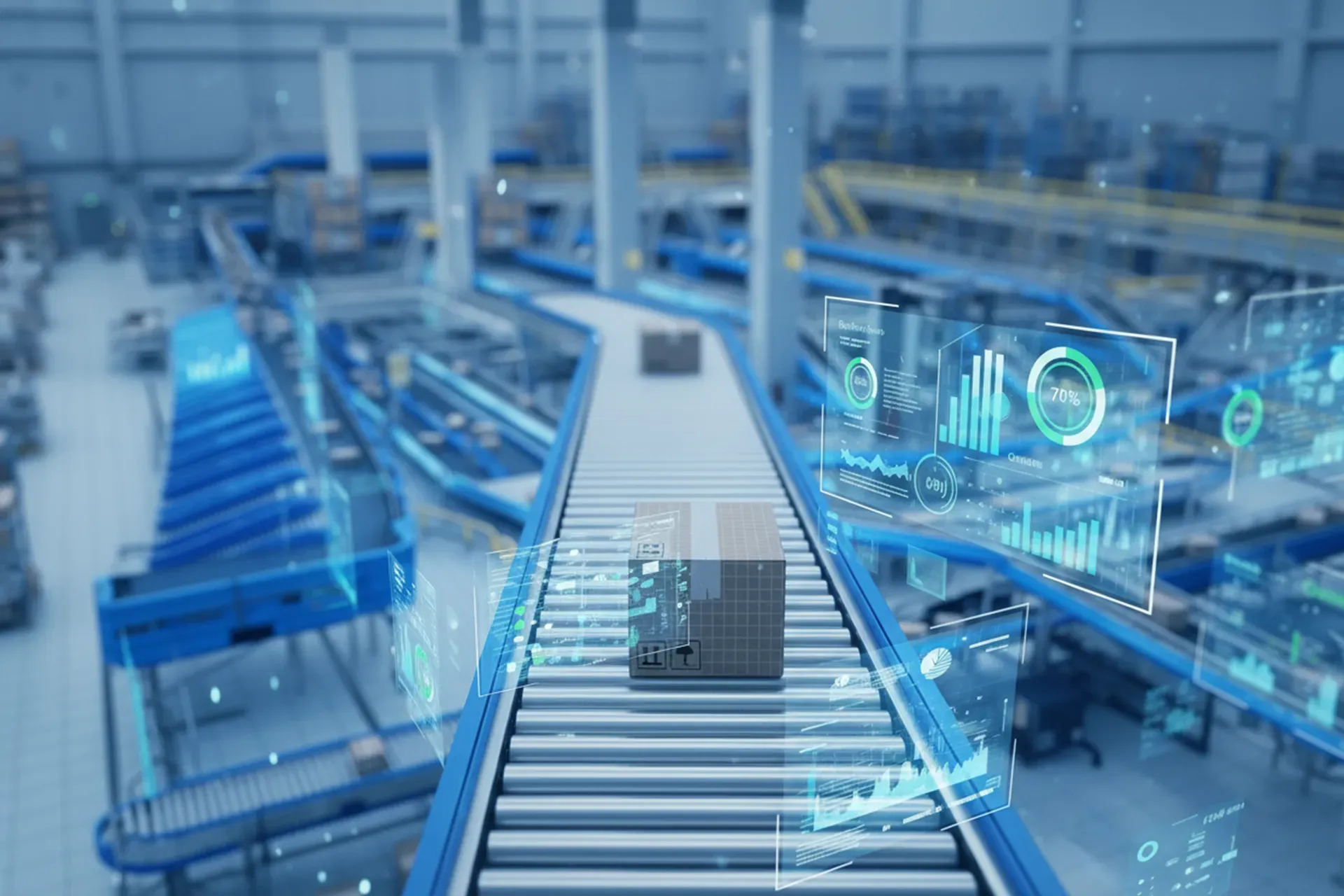
In a warehouse setting, this means the digital twin replicates conveyors, sorters, pick stations, storage zones, and the movement of goods through them. When the model runs, it processes orders, routes products, engages staff, and surfaces bottlenecks just as the real system would, but without any physical consequences if something goes wrong.
The level of fidelity matters. A well-built logistics digital twin does not just show you a static floor plan. It simulates time-dependent behavior: peak hours, shift changes, equipment failures, and seasonal surges. Most platforms achieve this through discrete event simulation software, which models the system as a sequence of events unfolding over time. This dynamic quality is what separates a digital twin from a simple diagram or spreadsheet model.
What are the main use cases for digital twins in logistics?
The most common use cases for digital twins in logistics include warehouse design validation, throughput analysis, bottleneck identification, investment planning, and operational scenario testing. Organizations use them to answer high-stakes questions before committing budget or making changes that are difficult to reverse.
Here are the use cases where logistics teams consistently find the most value:
- Warehouse design and layout validation: Test a new facility design or reconfiguration before construction or reorganization begins.
- Throughput analysis: Understand how many orders, pallets, or units the system can handle under different conditions.
- Bottleneck identification: Pinpoint exactly where congestion, delays, or capacity constraints occur and why.
- Workforce and resource planning: Determine the right number of staff, shifts, or equipment for a given volume target.
- Investment validation: Quantify the expected return on a new conveyor system, automated sorter, or expanded dock before signing a contract.
- What-if scenario testing: Simulate the impact of a new product line, a change in order profile, or a disruption event like a supplier delay.
Across material handling, e-commerce fulfillment, pharma distribution, and retail logistics, these use cases share a common thread: they all involve decisions where getting it wrong is expensive and getting it right early saves significant time and money. Intralogistics simulation and material flow optimization are particularly valuable here, helping teams visualize how goods move through a facility before any physical changes are made.
Build your own simulation, your way
Enterprise Dynamics gives developers full control to model, scale, and integrate complex systems with C++, APIs, and real-time data.
Explore Enterprise DynamicsWhat’s the difference between a digital twin and a simulation model?
The key difference between a digital twin and a simulation model is the connection to live operational data. A simulation model is a standalone virtual representation used to analyze and test scenarios. A digital twin is a simulation model that is continuously synchronized with real-world data from the physical system it represents.
In practical terms, a simulation model is often built for a specific project, run to answer a defined question, and then set aside. A digital twin persists alongside the real operation, updating as conditions change and enabling ongoing monitoring and decision support.
That said, the boundary between the two is not always sharp. Many organizations start with a high-fidelity simulation model and evolve it into a digital twin as they integrate live data feeds from sensors, WMS systems, or ERP platforms. The simulation model is the foundation; the data integration is what makes it a twin.
For logistics operations evaluating options, the practical question is not always “twin or model” but rather “how much live data integration do we need right now?” A rigorous warehouse simulation software platform — one that functions as a capable DES simulation environment — can serve both purposes depending on how it is configured and connected.
What data does a logistics digital twin need to run?
A logistics digital twin needs four core categories of data to run accurately: operational data describing how the system is structured, demand data reflecting order and volume patterns, performance data from equipment and processes, and real-time or historical data feeds to keep the model current.
More specifically, a functional logistics digital twin typically requires:
- Facility layout and system configuration: Dimensions, equipment types, conveyor speeds, storage capacities, and routing logic.
- Order and demand profiles: Historical order data, SKU mix, order frequency, seasonal peaks, and volume distributions.
- Process times and resource parameters: Pick rates, scan times, loading durations, shift schedules, and staff allocation rules.
- System integration data: Feeds from WMS, ERP, or warehouse control systems that reflect live inventory, order queues, and equipment status.
- Exception and failure data: Equipment downtime rates, error rates, and maintenance schedules to model realistic variability.
The quality of the output depends heavily on the quality of the input. A digital twin built on clean, representative data will produce reliable insights. One built on rough estimates will still provide directional value but should be treated with appropriate caution when making high-stakes decisions. This is equally true whether you are running conveyor simulation, AGV simulation, or AS/RS simulation — the underlying data quality sets the ceiling on what the model can tell you.
When should a logistics operation invest in a digital twin?
A logistics operation should invest in a digital twin when the cost of making the wrong decision outweighs the cost of building the model. This typically applies when planning a new facility, scaling an existing one, evaluating automation investments, or managing a system complex enough that spreadsheets and intuition no longer give reliable answers.
Specific triggers that indicate the timing is right include facing a major capital decision, experiencing recurring operational problems that are difficult to diagnose, preparing for a significant volume increase, or needing to validate a vendor’s performance claims before committing to a contract.
Smaller, simpler operations may find that a one-time simulation study meets their needs without requiring a persistent twin. But as operations grow in complexity, the ongoing value of a live, connected model grows with it. The ability to test changes before they go live, train staff on new processes, and respond to disruptions with data rather than guesswork becomes a genuine competitive advantage. For warehousing and supply chain teams in particular, logistics simulation software and supply chain simulation software have made this kind of rigorous, data-driven planning far more accessible than it once was.
How Enterprise Dynamics supports your logistics digital twin
We built Enterprise Dynamics specifically to help logistics and material handling teams answer the hard questions before they become expensive problems. Whether you are designing a new distribution center, validating an automation investment, or diagnosing a persistent bottleneck, Enterprise Dynamics gives you the tools to model, test, and optimize in a risk-free virtual environment. As a purpose-built DES simulation platform, it is designed to handle the full complexity of modern intralogistics operations — from material flow simulation across large distribution networks to detailed warehouse automation simulation at the equipment level.
Here is what Enterprise Dynamics brings to your logistics digital twin:
- Drag-and-drop modeling: Build accurate virtual models quickly using a library of pre-built logistics objects, with no programming required to get started.
- 2D and 3D visualization: See your operation in motion and communicate findings clearly to stakeholders across the business.
- WMS and ERP integration: Connect your model to live operational data to keep your digital twin synchronized with the real world.
- Throughput and bottleneck analysis: Identify exactly where capacity breaks down and test solutions before implementing them.
- What-if scenario testing: Explore the impact of new order profiles, layout changes, staffing adjustments, or equipment additions with confidence.
If you are ready to explore what a logistics digital twin could do for your operation, get in touch with our team and we will help you find the right starting point.
Frequently Asked Questions
How long does it typically take to build a logistics digital twin?
The timeline depends on the complexity of the operation and the availability of clean data, but most logistics digital twin projects range from a few weeks to several months. A focused simulation study for a single warehouse or distribution center can often be completed in four to eight weeks, while a more comprehensive, fully integrated twin connected to live WMS and ERP data may take longer to configure and validate. Having well-organized historical data and clear project objectives ready from the start is the single biggest factor in accelerating the process.
What are the most common mistakes teams make when implementing a logistics digital twin?
The most frequent mistake is underestimating the importance of data quality — building a twin on incomplete or unrepresentative data leads to outputs that look credible but produce misleading recommendations. A second common pitfall is over-scoping the project at the start, trying to model every corner of the operation at once rather than focusing on the highest-value problem first. Starting with a clearly defined use case, such as validating a specific bottleneck or a planned automation investment, delivers faster results and builds internal confidence in the model before expanding its scope.
Do we need specialized technical staff to operate and maintain a logistics digital twin?
Not necessarily, especially when using modern platforms designed for logistics practitioners rather than software engineers. Tools like Enterprise Dynamics are built with drag-and-drop modeling and pre-built logistics objects that allow operations engineers and supply chain analysts to build and run models without deep programming knowledge. That said, someone on the team should own the model and understand how to update it as the operation changes — this is typically an industrial engineer, a continuous improvement lead, or an operations analyst with an interest in data-driven decision-making.
Can a digital twin be used to train warehouse staff on new processes before they go live?
Yes, and this is one of the more underutilized applications of logistics digital twins. The 3D visualization capabilities of a well-built twin allow teams to walk through new workflows, equipment configurations, or layout changes in a virtual environment before the physical changes are made. This is particularly valuable when onboarding staff to new automation systems, introducing a new pick strategy, or preparing a team for a peak season volume surge — all without disrupting live operations or incurring any real-world risk.
How do we know if the digital twin's outputs are accurate enough to trust for major decisions?
Validation is a critical step in any digital twin project and should not be skipped. The standard approach is to run the model using historical data from a known period and compare the outputs — throughput, cycle times, resource utilization — against what actually happened in the real operation. If the model replicates past performance within an acceptable margin, typically within five to ten percent for key metrics, it provides a solid foundation for forward-looking scenario testing. Any reputable digital twin implementation partner will build a validation phase into the project before the model is used for high-stakes decisions.
What is the difference between using a digital twin for a one-time project versus keeping it as a permanent operational tool?
A one-time project twin is built to answer a specific question — such as validating a new facility design or evaluating an automation investment — and is retired once that decision is made. A persistent operational twin stays connected to live data, evolves as the operation changes, and becomes an ongoing decision-support tool for planning, troubleshooting, and continuous improvement. Many organizations start with the project-based approach to prove value and then transition to a persistent twin as confidence in the model grows and the ongoing return on investment becomes clear.
How does a logistics digital twin handle variability and uncertainty, such as unexpected demand spikes or equipment failures?
A high-fidelity logistics digital twin models variability explicitly rather than assuming everything runs at average performance. This includes probabilistic equipment downtime rates, variable process times drawn from real distributions, and stochastic demand patterns based on historical order data. By running multiple simulation replications under different conditions, the twin produces a range of outcomes rather than a single point estimate, giving decision-makers a realistic picture of best-case, worst-case, and most-likely performance before committing to a course of action.
Related Articles
- What are the key features to look for in warehouse simulation software?
- Can warehouse simulation software model cross-docking operations?
- How does warehouse simulation software handle multi-threaded computing?
- How does warehouse automation simulation reduce risk in large capital projects?
- What is the role of API access in warehouse simulation software?