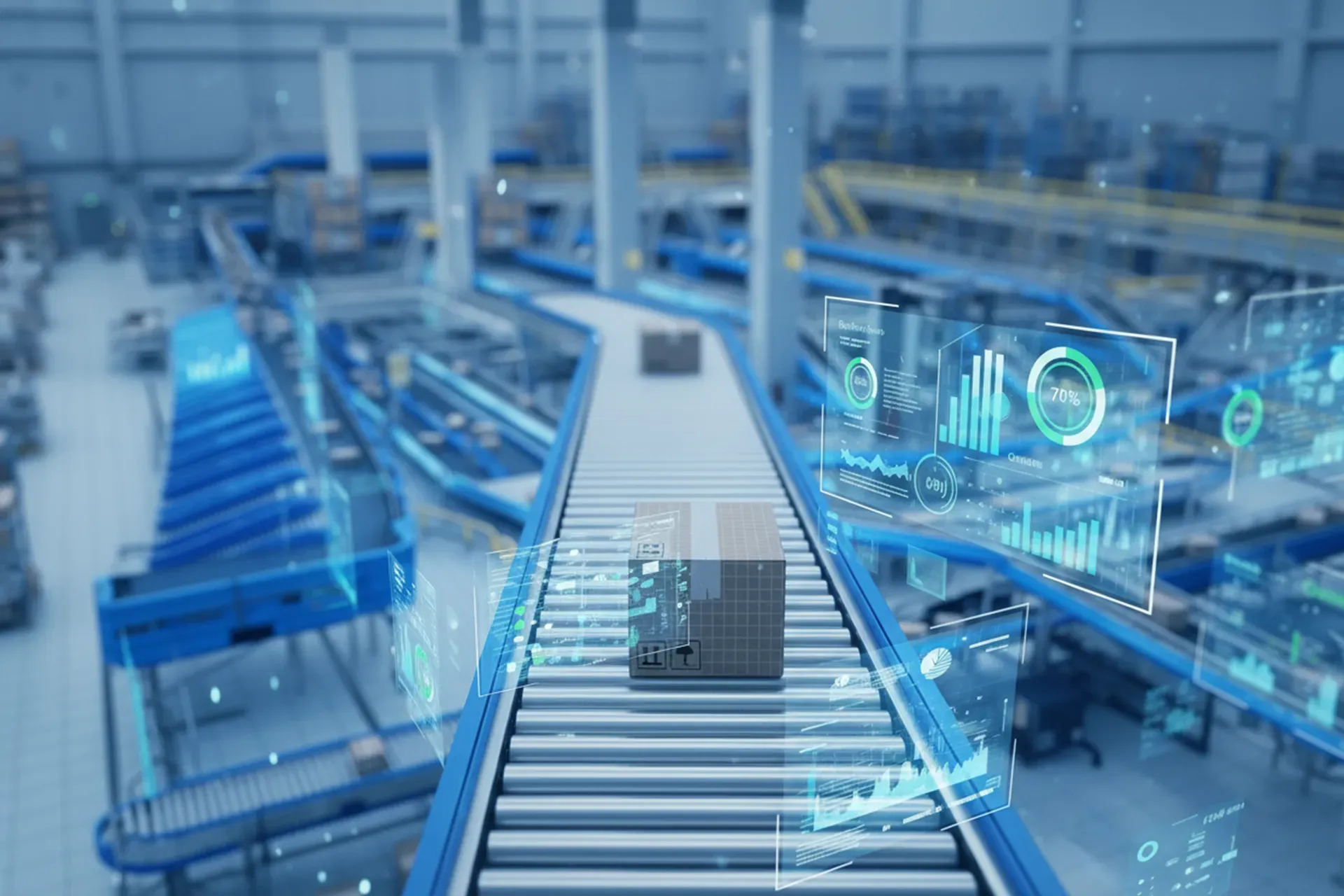
Combining simulation formalisms in a single warehouse model delivers significantly more accurate and actionable results than any single approach alone. When discrete event simulation, agent-based modeling, and continuous simulation work together, they capture the full complexity of a warehouse, from conveyor throughput to human behavior to inventory flow, within one coherent environment. The sections below explore why this matters and how it works in practice.
What happens when a single simulation formalism isn’t enough?
A single simulation formalism becomes insufficient when your warehouse model needs to represent fundamentally different types of behavior simultaneously. Most real warehouses involve moving goods, moving people, and flowing data, each of which follows different rules. When you force all of that into one formalism, the model either oversimplifies critical processes or becomes so rigid it can’t answer the questions you actually need answered.
Discrete event simulation software, for example, excels at modeling conveyor belts, sortation systems, and order-picking sequences. But it struggles to represent how a group of warehouse workers naturally navigate around each other during a peak shift. Agent-based modeling handles that human behavior well, yet it isn’t designed to track continuous inventory replenishment rates over time. The moment your operational question spans more than one of these domains, a single formalism starts to show its limits.
The practical consequence is that teams often build separate models for separate questions and then try to reconcile the results manually. This is time-consuming, error-prone, and frequently leads to blind spots, especially at the points where different systems interact.
What are the main simulation formalisms used in warehouse models?
The three main simulation formalisms used in warehouse modeling are discrete event simulation (DES), agent-based modeling (ABM), and continuous simulation. Each captures a different dimension of warehouse behavior, and understanding what each does well is the foundation for knowing when to combine them.
- Discrete event simulation (DES) models processes as a sequence of events: items arriving, being sorted, picked, packed, and dispatched. It is the most widely used formalism in warehouse simulation software because it maps naturally onto logistics workflows with clear start and end points. DES simulation is particularly effective for intralogistics simulation, where material flow optimization depends on accurately sequencing discrete process steps.
- Agent-based modeling (ABM) simulates individual actors, workers, forklifts, autonomous mobile robots, each following their own rules and reacting to their environment. It is well suited to modeling emergent behavior that arises from many individual decisions, such as congestion patterns or pick path conflicts.
- Continuous simulation represents quantities that change smoothly over time, such as inventory levels, energy consumption, or temperature in a cold storage facility. Rather than tracking individual events, it uses differential equations to model rates of change.
In isolation, each formalism is powerful within its own domain. The challenge is that a real warehouse rarely fits neatly into just one category.
Build your own simulation, your way
Enterprise Dynamics gives developers full control to model, scale, and integrate complex systems with C++, APIs, and real-time data.
Explore Enterprise DynamicsHow does combining formalisms improve warehouse model accuracy?
Combining formalisms improves warehouse model accuracy by allowing each part of the system to be represented using the method that fits it best, rather than forcing everything into a single modeling logic. The result is a model that reflects reality more closely and therefore produces insights you can actually trust when making operational or investment decisions.
Consider a pharmaceutical distribution center. The conveyor simulation and sortation system logic is best handled with discrete event simulation, where individual totes trigger specific events. The behavior of warehouse staff during a rush period, how they cluster, avoid each other, and respond to system alerts, is better captured through agent-based modeling. Meanwhile, inventory replenishment rates feeding into the facility from upstream supply chain partners might be represented as continuous flows. When all three run together in a single model, interactions between these layers become visible and testable.
Without that integration, you might optimize conveyor throughput perfectly on paper, only to discover in the real facility that staff congestion near the packing stations creates a bottleneck that your DES simulation model never anticipated. Multi-formalism simulation surfaces those cross-domain interactions before they become costly real-world problems.
What warehouse decisions benefit most from multi-formalism simulation?
The warehouse decisions that benefit most from multi-formalism simulation are those where human behavior, physical systems, and resource flows all influence the outcome at the same time. These tend to be high-stakes decisions where getting it wrong is expensive.
- Automation investment validation – Before committing to a major conveyor, AS/RS simulation, shuttle system, or robotic picking installation, a multi-formalism model can test how the automated system interacts with human workers still present in the facility, and how inventory flows respond under different demand scenarios.
- Workforce planning during peak periods – Agent-based behavior combined with discrete event process modeling reveals where staff bottlenecks emerge under high-volume conditions, and what staffing levels or shift patterns resolve them most efficiently.
- Layout redesign – When reconfiguring a warehouse floor, the interaction between physical flow paths, worker movement, and equipment routing needs to be tested together, not separately. Material flow simulation is essential here to understand how goods move through the redesigned space before any physical changes are made.
- Safety and evacuation planning – Understanding how people move through a facility during an emergency requires agent-based modeling, but the trigger conditions and equipment states that create the emergency context come from discrete event logic.
- New product line or channel introduction – Adding e-commerce fulfillment to an existing B2B distribution operation changes both process flows and human behavior patterns simultaneously, making combined modeling essential.
How does multi-formalism simulation differ from running separate models?
Multi-formalism simulation runs all formalisms within a single shared environment, so they interact with each other in real time. Running separate models means each formalism operates independently, and the outputs must be manually reconciled afterward, a process that misses the dynamic interactions between systems that are often the most important findings.
When formalisms are separate, you can optimize each subsystem in isolation. But warehouses are not collections of isolated subsystems, they are tightly coupled environments where a slowdown in one area cascades immediately into others. A worker delay at a packing station affects conveyor buffer levels, which affects induction rates, which affects order completion times. Separate models cannot capture that chain of cause and effect as it unfolds. This is a well-known limitation in material handling simulation, where the interdependencies between equipment, people, and inventory flows are too significant to model in isolation.
Multi-formalism simulation also reduces the risk of model inconsistency. When you maintain two or three separate models, keeping them synchronized as your facility changes is a significant overhead. A single integrated model has one source of truth, which makes it far easier to maintain and reuse over time, including as a digital twin warehouse software that stays current with operational reality.
Which simulation platforms support multi-formalism warehouse modeling?
Multi-formalism warehouse modeling requires a platform that natively supports more than one simulation paradigm within the same model runtime, rather than simply allowing data exchange between separate tools. Not all warehouse simulation software offers this capability, many platforms are built around a single formalism and require workarounds or external integrations to approximate multi-formalism behavior.
Platforms that genuinely support multi-formalism modeling allow modelers to define discrete events, autonomous agents, and continuous flows within the same model, share state between them at every simulation step, and visualize their interactions in a unified 2D or 3D environment. The ability to use a single scripting or programming interface across all formalisms is also an important practical consideration for development teams. When evaluating a DES simulation platform for warehousing or logistics, the ability to extend beyond pure DES into agent-based and continuous modeling is a key differentiator worth assessing in any DES software comparison.
How Enterprise Dynamics supports multi-formalism warehouse simulation
We built our simulation platform specifically to address the limitations that arise when a single formalism isn’t enough. Enterprise Dynamics and our next-generation ERS platform support multi-formalism modeling out of the box, giving warehouse engineers and system integrators the tools to build models that reflect the full complexity of their operations. As a DES simulation tool designed for warehousing, logistics, and material handling, it goes well beyond standard discrete event simulation software by integrating agent-based and continuous modeling in the same environment.
- Discrete event, agent-based, and continuous simulation in one model – no need to reconcile outputs from separate tools
- Drag-and-drop atom libraries for rapid model construction, covering conveyors, sortation, AGV simulation, workforce, and more
- 2D and 3D visualization to communicate results clearly to technical and non-technical stakeholders
- WMS and ERP integration to build data-driven digital twin warehouse software that stays aligned with live operations
- Scalable architecture via ERS for high-performance, distributed simulation across large and complex facilities
Whether you are validating a major automation investment, redesigning your warehouse layout, or planning for peak season demand, Enterprise Dynamics gives your team a risk-free environment to test every scenario before committing. Get in touch with us to discuss how multi-formalism simulation can work for your warehouse operation.
Frequently Asked Questions
How long does it typically take to build a multi-formalism warehouse simulation model?
The timeline depends heavily on the complexity of the facility and the availability of operational data, but most initial multi-formalism models can be built in a few weeks using a platform with pre-built atom libraries and drag-and-drop components. A smaller warehouse with straightforward workflows might be modeled in one to two weeks, while a large, multi-zone distribution center with complex automation could take one to three months. The key factor is data readiness — having accurate layout drawings, process times, staff counts, and equipment specs ready from the start significantly reduces build time.
What data do I need to get started with a multi-formalism warehouse simulation?
At a minimum, you need facility layout data (floor plans or CAD drawings), process flow documentation (order picking sequences, conveyor routing logic, replenishment schedules), and historical operational data such as order volumes, throughput rates, and staffing levels by shift. For the agent-based components, behavioral data — such as how workers are assigned to zones or how AMRs are dispatched — is essential to make the model realistic. If you have WMS or ERP data exports available, these can be used directly to drive the simulation and significantly improve accuracy.
Can multi-formalism simulation models be reused after the initial project, or do they need to be rebuilt each time?
A well-built multi-formalism model is designed to be a long-term asset, not a one-time deliverable. Once the core model is validated against real operational data, it can be updated with new parameters — such as a layout change, a new product line, or revised staffing levels — without rebuilding from scratch. This is especially true when the model is connected to live WMS or ERP data as a digital twin, where it continuously reflects current operational reality and can be re-run whenever a new decision scenario arises.
What are the most common mistakes teams make when attempting multi-formalism warehouse simulation for the first time?
The most frequent mistake is over-scoping the model at the start — trying to simulate every process in full detail before validating the core logic, which leads to bloated models that are hard to debug and slow to run. Another common pitfall is neglecting the agent-based layer and treating worker behavior as fixed process times, which causes the model to miss congestion and bottleneck dynamics entirely. Teams also sometimes underestimate the importance of model validation: running the simulation against a known historical period to confirm it reproduces real outcomes before using it to test future scenarios.
How do I know if my warehouse operation is complex enough to justify multi-formalism simulation, rather than a simpler single-formalism model?
A straightforward test is to ask whether your key operational questions involve more than one type of system interacting at the same time — for example, whether a conveyor throughput question also depends on how many workers are available at packing stations, or whether an inventory flow question is affected by staff behavior during shift changes. If the answer to any of those is yes, a single formalism will likely give you an incomplete picture. As a rule of thumb, any warehouse that combines automation with human workers, or that has upstream inventory flows feeding into discrete fulfillment processes, will benefit from a multi-formalism approach.
Is multi-formalism simulation only relevant for large distribution centers, or can smaller warehouses benefit too?
Multi-formalism simulation is valuable at any scale where different types of system behavior interact and where the cost of a wrong decision is significant. A mid-sized e-commerce fulfillment center, for instance, might have only a modest conveyor system but a highly variable workforce and fluctuating inventory inflows — a scenario where combining DES, ABM, and continuous simulation would surface insights that a spreadsheet or single-formalism model simply cannot. The investment in simulation pays off relative to the cost of the decision being tested, not the size of the facility.
How does multi-formalism simulation support ongoing operations, not just one-time design projects?
When integrated with live WMS and ERP data, a multi-formalism simulation model transitions from a project tool into an operational digital twin that can be used continuously for scenario planning, staffing decisions, and performance benchmarking. Operational teams can use it to test the impact of a new client contract before accepting it, simulate peak season staffing plans before committing headcount, or evaluate the ROI of incremental automation investments on a rolling basis. This ongoing use case is where the long-term value of a well-maintained multi-formalism model becomes most apparent.