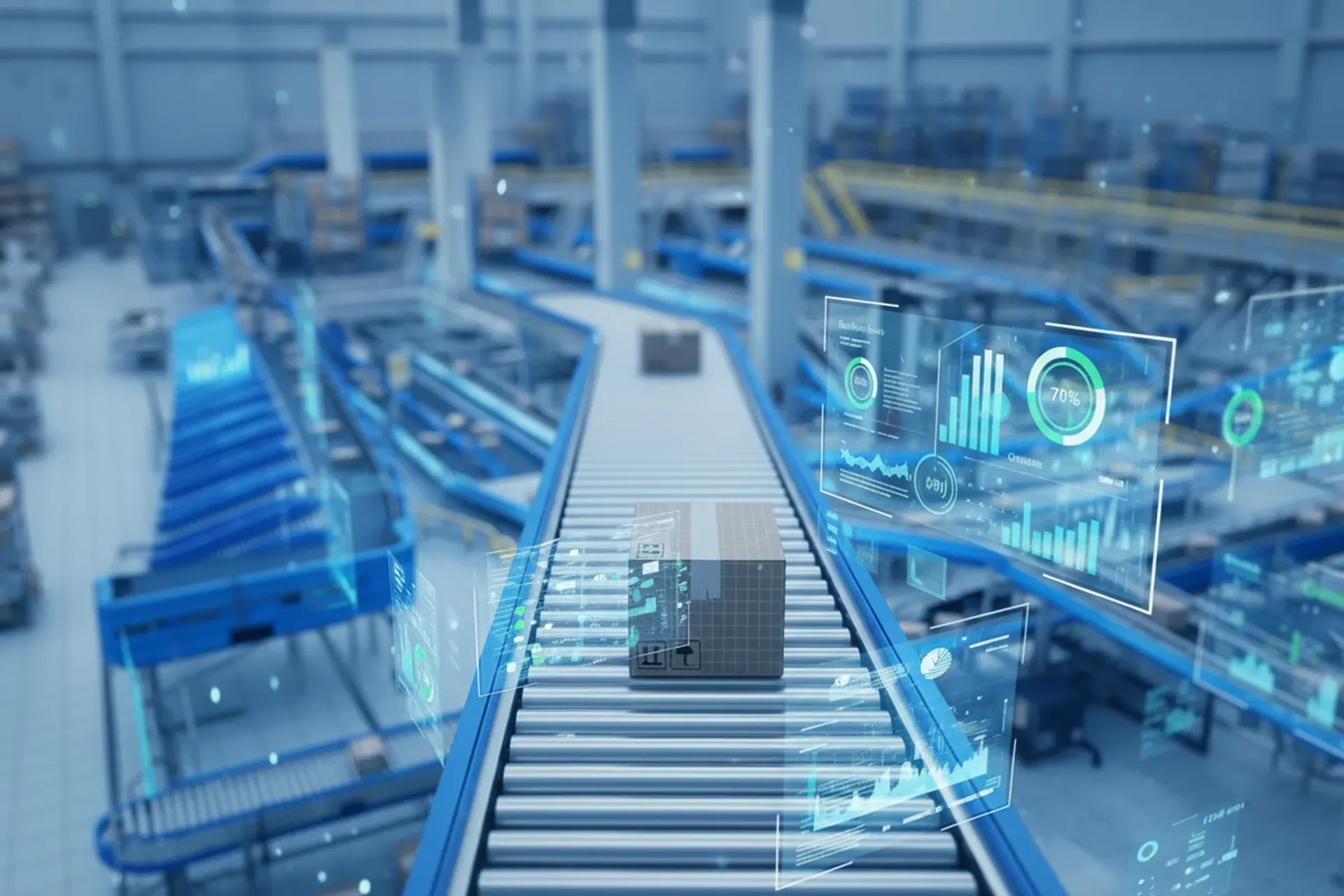
Warehouse automation simulation helps engineers test control logic by creating a virtual replica of the automated system, including conveyors, sorters, robots, and PLCs, so that routing rules, sequencing logic, and error-handling routines can be validated before any physical hardware is commissioned. This approach catches logic errors early, when fixes are cheap, rather than during costly on-site commissioning phases. The sections below walk through the most common questions engineers ask when evaluating this approach.
What types of control logic can be tested in a warehouse simulation?
Warehouse simulation software can test virtually any control logic that governs how automated equipment behaves, including routing decisions, sortation rules, induction sequencing, zone release logic, traffic management between autonomous mobile robots (AMRs), and exception handling for jams or label read failures. If the real system makes a decision, the simulation can replicate and stress-test it.
In practice, engineers use warehouse simulations to validate the following categories of control logic:
- Routing and sortation logic – verifying that items are directed to the correct chutes, lanes, or destinations under varying order profiles
- Sequencing and buffering rules – ensuring that products arrive at merge points or packing stations in the right order and at the right rate
- Traffic management – testing how AMRs, shuttles, or conveyors negotiate shared paths and avoid deadlocks
- Exception and error-handling routines – simulating no-reads, jams, or equipment failures to confirm the system recovers correctly
- WMS and WCS integration logic – validating how orders flow from a warehouse management system into equipment control commands
The ability to combine all these logic types in one model is what makes discrete event simulation software so powerful for warehouse automation projects. Engineers can observe interactions between subsystems that would be impossible to predict on paper.
How does a virtual warehouse model replicate real automation behavior?
A virtual warehouse model replicates real automation behavior by encoding the physical layout, equipment kinematics, throughput rates, and control rules into a discrete event simulation environment. Every conveyor segment, divert, lift, or robot is represented as a digital object with configurable speed, capacity, and decision logic, mirroring the specifications of the real hardware.
The model is driven by realistic order data, either historical or synthetically generated, so the system experiences demand patterns that match live operations. When an order enters the simulation, it triggers the same sequence of control decisions that the real WCS or PLC would execute: read a barcode, evaluate a routing rule, divert to a lane, signal a downstream zone. The simulation engine processes these events in time, allowing engineers to observe throughput, queue lengths, and utilization across the entire system simultaneously.
Integration with WMS and ERP data sharpens accuracy further. Rather than using assumed order volumes, the model can ingest actual order histories, making the virtual environment a genuine digital twin of the planned warehouse rather than a rough approximation. This is where material flow simulation proves its value — the model reflects not just equipment behavior, but the full intralogistics logic that drives it.
Build your own simulation, your way
Enterprise Dynamics gives developers full control to model, scale, and integrate complex systems with C++, APIs, and real-time data.
Explore Enterprise DynamicsWhat’s the difference between emulation and simulation for control logic testing?
Simulation models the behavior of a system at a logical level to analyze performance and validate control rules, while emulation connects the actual PLC or WCS software to a virtual representation of the physical equipment so that the real control code runs against a simulated machine environment. Both test control logic, but they serve different purposes and are used at different project stages.
DES simulation is faster to build, easier to run at accelerated speed, and ideal for exploring many scenarios and design alternatives. It answers questions like “does this routing logic produce the right throughput?” or “where does the system deadlock under peak load?” Emulation, by contrast, is slower and more complex to configure, but it validates the actual compiled PLC code rather than a logical representation of it.
In most warehouse automation projects, a DES simulation tool comes first to prove the design concept and refine control logic at a functional level. Emulation follows later to certify that the real software behaves as intended before go-live. The two approaches complement each other rather than compete.
How do engineers identify control logic errors before system go-live?
Engineers identify control logic errors before go-live by running the warehouse simulation under a range of conditions, normal throughput, peak demand, equipment failures, and edge-case order profiles, and observing where the system produces unexpected results such as deadlocks, queue buildups, incorrect sortation, or throughput shortfalls.
The process typically follows these steps:
- Build the baseline model – replicate the physical layout and encode the planned control rules
- Run steady-state scenarios – confirm the system hits throughput targets under average demand
- Stress-test with peak demand – inject order volumes at the upper end of the design specification to expose bottlenecks
- Introduce failure modes – simulate equipment outages, no-reads, and jams to test recovery logic
- Test edge cases – use unusual order profiles (single-line orders, oversized items, mixed SKU batches) that reveal gaps in routing rules
- Iterate and retest – adjust the control logic in the model and rerun scenarios until performance meets requirements
Because the DES simulation engine runs faster than real time, engineers can compress weeks of operational experience into hours of testing. Errors that would surface only after months of live operation become visible and fixable before a single piece of hardware is installed.
When should control logic testing with simulation happen in a project?
Control logic testing with warehouse simulation should begin during the design phase, well before equipment procurement or software development is finalized. Starting early means that fundamental logic errors are caught when changing a rule in a model costs hours, not the weeks or months it would take to rework installed hardware or compiled PLC code.
As the project progresses, simulation testing continues in parallel with detailed engineering. When the WCS or WMS design matures, the simulation model is updated to reflect the evolving specifications, providing a continuous validation checkpoint. A final round of testing before commissioning confirms that the complete integrated design performs as expected under realistic conditions.
Projects that delay simulation testing until commissioning consistently encounter the same problems: logic errors discovered on-site, extended commissioning timelines, and costly last-minute hardware changes. Starting simulation early is one of the most reliable ways to protect both project budgets and go-live dates.
What simulation tools do warehouse automation engineers use for this?
Warehouse automation engineers use discrete event simulation software that can model material flow, equipment behavior, and control logic within a single environment. The most capable tools offer drag-and-drop model building, 2D and 3D visualization, integration with WMS and ERP systems, and scripting capabilities for encoding complex control rules. When evaluating a DES simulation platform, it is worth considering how well it handles intralogistics simulation specifically, since general-purpose tools do not always capture the nuances of material handling simulation in high-throughput warehouse environments.
Key features engineers look for in warehouse simulation software include:
- Pre-built libraries of warehouse equipment objects (conveyors, sorters, shuttles, AMRs)
- Realistic material flow simulation with configurable speeds, capacities, and failure rates
- Scenario management for comparing multiple design alternatives side by side
- Data import from WMS or ERP systems to drive the model with real order profiles
- Bottleneck analysis and KPI dashboards for interpreting results quickly
- Scripting or API access for encoding proprietary control logic
The right DES software depends on project complexity, team expertise, and how deeply the simulation needs to connect with real control systems. For straightforward throughput validation, a standard discrete event simulation platform is sufficient. For projects requiring integration with live WCS software or custom logic, a DES simulation package with open scripting and API support gives engineers the flexibility they need.
How Enterprise Dynamics supports warehouse automation control logic testing
Enterprise Dynamics is our discrete event simulation platform built specifically for the complexity that warehouse automation engineers face. It gives engineering teams a practical, flexible environment to model, validate, and optimize control logic before a single piece of hardware is commissioned. As a DES simulation modelling software solution designed with intralogistics simulation in mind, it covers everything from conveyor simulation and AGV simulation to automated storage and retrieval system simulation. Here is what makes it well-suited to this type of work:
- Drag-and-drop atom libraries – pre-built objects for conveyors, sorters, AMRs, and other warehouse equipment speed up model construction without sacrificing accuracy
- WMS and ERP integration – connect the model to real order data so control logic is tested against actual demand patterns, not assumptions
- 2D and 3D visualization – observe material flow and control decisions in real time, making it easier to spot routing errors or deadlocks at a glance
- Scripting with 4DScript – encode custom routing rules, exception handling, and sequencing logic directly into the model
- Scenario and KPI analysis – compare design alternatives and measure throughput, utilization, and bottleneck impact across every scenario
Whether you are validating a greenfield sortation system or stress-testing control logic for an expansion of an existing facility, Enterprise Dynamics gives your team the confidence to go live knowing the logic has been proven. Get in touch with us to discuss your project and see how we can support your next warehouse automation challenge.
Frequently Asked Questions
How long does it typically take to build a warehouse simulation model for control logic testing?
Build time depends heavily on the complexity of the facility and the availability of input data, but most warehouse simulation models for control logic testing take anywhere from a few weeks to a couple of months to reach a usable baseline. Projects with well-documented layouts, clear equipment specifications, and accessible WMS or ERP order data tend to move fastest. Using a platform with pre-built equipment libraries, like drag-and-drop conveyor and sorter objects, can significantly reduce model construction time compared to building from scratch.
What data do I need to provide to get started with a warehouse simulation project?
At a minimum, you’ll need a facility layout or CAD drawing, equipment specifications (speeds, capacities, failure rates), planned control rules or routing logic documentation, and a representative set of order data, either historical or projected. The more accurate and detailed these inputs are, the closer the simulation will reflect real-world behavior. If some data isn’t available yet, reasonable assumptions can be used initially and updated as the design matures, which is one of the advantages of starting simulation early in the project lifecycle.
Can warehouse simulation be used to test control logic for an expansion of an existing facility, not just greenfield projects?
Absolutely, and brownfield expansion projects are actually one of the most valuable use cases for simulation. When adding new automation to a live facility, you need to validate not only that the new control logic works in isolation, but also how it interacts with existing systems, shared conveyor paths, and current WMS workflows. Simulation lets you stress-test those integration points and identify conflicts before any physical changes are made to the live operation, minimizing disruption to ongoing throughput.
What are the most common control logic mistakes that simulation catches before go-live?
The most frequently uncovered issues include deadlocks caused by competing traffic on shared conveyor paths, sequencing errors at merge points that cause downstream packing or shipping bottlenecks, routing rules that fail under specific order profiles like single-line or oversized-item orders, and exception-handling gaps where the system stalls rather than recovers after a jam or no-read event. Many of these errors only emerge under peak load or unusual order combinations, which is exactly why stress-testing and edge-case scenario testing are essential steps in the validation process.
Do I need a dedicated simulation specialist on my team, or can project engineers run the model themselves?
Modern warehouse simulation platforms are designed to be accessible to engineers with domain expertise, not just simulation specialists. Pre-built equipment libraries and intuitive interfaces mean that automation engineers can build and run models without deep simulation programming knowledge. That said, for complex projects involving custom control logic, API integrations, or advanced scripting, having a simulation specialist, whether in-house or from the software vendor, involved at key stages will improve model accuracy and speed up the validation process considerably.
How do I know when the simulation results are accurate enough to trust for go-live decisions?
Confidence in simulation results comes from validation, the process of comparing model outputs against known benchmarks. For greenfield projects, this means checking that throughput rates, queue behaviors, and utilization figures align with the equipment manufacturer’s specifications and design intent. For brownfield expansions, you can validate the model against historical operational data from the existing facility before testing the new logic. A well-validated model doesn’t need to be perfect, but it should consistently reproduce expected behavior across multiple scenario types before its results are used to drive go-live decisions.
Can the same simulation model be reused after go-live for ongoing operational optimization?
Yes, and this is one of the most underutilized benefits of investing in a high-fidelity simulation model. Once the facility is live, the model can be updated with actual operational data to become a true digital twin, useful for evaluating process changes, testing new routing rules, planning seasonal capacity adjustments, or assessing the impact of adding new equipment without disrupting live operations. Teams that maintain their simulation model post-commissioning consistently find it pays dividends well beyond the initial project.
Related Articles
- Can digital twin warehouse software simulate entire distribution networks?
- How does warehouse automation simulation support machine learning integration?
- How does warehouse layout simulation help compare vendor automation solutions?
- What are the 4 pillars of supply chain resilience?
- How can supply chain simulation software identify bottlenecks?